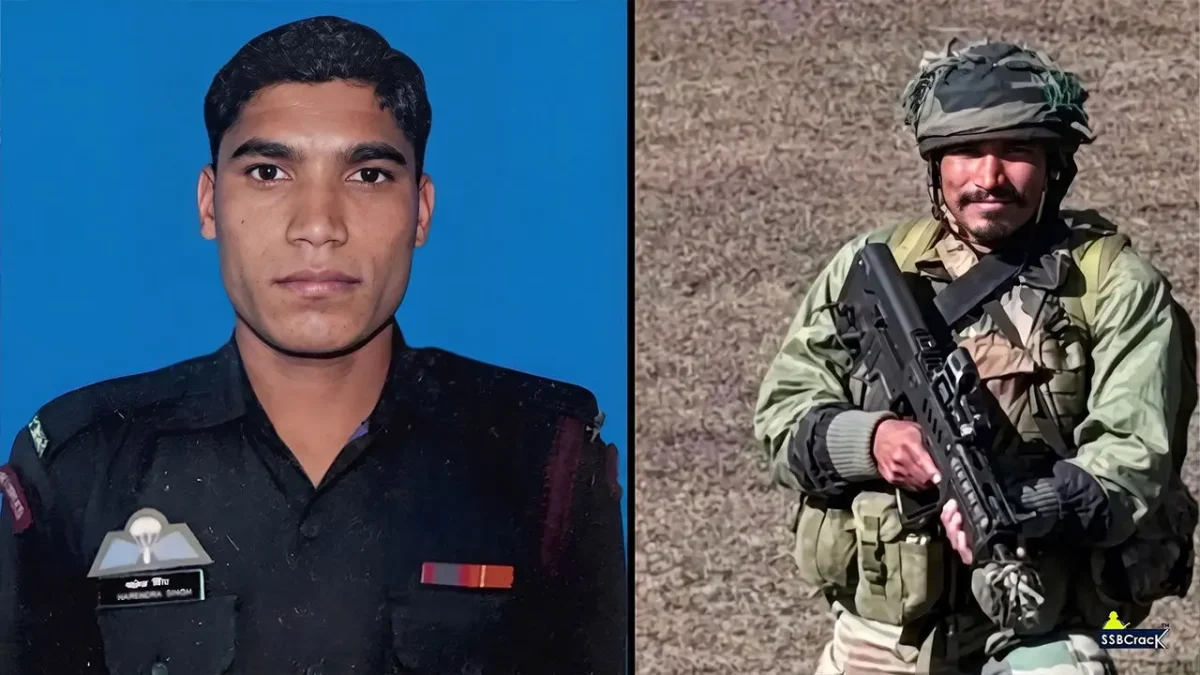
Every Special Forces operation depends on people the public rarely hears about: the scouts who move first, the non-commissioned officers who read the ground, and the medics who keep the wounded alive. Havildar Gajendra Singh of 2nd Battalion, The Parachute Regiment (Special Forces) was all of these. On 18 January 2026, in the dense, high-altitude forests of Kishtwar in Jammu and Kashmir, he pulled two wounded scouts out of enemy fire one after the other, gave them first aid, and then, bleeding from multiple bullet wounds, went back into the fight and critically injured a most wanted foreign terrorist.


He did not survive his wounds. Seven months later, on the eve of Independence Day 2026, the President approved the Kirti Chakra (posthumous) for him, India’s second-highest peacetime gallantry award. This article tells his story using the official citation and reputable news reports, and draws out what defence aspirants can learn from a soldier who put his comrades before himself.
Havildar Gajendra Singh at a Glance
| Detail | Information |
|---|---|
| Name | Havildar Gajendra Singh (Gariya), KC (Posthumous) |
| Personnel number | 13627256K |
| Unit | 2nd Battalion, The Parachute Regiment (Special Forces), 2 Para SF |
| Appointment | Intelligence Troop Havildar |
| Home | Beethi village, Kapkot area, Bageshwar district, Uttarakhand |
| Parents | Shri Dhan Singh Gariya and Smt Chandra Gariya |
| Joined the Army | 2004, while still in college (as recalled by his family) |
| Operation | Operation TRASHI-I, Chatroo belt, Kishtwar district, J&K |
| Date of the action | 18 January 2026 |
| Award | Kirti Chakra (Posthumous), announced 14 August 2026 |
A Son of the Kumaon Hills
Gajendra Singh came from Beethi, a small village in the Kapkot area of Bageshwar district in Uttarakhand. Reports from Bageshwar describe it as a hamlet of about 25 households perched on a steep hillside roughly two kilometres from the main road, reachable only on foot. Villagers told reporters that he and his siblings were raised on the income from goat rearing, a livelihood the family still follows.
His parents, Dhan Singh and Chandra Devi, continued to live in the village with his brother, while his wife Leela and their two sons, Dheeraj and Rahul, lived in Army quarters in Dehradun. According to his family, Gajendra joined the Army in 2004 while he was still in college, driven by a strong sense of patriotism. He was 39 years old in January 2026, with more than two decades of service behind him.
Uttarakhand has a long tradition of sending its sons into uniform, and the hill districts of Kumaon contribute heavily to the Army’s ranks. Gajendra’s journey from a roadless mountain village to one of the Army’s most demanding units is a reminder that grit and character, not privilege, decide who earns the maroon beret.
Serving With 2 Para (Special Forces)
2 Para (SF) is one of the Special Forces battalions of the Parachute Regiment, trained for mountain warfare, counter-terrorism and high-risk operations behind enemy lines. Times Now, citing Army sources, notes that the battalion carries the operational nickname “Predators” and has been extensively deployed in Jammu and Kashmir because of its specialised training and experience. The battalion is also remembered for the famous airborne drop at Tangail during the 1971 war.
Every soldier in a Para SF unit is a volunteer who must survive a punishing probation that tests physical endurance, mental toughness and judgement under stress. By early 2026, Gajendra was serving as the Intelligence Troop Havildar, an appointment that calls for patient study of the ground, a sharp sense of where an enemy is likely to hide and the confidence to lead search teams from the front.
He had been promoted to Havildar only weeks before his final operation. A retired Para SF officer later wrote on social media that Gajendra had been distributing sweets in the unit to celebrate the promotion and that he was a highly trained battlefield medic. Times Now, which reported the post, said it could not independently verify those details, but the official citation that followed confirms that he gave life-saving first aid to wounded comrades under fire.
Operation TRASHI-I in Kishtwar
Kishtwar, east of the Chenab and south of the Kashmir Valley, has become a key infiltration and transit corridor for terrorists in the Jammu region, with thick forests and steep slopes that make searches slow and dangerous. In January 2026, acting on intelligence about terrorist movement in the Chatroo belt, the Army’s White Knight Corps and the Jammu and Kashmir Police launched a joint search operation named Operation TRASHI-I.
On 18 January, search parties advancing through the forests near Sonnar village in the Mandral-Singhpora area came under sudden grenade and automatic fire from terrorists holding higher ground. Officials told PTI that a group of two to three terrorists, believed to be linked to the Pakistan-based Jaish-e-Mohammad, was hiding in the area. Eight soldiers were injured in the exchange, most of them by grenade splinters.
Two scouts, one Havildar
The Kirti Chakra citation describes what Gajendra did. Serving as Intelligence Troop Havildar, he had focused relentlessly on one jungle area of Kishtwar district and confirmed it as the primary hideout area. On 18 January, leading a search team in dense jungle at an altitude of more than 3,000 metres, he detected a suspected hideout near a vertical cliff. Sensing the threat, he advanced cautiously and confirmed the terrorists’ presence at extremely close range. When he challenged them, they opened a barrage of fire that wounded both his scouts.
Instead of seeking cover, he charged forward, evacuated the first scout to safety and gave him vital first aid. He then went back for the second wounded comrade and, while extracting him, was hit by multiple bullets. Only after both men were safe did he move back to a safe position. From there, despite heavy bleeding, he re-engaged the terrorists and critically injured a most wanted foreign terrorist.
The supreme sacrifice
The citation records that Havildar Gajendra Singh succumbed to his injuries. Contemporary news reports said he was evacuated with other injured personnel and died during treatment at a military hospital during the night of 18-19 January. His death was the first security force fatality in a counter-terror operation in Jammu and Kashmir in 2026.
The General Officer Commanding and all ranks of the White Knight Corps paid tribute to him, saying they honoured his “indomitable courage, valour and selfless devotion to duty” and stood firmly with his family. Lieutenant Governor Manoj Sinha also paid tribute. In the following days, search teams found a hideout near the site stocked with rations, utensils, a gas cylinder and a stove, a sign that the terrorists had planned to stay through the winter, and the operation continued with drones and sniffer dogs.
A Village Says Goodbye
On 20 January 2026, his mortal remains were flown by Army helicopter to the Kapkot college ground, because Beethi has no motorable road. His elderly parents walked about four kilometres to reach the road and then travelled on to Kapkot to see their son one last time. A guard of honour was presented by personnel of 2 Para (SF) and a signals unit from Kausani, and the procession moved to the confluence of the Saryu and Khirganga rivers, where he was cremated with full military honours amid slogans of “Bharat Mata Ki Jai”.
His mother told reporters that he was her only son and had carried the responsibility of the entire family. His father said that although he had lost the support of his old age, his son had protected the country, and that was his pride. A cousin remembered him as someone who stayed grounded even after becoming a Special Forces commando, always ready to help anyone in need.
The Kirti Chakra
On 14 August 2026, President Droupadi Murmu approved 78 gallantry awards, including 13 posthumous, for the Defence Forces and Central Armed Police Forces on the eve of the 80th Independence Day. The list included nine Kirti Chakras, three of them for the Army. Havildar Gajendra Singh of 2 Para (SF) was awarded the Kirti Chakra posthumously, with effect from 18 January 2026, alongside Lieutenant Colonel Maneo Francis of 21 Para (SF) and Major Jitendra Rathee of 2 Para (SF).
The citation concludes that the award was made for his extraordinary leadership, unyielding courage and bravery in saving his comrades’ lives and incapacitating a foreign terrorist at the ultimate personal cost. Two Kirti Chakras for one battalion in a single list speaks volumes about the operational load 2 Para (SF) has carried in Jammu and Kashmir.
Lessons for Defence Aspirants
- Leaders are found at every rank. Gajendra Singh was a Havildar, not an officer, yet the citation praises his leadership. Officer aspirants should remember that the men they will command include soldiers of exactly this calibre.
- Preparation decides the moment. His patient study of one patch of jungle is what located the hideout. Thorough homework, whether on the ground or for the SSB, is never wasted.
- Never leave a comrade behind. Going back a second time, already under fire, is the clearest picture of the loyalty and responsibility that SSB assessors look for in group tasks and interviews.
- Skills multiply courage. As a trained medic, he could do more than drag his scouts to safety; he could keep them alive. Learn first aid and other practical skills early.
- Humble roots are no barrier. A roadless village and a family that lived by goat rearing did not stop him from reaching the Special Forces.
Frequently Asked Questions
Who was Havildar Gajendra Singh?
He was a soldier of 2nd Battalion, The Parachute Regiment (Special Forces) from Bageshwar district in Uttarakhand, serving as Intelligence Troop Havildar, who was killed during Operation TRASHI-I in Kishtwar, Jammu and Kashmir, in January 2026.
Which gallantry award did he receive?
He was awarded the Kirti Chakra (posthumous), effective 18 January 2026, in the gallantry awards approved by the President on 14 August 2026.
What did he do during the encounter?
When terrorists opened fire and wounded both his scouts, he evacuated each of them in turn, gave first aid, and then, despite multiple bullet wounds, re-engaged the terrorists and critically injured a most wanted foreign terrorist.
Where was the encounter?
In the forests of the Chatroo belt in Kishtwar district, near Sonnar village in the Singhpora area, at an altitude of more than 3,000 metres.
How can a soldier join the Para Special Forces?
Soldiers and officers already serving in the Army can volunteer for the Para SF. They must pass a demanding probation that tests fitness, endurance and mental strength before they are accepted into a Special Forces battalion.
Conclusion
Havildar Gajendra Singh’s final hours compress everything the Special Forces stand for into a single act. He found the enemy through patient work, faced him at close range, refused to abandon two wounded men and kept fighting after he had been hit. From the hills of Kapkot to the forests of Kishtwar, his life is a lesson for every aspirant who dreams of wearing the uniform: true courage is measured by what you do for the people beside you.