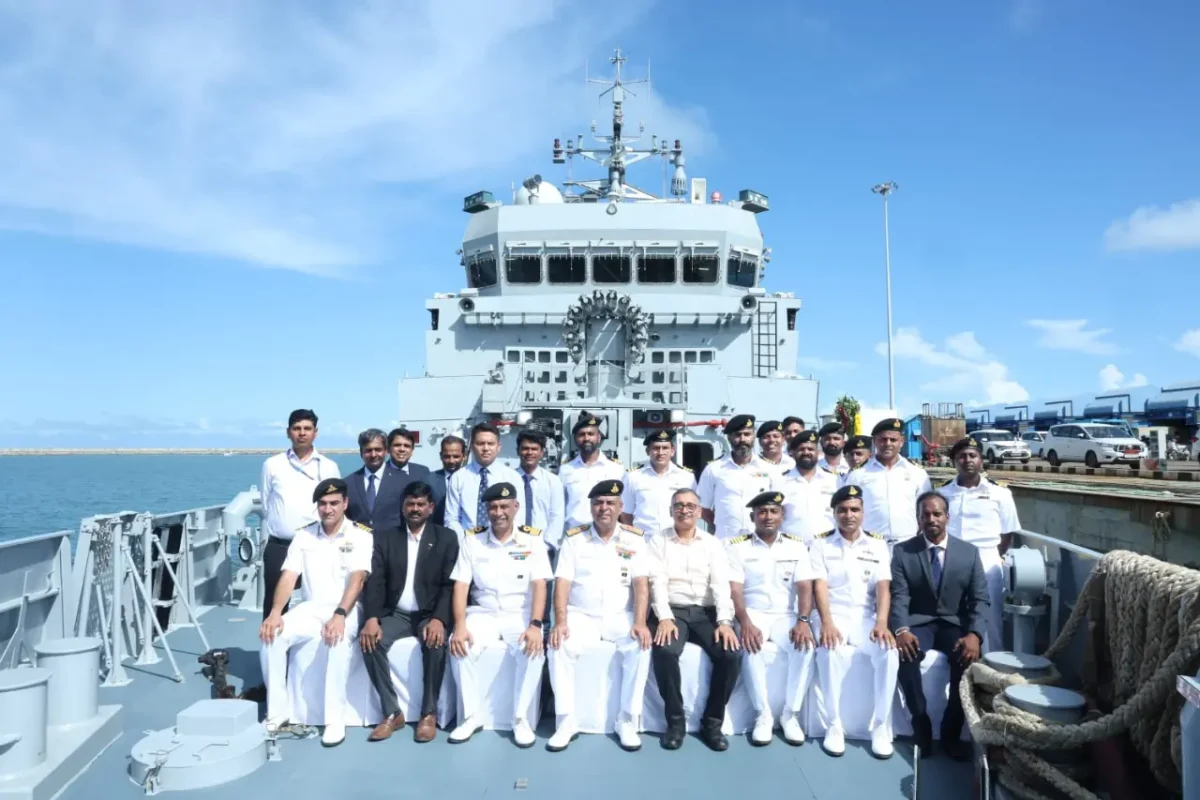
On November 5, 2026, the Indian Navy took delivery of Amini, an indigenously designed and built Anti-Submarine Warfare Shallow Water Craft (ASW SWC). The vessel was constructed by Garden Reach Shipbuilders and Engineers (GRSE), Kolkata, and its induction adds another specialised platform to India’s coastal defence inventory.
The delivery is part of the Navy’s wider modernisation effort, which is focused on improving the ability to detect, track and engage underwater threats in shallow and coastal waters. For a force responsible for safeguarding an extensive coastline and key maritime approaches, such vessels are intended to fill a specific operational requirement.
Amini was built in line with the classification rules of the Indian Register of Shipping (IRS). The ship is fitted with a waterjet propulsion system, a feature shared by the ASW Shallow Water Craft class, and one that supports manoeuvrability in shallow coastal areas. The source notes that these vessels are among the largest Indian naval warships propelled by waterjets.
Its anti-submarine warfare suite includes lightweight torpedoes, indigenous rocket launchers and advanced sonars. According to the source, these systems are meant to help the vessel detect and engage underwater threats, strengthening anti-submarine operations in strategically important maritime zones.
Beyond its primary ASW role, Amini is also designed for coastal surveillance and mine-laying operations. That gives the ship a wider utility in littoral waters, where several maritime tasks can overlap in the same operating space.
Named after Amini Island in Lakshadweep
The ship takes its name from Amini Island in the Union Territory of Lakshadweep. The Navy has a long-standing practice of naming warships after places of national and maritime significance, and this ship continues that tradition.
The new Amini also carries forward the name of the erstwhile INS Amini, a Petya III-class anti-submarine warfare corvette that served in the Indian Navy before being decommissioned in 2002. By reviving the name, the Navy preserves continuity with an earlier vessel while introducing a modern platform with updated systems.
Indigenous content above 80 percent
A major feature of Amini is its indigenous content, which exceeds 80 percent. The source presents this as evidence of the progress made by India’s domestic defence manufacturing ecosystem.
The vessel’s construction reflects the involvement of Indian shipyards, equipment manufacturers and technology providers in building sophisticated naval platforms and associated combat systems. The delivery also aligns with the Government of India’s Aatmanirbhar Bharat initiative, which seeks to reduce dependence on imported defence equipment while strengthening domestic design, manufacturing and technological capability.
GRSE Kolkata’s role in the project further underlines its place in India’s naval shipbuilding programme, especially in the development of specialised warships for coastal defence and anti-submarine operations.
Fifth ship in an eight-vessel programme
Amini is the fifth of eight Anti-Submarine Warfare Shallow Water Craft being built by GRSE for the Indian Navy. The vessel was delivered at Kattupalli, Tamil Nadu, on November 5, 2026.
The ship measures approximately 77.6 metres in length and has a shallow draught of around 2.7 metres. These dimensions are suited to coastal operations, including underwater surveillance, submarine detection and coordinated anti-submarine missions alongside naval aircraft.
Its diesel-engine-powered waterjet propulsion system gives it the manoeuvrability needed for shallow waters, where larger warships may face navigational constraints. With this delivery, the Indian Navy adds another indigenous platform to support coastal defence and underwater security.
The addition of Amini is expected to improve the Navy’s ability to monitor underwater threats, protect strategically important coastal installations and support maritime operations. The vessel’s high indigenous content and specialised anti-submarine role make it a notable step in the Navy’s move towards a more self-reliant and operationally capable fleet.