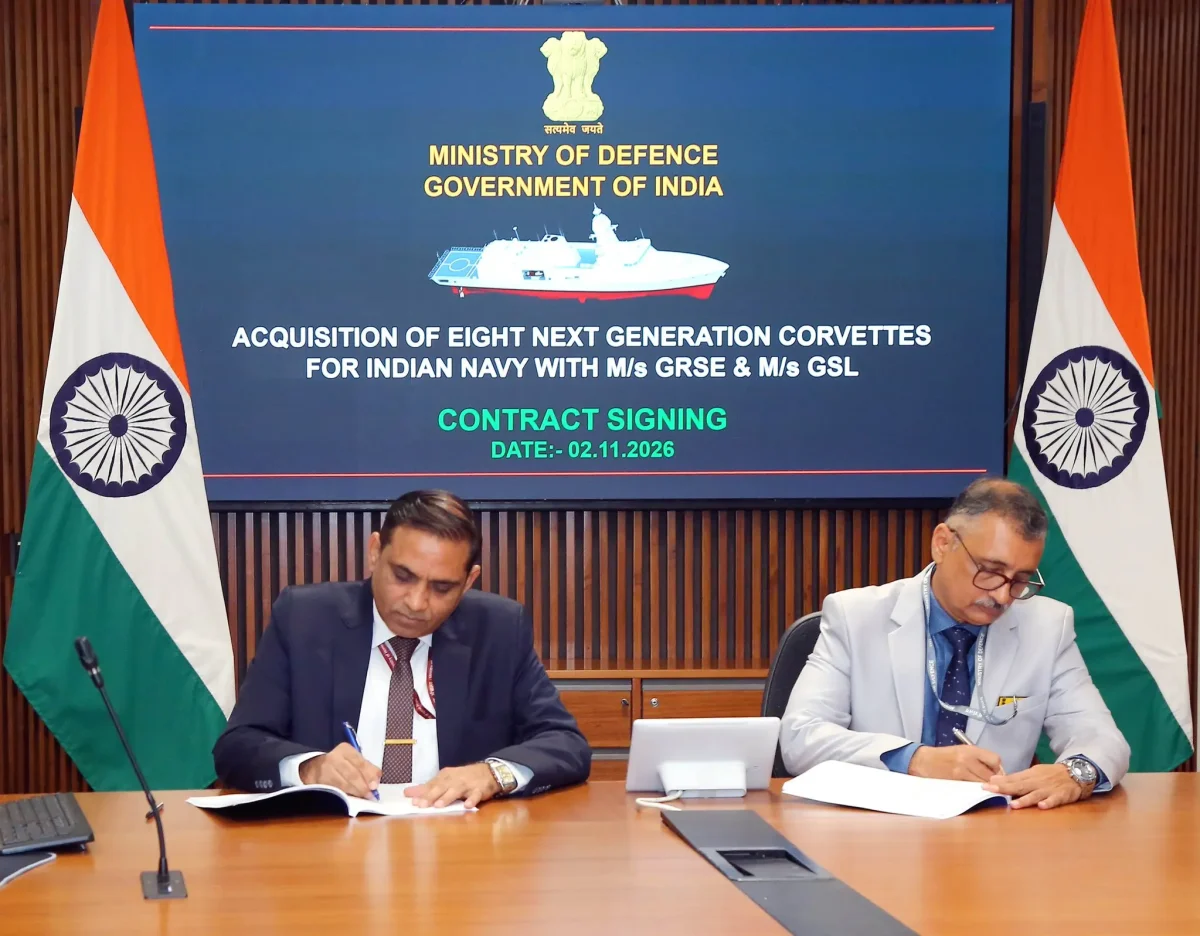
India has moved forward with a major naval procurement step, as the Ministry of Defence on Monday, November 2, 2026, signed contracts worth Rs 53,866.50 crore with Garden Reach Shipbuilders & Engineers Limited (GRSE) and Goa Shipyard Limited (GSL) for eight Next Generation Corvettes (NGCs) for the Indian Navy.
As per the agreement, GRSE will construct five of the warships, while GSL will build the remaining three. The deal adds to the Navy’s future fleet under a programme that the Ministry of Defence says is focused on indigenous design and domestic construction.
Indigenous design and shipbuilding model
The Ministry of Defence said this is the first project in which the ships will be indigenously designed by the Indian Navy and built by Defence Public Sector Undertakings (DPSUs) chosen through a competitive process. This makes the programme notable not only for the number of vessels but also for the way the design and construction responsibilities have been allocated.
The corvettes are intended to carry advanced missiles, weapons and sensor suites, enabling operations in the air, surface and sub-surface domains. According to the Ministry, they are expected to improve the Navy’s ability to protect maritime trade routes, conduct anti-surface and anti-submarine warfare, support coastal defence and carry out littoral combat missions.
Operational role and maritime surveillance
The warships are also meant to support maritime presence and surveillance tasks. The Ministry said this will help the Navy monitor areas of strategic importance and respond to emerging maritime security requirements, while giving the force greater flexibility across different maritime environments.
The programme is also expected to strengthen India’s shipbuilding base by improving coordination among defence public sector shipyards, private shipyards, Indian industrial partners and Micro, Small and Medium Enterprises (MSMEs). The Ministry presented this as an industrial benefit alongside the naval capability upgrade.
Employment and domestic manufacturing impact
Over the next ten years, construction of the eight corvettes is expected to generate approximately 72 lakh person-days of employment in the shipyards and another 460 lakh person-days in ancillary industries and MSMEs. These figures point to a large labour requirement spread across both direct shipyard work and supporting industries.
The Ministry of Defence also said the project will encourage the use of Made-in-India materials and equipment, indigenous technologies, and Indian skills and expertise. It described the programme as a step toward Aatmanirbharta in defence manufacturing and a contribution to the government’s Make in India initiative.
With the Navy handling indigenous design and the DPSUs carrying out construction through competitive selection, the project reflects a wider shift in how warships are being acquired for the Indian Navy. The stated aim is to deepen domestic design and production capacity while adding a new set of vessels suited for a broad range of maritime security tasks.