




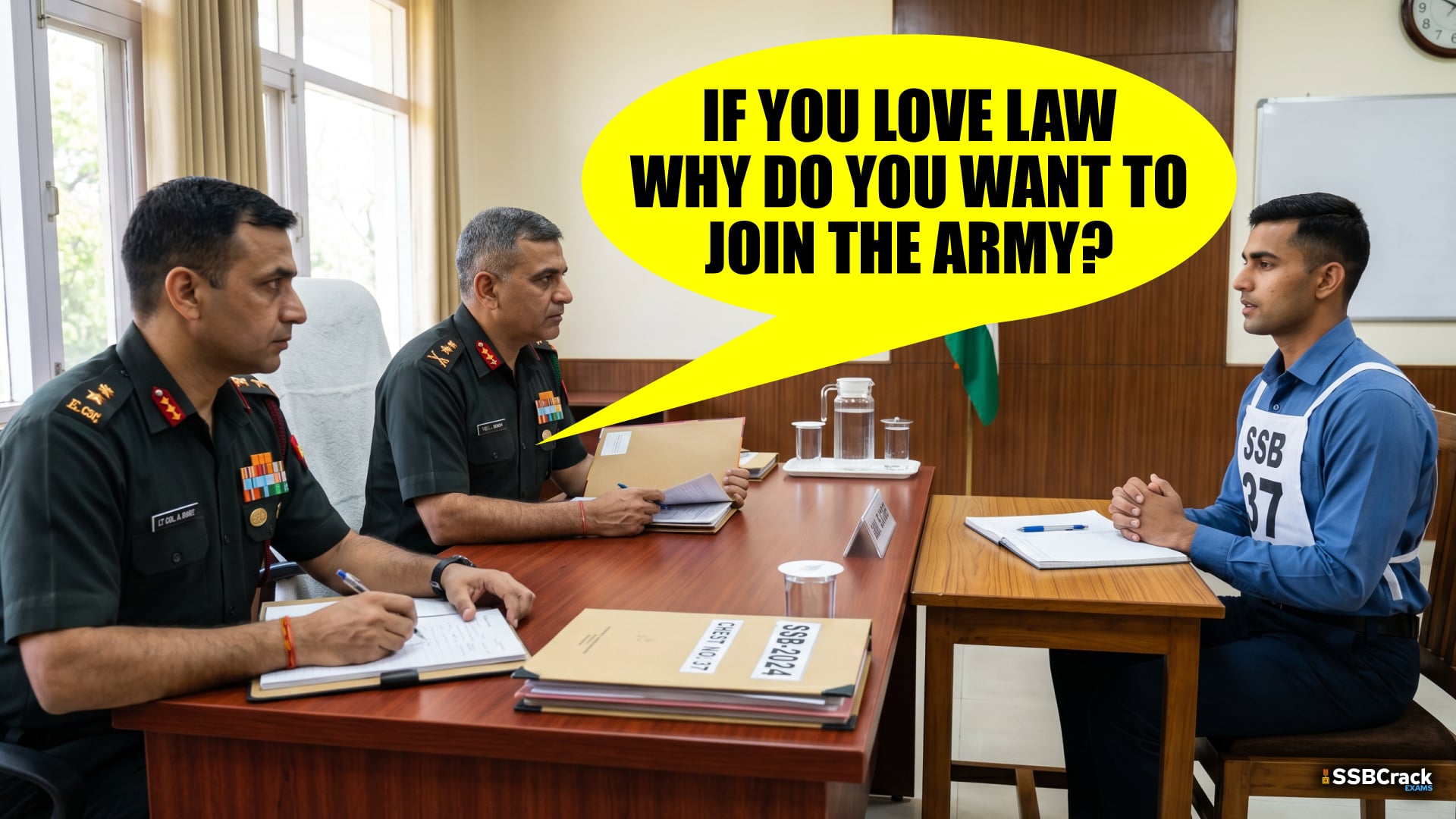
The Judge Advocate General, or JAG Entry, is one of the most prestigious officer entries into the Indian Army for law graduates. It offers a unique opportunity to combine legal expertise with military leadership and national service.
Many JAG aspirants make the mistake of preparing only legal subjects and constitutional provisions. However, it is important to remember that the SSB Interview is not selecting lawyers—it is selecting future Army officers who happen to possess legal qualifications. Your legal knowledge is important, but your personality, leadership potential, communication skills, responsibility, social adaptability, and Officer Like Qualities are equally important.
In this article, we will discuss 20 important interview questions frequently asked to JAG candidates, understand why these questions are asked, learn how to answer them effectively, and examine sample responses that reflect the qualities expected in future legal officers of the Indian Army.
1. Tell me about yourself.
Why it is asked
To assess communication skills, confidence, self-awareness, and personality.
How to answer
Include:
- Family background
- Education
- Law studies
- Achievements
- Hobbies
- Responsibilities
Sample Answer
“I am a law graduate from XYZ University. During my academic journey, I actively participated in moot court competitions, legal aid activities, and student leadership initiatives. These experiences strengthened my analytical thinking, communication skills, and sense of responsibility.”
2. Why do you want to join the Army through JAG Entry?
Why it is asked
To assess motivation and career clarity.
How to answer
Combine legal interest with military aspirations.
Sample Answer
“JAG Entry allows me to apply my legal education while serving the nation as an Army officer. The opportunity to contribute to military justice, discipline, and leadership while wearing the uniform is highly motivating.”
3. Why Army and not traditional legal practice?
Why it is asked
To assess commitment to military service.
How to answer
Respect both careers while explaining your preference.
Sample Answer
“Legal practice offers professional growth, but the Army provides a unique combination of law, leadership, responsibility, and national service. I am particularly attracted to the opportunity to serve within a disciplined and mission-oriented organization.”
4. What do you know about the JAG Branch?
Why it is asked
To assess awareness and preparation.
How to answer
Know the basic role of JAG officers.
Sample Answer
“The JAG Branch provides legal advice to the Army, assists in military justice matters, deals with disciplinary cases, legal documentation, and supports commanders on legal issues affecting military operations and administration.”
5. Why should we select you?
Why it is asked
To assess confidence and suitability.
How to answer
Link personal qualities with officer requirements.
Sample Answer
“I possess analytical ability, integrity, communication skills, adaptability, and a strong sense of responsibility. My legal education and leadership experiences have prepared me to handle challenges effectively.”
6. What are your strengths?
Why it is asked
To assess self-awareness.
How to answer
Support strengths with examples.
Sample Answer
“My strengths are logical reasoning, communication skills, and perseverance. Moot court competitions and academic projects helped me develop these qualities significantly.”
7. What are your weaknesses?
Why it is asked
To assess honesty and self-improvement.
How to answer
Mention a manageable weakness.
Sample Answer
“I sometimes spend extra time analyzing complex issues before making decisions. I am working on balancing thorough analysis with timely decision-making.”
8. Why did you choose law as a career?
Why it is asked
To assess academic motivation.
How to answer
Explain genuine reasons.
Sample Answer
“I chose law because it combines analytical thinking, problem-solving, public service, and the opportunity to contribute positively to society through justice and legal awareness.”
9. Which law subject interests you the most?
Why it is asked
To assess legal inclination.
How to answer
Explain practical relevance.
Sample Answer
“Constitutional Law interests me the most because it forms the foundation of governance, rights, and institutional functioning in a democratic society.”
10. Which law subject do you find challenging?
Why it is asked
To assess honesty and learning attitude.
How to answer
Show effort toward improvement.
Sample Answer
“Initially, I found Taxation Law challenging due to its technical nature. Through regular study and practical examples, I improved my understanding significantly.”
11. Tell me about a leadership experience.
Why it is asked
To assess leadership potential.
How to answer
Use a real-life example.
Sample Answer
“As the coordinator of a legal aid awareness program, I led a team of students, organized activities, delegated responsibilities, and ensured successful execution of the event.”
12. What responsibilities do you handle at home?
Why it is asked
To assess maturity and responsibility.
How to answer
Mention genuine responsibilities.
Sample Answer
“I assist with family decision-making, documentation work, financial planning discussions, and support family members whenever required.”
13. What are your hobbies?
Why it is asked
To assess personality beyond academics.
How to answer
Mention genuine hobbies.
Sample Answer
“I enjoy reading, fitness activities, public speaking, current affairs discussions, and participating in community service initiatives.”
14. What is your biggest achievement?
Why it is asked
To assess commitment and effort.
How to answer
Choose a meaningful achievement.
Sample Answer
“My biggest achievement was representing my university in a national moot court competition, which required extensive research, teamwork, and effective advocacy.”
15. Tell me about a failure and what you learned.
Why it is asked
To assess resilience and learning ability.
How to answer
Focus on lessons learned.
Sample Answer
“I once failed to secure a position in a student leadership election. The experience taught me the importance of communication, planning, and understanding stakeholder expectations.”
16. What qualities should an Army officer possess?
Why it is asked
To assess understanding of military leadership.
How to answer
Mention practical OLQs.
Sample Answer
“An Army officer should possess integrity, courage, responsibility, initiative, teamwork, emotional stability, determination, and the ability to lead by example.”
17. How do you handle pressure and deadlines?
Why it is asked
To assess emotional stability.
How to answer
Mention practical strategies.
Sample Answer
“I prioritize tasks, create schedules, focus on critical objectives, and maintain a calm and organized approach while working under pressure.”
18. What would you do if your team disagreed with your opinion?
Why it is asked
To assess teamwork and flexibility.
How to answer
Show openness and objectivity.
Sample Answer
“I would listen to all viewpoints, evaluate them objectively, and support the option that best serves the team’s objective rather than insisting on my own opinion.”
19. If not selected through JAG Entry, what will you do?
Why it is asked
To assess resilience and planning.
How to answer
Remain positive and practical.
Sample Answer
“I will continue developing my legal career, improve areas where I can perform better, and pursue future opportunities to serve the nation.”
20. What does becoming an Army officer mean to you?
Why it is asked
To assess understanding of military responsibility.
How to answer
Focus on leadership and service.
Sample Answer
“Becoming an Army officer means accepting responsibility for people and institutions, upholding integrity, leading by example, and serving the nation with dedication and honor.”
Law-Related Questions Frequently Asked to JAG Candidates
Apart from personality-based questions, interviewers often ask basic legal questions.
Constitutional Law
- What is the Basic Structure Doctrine?
- Explain Fundamental Rights.
- Difference between Fundamental Rights and Directive Principles of State Policy.
Criminal Law
- What is the difference between bailable and non-bailable offences?
- What is mens rea?
- Explain criminal liability.
Contract Law
- Essentials of a valid contract.
- What is consideration?
- Difference between void and voidable contracts.
Current Legal Issues
- Important recent judgments.
- Uniform Civil Code debates.
- Legal implications of emerging technologies.
Tip
The interviewer usually evaluates conceptual understanding and analytical ability rather than expecting textbook recitation.
What Assessors Look for in JAG Candidates
Officer Like Qualities (OLQs)
- Effective Intelligence
- Initiative
- Responsibility
- Self-Confidence
- Organizing Ability
- Cooperation
- Social Adaptability
- Determination
- Courage
- Emotional Stability
Legal Awareness
Sound understanding of basic legal concepts.
Communication Skills
Ability to express ideas clearly and logically.
Leadership Potential
Ability to lead and influence others positively.
Integrity
Strong ethical and moral standards.
Common Mistakes Made by JAG Aspirants
- Focusing only on legal knowledge.
- Ignoring personality development.
- Giving overly technical legal answers.
- Memorizing constitutional provisions without understanding.
- Claiming leadership without examples.
- Becoming argumentative during discussions.
- Treating the interview like a law school viva.
Interview Answer Formula
For experience-based questions:
Situation → Action → Result → Learning
Example:
“Our moot court team faced a research deadline challenge. I coordinated responsibilities, monitored progress, and ensured timely completion. We performed well, and I learned the importance of teamwork and planning.”
Final Advice for JAG Entry Aspirants
Remember that JAG officers are Army officers first and legal officers second. Your legal qualification provides specialized expertise, but recommendation depends largely on your personality, leadership potential, communication skills, responsibility, teamwork, and Officer Like Qualities.
Focus on developing yourself as a leader who happens to possess legal expertise rather than a lawyer seeking a military job.
Conclusion
The Judge Advocate General Branch offers a unique opportunity to combine legal expertise with military leadership and national service. The candidates who succeed are not merely knowledgeable in law; they demonstrate integrity, responsibility, leadership, adaptability, and the character expected of an Army officer.
Prepare your legal subjects thoroughly, but devote equal attention to developing Officer Like Qualities through your daily actions, responsibilities, relationships, and decision-making. That combination of competence and character is what ultimately leads to success in the SSB Interview.


