




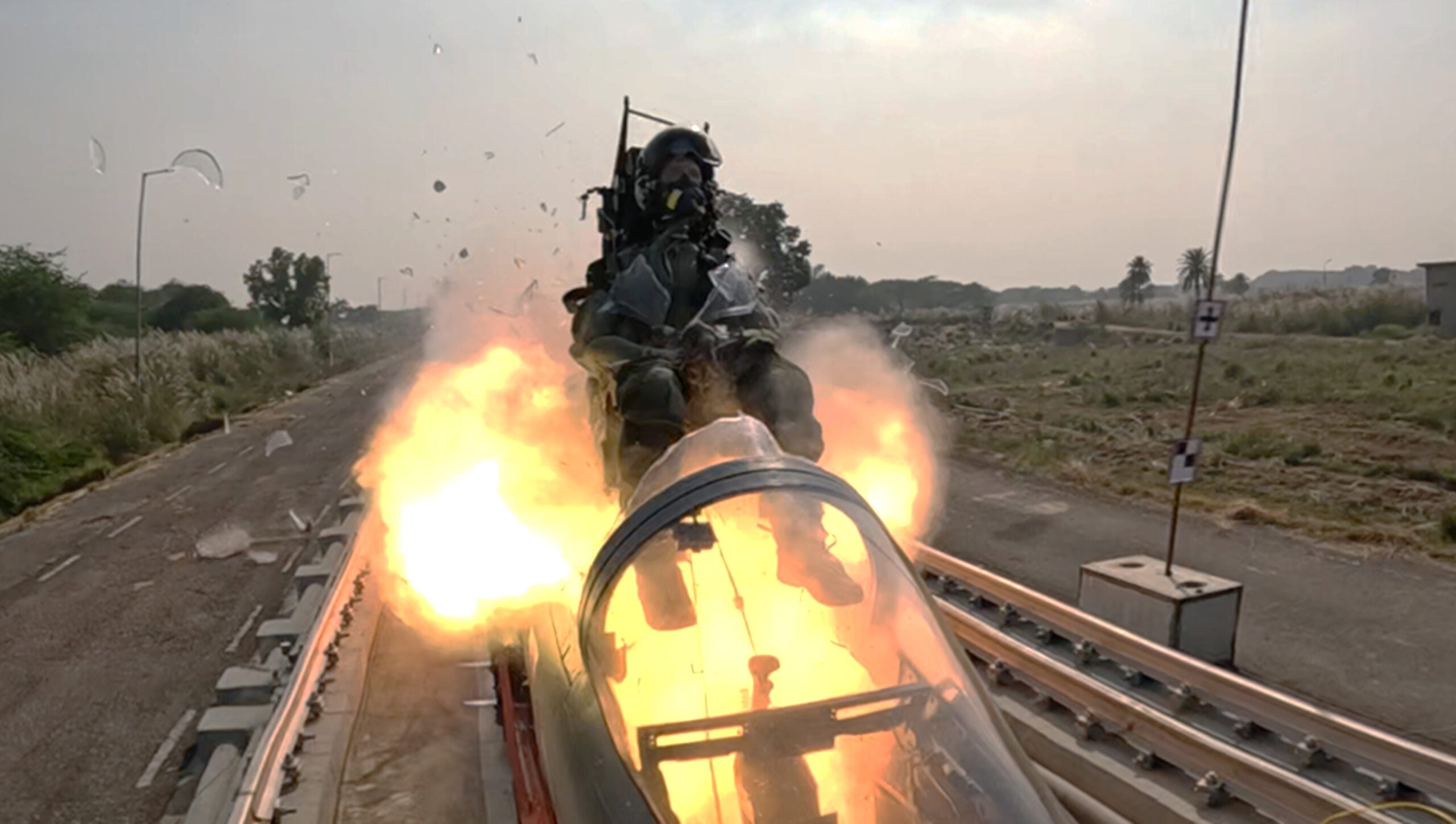
India has achieved a significant advancement in its indigenous defense capabilities through the successful validation of a fighter aircraft escape system via a high-speed rocket sled test. The operation was orchestrated by the Defence Research and Development Organisation (DRDO) at the Rail Track Rocket Sled facility of the Terminal Ballistics Research Laboratory in Chandigarh. This initiative was a collaborative effort involving the Aeronautical Development Agency and Hindustan Aeronautics Limited.
The rigorous test focused on crucial elements such as canopy severance, ejection sequencing, and the comprehensive recovery of aircrew using an instrumented anthropomorphic test dummy. By employing phased solid-propellant rocket motors, the aircraft forebody was propelled at a meticulously controlled velocity, reaching speeds of up to 800 km/h. This simulation was designed to replicate real ejection conditions, moving beyond traditional static testing methods like net and zero-zero tests.
Comprehensive data collection methods were employed during the experiment, including both onboard and ground-based imaging to capture the complete sequence of events. Additionally, an array of sensors was utilized to measure critical parameters such as loads, moments, and accelerations, providing valuable insights into pilot safety during the ejection process.
Defence Minister Rajnath Singh lauded the test as a momentous milestone for India’s self-reliance in defense technology, marking a significant step forward in developing homegrown capabilities.
In the broader context of Indian defense modernization, this test follows a series of successful trials conducted by the DRDO over the past year. Notably, in April 2025, the organization achieved a landmark milestone with the inaugural flight of the Astra Mk-1 air-to-air missile from an Su-30 fighter jet, demonstrating its long-range engagement capabilities. Moreover, the Indian Army recently conducted a test launch of the BrahMos supersonic cruise missile from a test range in the Bay of Bengal.
In September 2025, further advancements were seen with the successful testing of the indigenously developed Akash-NG surface-to-air missile, which aims to enhance interception accuracy and bolster India’s layered air defense system. These developments collectively underscore India’s commitment to strengthening its defense infrastructure and capabilities through indigenous innovations.


