




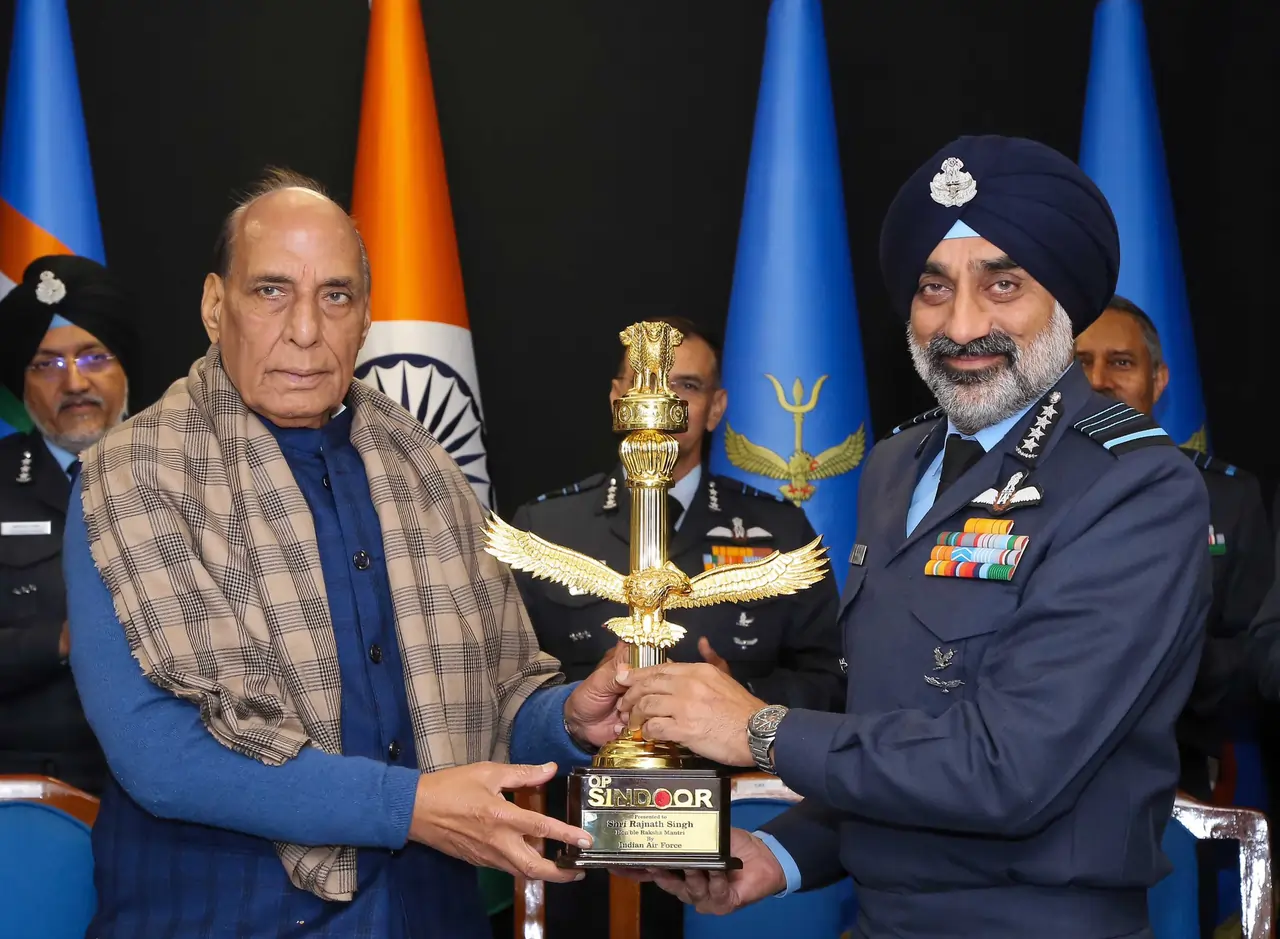
In a significant address at the Air Force Commanders’ Conclave in New Delhi, Defence Minister Shri Rajnath Singh emphasized the successful execution of Operation Sindoor, which showcased India’s ability to respond swiftly and decisively to threats. He described the operation as a demonstration of the Armed Forces’ high-impact, short-duration operational capability.
Singh praised the Indian Air Force (IAF) for being a “technologically advanced, operationally agile, strategically confident, and future-oriented force.” He acknowledged its vital role in safeguarding national interests amid a changing global security landscape. Notably, Singh commended the IAF’s rapid and precise actions in neutralizing terror camps, noting the mature management of the situation that followed these strikes.
Singh expressed confidence in the defense preparedness of the nation, particularly following attempted attacks on Indian installations. He remarked, “Usually, when the enemy attacks, people hide. But when Pakistani forces attempted to target Indian installations, the people of India remained calm and carried on with their daily lives. This shows the confidence of every Indian in our operational preparedness.”
The Defence Minister urged commanders to leverage lessons from Operation Sindoor, advocating a thorough understanding of adversarial capabilities to enhance vigilance against future challenges.
Reflecting on contemporary conflicts, Singh underscored the role of air power as not just tactical but as a critical strategic instrument. He pointed out that speed, surprise, and shock are fundamental advantages of air power, emphasizing its ability to convey strategic messages of national interest.
As warfare evolves, Singh highlighted that the demands of 21st-century conflict now encompass technology, adaptability, and innovative ideas beyond traditional weaponry. He underlined the significance of emerging domains such as cyber warfare, artificial intelligence, and satellite-based surveillance, stressing that success in modern conflicts increasingly relies on precision-guided munitions and real-time intelligence.
The Minister reaffirmed the Government’s dedication to bolstering national security, declaring that nations which excel in the trinity of technology, strategic vision, and adaptability will lead on the global stage.
Singh also pointed to the ‘Sudarshan Chakra’ initiative, announced by Prime Minister Narendra Modi, which he believes will be pivotal in protecting national assets. He called the development of indigenous jet engines a national mission, reiterating the commitment to self-reliance in defense capabilities.
Discussing defense modernization, Singh highlighted the importance of collaboration with the private sector, startups, and MSMEs through initiatives like iDEX and ADITI. As of November 2025, 672 winners from 565 iDEX challenges illustrate a growing involvement of youth in defense innovation.
He characterized Operation Sindoor as a key example of tri-service coordination and reinforced the need for joint operational capabilities across all branches of the military to enhance national security significantly. Additionally, Singh commended the IAF for its continued role in Humanitarian Assistance and Disaster Relief (HADR) operations, both domestically and internationally, reflecting its commitment and building public trust.
The conclave saw participation from key military leaders, including Chief of Defence Staff General Anil Chauhan and senior IAF commanders. Upon his arrival, Singh was briefed by Chief of the Air Staff Air Chief Marshal AP Singh on the IAF’s operational readiness.
The Air Force Commanders’ Conclave serves as an essential platform for discussing strategic priorities, emerging challenges, and the promotion of self-reliance in defense capabilities, steering the IAF towards future excellence and operational readiness.


