




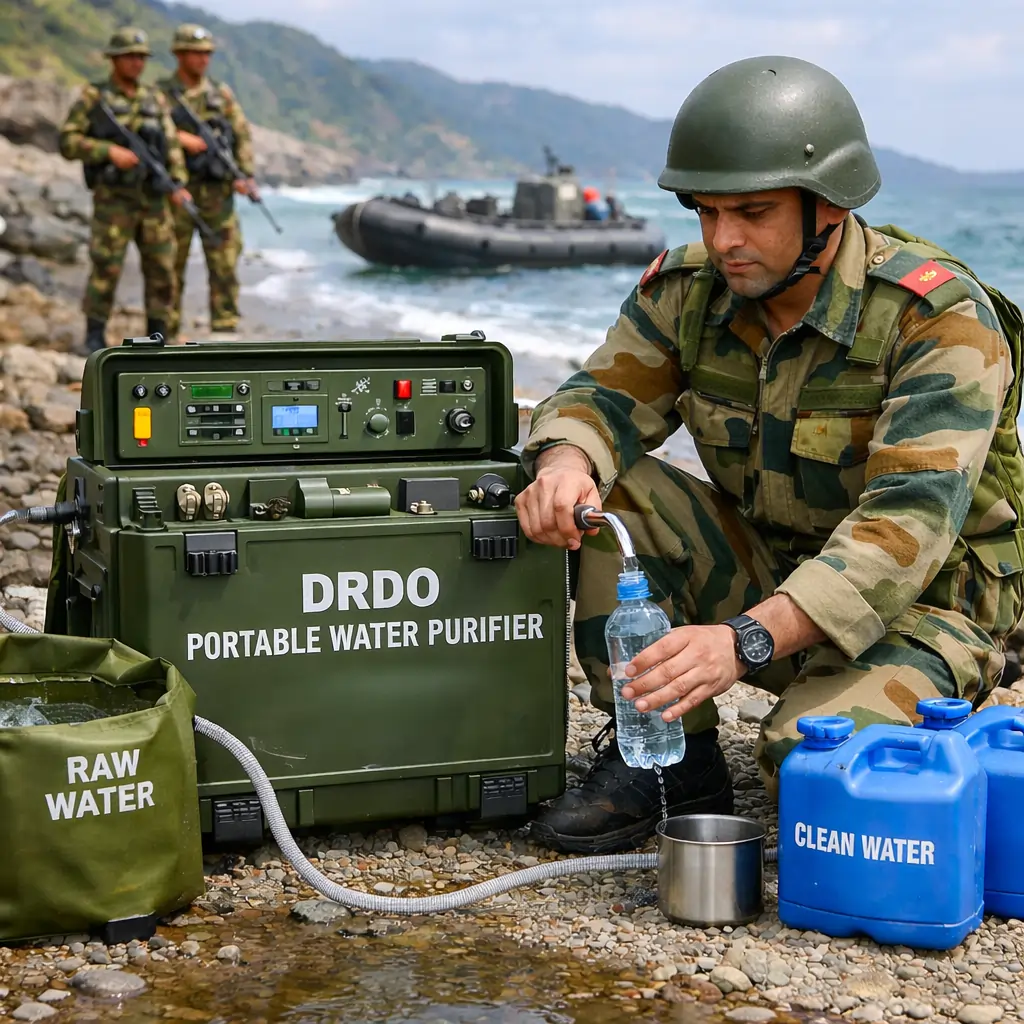
The Defence Research and Development Organisation (DRDO) has unveiled a new compact and portable water purification system aimed at addressing the pressing drinking water needs of military troops stationed in remote, high-altitude, and coastal areas. Named the Sea Water Desalination System (SWaDeS), this innovative technology has been developed at DRDO’s Defence Laboratory in Jodhpur in direct response to operational requirements from the Army, Navy, and Air Force.
SWaDeS is engineered to convert saline seawater and brackish water into safe, potable drinking water, particularly useful during extended field deployments where access to fresh water is limited or non-existent. The system offers a dual-mode design, making it versatile enough for various operational contexts.
The manual variant of SWaDeS is lightweight and can be operated by a single soldier, making it ideal for emergency situations, such as long-range patrols in areas lacking power. This version is capable of generating enough potable water to sustain 10–12 personnel. On the other hand, the engine-operated variant boasts a higher capacity, able to desalinate seawater with total dissolved solids (TDS) levels reaching up to 35,000 mg/L, reducing it to below 500 mg/L, which complies with established drinking water standards. This more powerful system can be set up in a matter of 2–3 minutes and meet the daily water needs of approximately 20–25 soldiers.
Both variants of SWaDeS have undergone extensive testing and successfully completed Acceptance Test Procedures (ATP), confirming their reliability and readiness for military deployment.
The operational relevance of SWaDeS is evident across various terrains, successfully fulfilling its role in naval missions, coastal bases, and even inland saline waters, such as Ladakh’s Pangong Tso. The dual-mode design ensures its usability in diverse environments, ranging from deserts and high-altitude regions to maritime settings, thereby enhancing troop endurance and self-sufficiency.
The development of SWaDeS forms part of DRDO’s broader initiative to bolster water security for India’s armed forces. Other significant systems under this initiative include the CBRN Water Purification System Mk-II, capable of treating water contaminated by chemical, biological, radiological, and nuclear agents; backpack-portable membrane-based purifiers designed for extreme cold conditions in places like Siachen; Emergency Sea Water Purification Kits for naval operations; and high-altitude reverse osmosis units, with over 100 already deployed in Ladakh since 2022.
While primarily designed for military applications, the SWaDeS system also presents significant potential for civilian use, particularly in water-stressed coastal and island regions. This aligns with the national vision of Atmanirbhar Bharat (self-reliant India) and underscores the importance of indigenous technology development.
The induction of systems like SWaDeS not only enhances India’s operational resilience in water-scarce environments but also highlights DRDO’s commitment to delivering essential life-support technologies that directly contribute to soldier survivability and mission success.


