




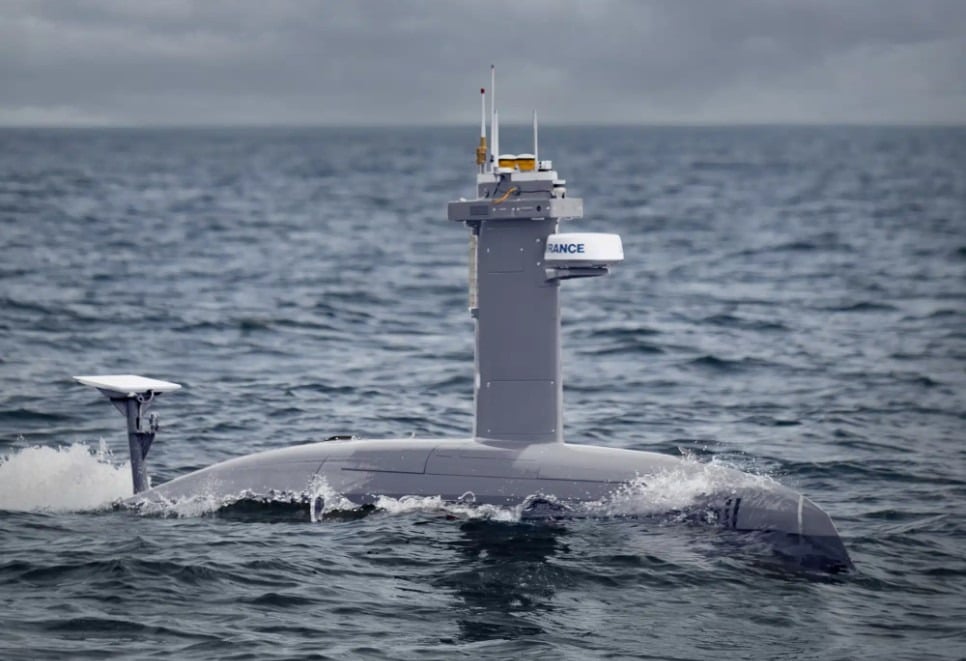
Exail, a prominent player in the field of maritime technology, has recently secured two significant contracts for its DriX H-9 autonomous surface drone. These contracts are set to enhance applications in maritime defense and hydrographic operations.
The first contract, awarded by the innovation division of an undisclosed navy, entails enhancements to the DriX H-9’s capabilities. Specifically, it will involve the integration of counter-drone technologies sourced from a third-party provider. This advancement is aimed at equipping the DriX H-9 with the ability to detect, track, and neutralize hostile aerial unmanned aircraft systems. The technology, originally developed for land applications, is now being tailored for maritime environments, significantly extending anti-drone defense capabilities offshore. The potential uses of this upgraded drone include fleet protection, the safe escort of high-value vessels, port security, and the safeguarding of crucial maritime infrastructure against aerial threats.
The second contract has been awarded by the French Navy’s Hydrographic and Oceanographic Service (SHOM), marking its second acquisition of the DriX platform. This contract aims to enhance seabed mapping and data collection efforts crucial for navigation safety and the management of maritime spaces.
With these two new agreements, Exail has increased its total orders for the DriX H-9 to three in a matter of months. Furthermore, the company is in advanced negotiations for additional surface drone agreements slated for 2026.
The DriX H-9, a 9-meter (29.5-foot) vessel designed for extended maritime missions, is powered by a diesel engine and has a fuel capacity of 550 liters (145 gallons). Capable of reaching speeds up to 13 knots (24 kilometers or 15 miles per hour), it can operate for up to 20 days and cover distances of approximately 2,000 nautical miles (3,704 kilometers or 2,303 miles).
For logistical ease, the drone can be conveniently transported inside a standard 40-foot (12.2-meter) shipping container. Its operation is facilitated by a human-machine interface specifically designed for mission planning and procedural control, providing operators with continuous updates on vessel status, mission progress, sensor configurations, and system alerts. This capability allows for real-time adjustments during operations.
Boasting a modular payload architecture, the DriX H-9 can accommodate a variety of sensors and equipment tailored for hydrographic studies, scientific research, subsea inspections, exploration, and infrastructure monitoring. Additionally, it supports towing operations, including the deployment of towed underwater vehicles, making it a versatile asset in various maritime operations. When fitted with multibeam echosounders, the DriX H-9 can perform seabed mapping at depths reaching up to approximately 3,000 meters (9,842 feet), showcasing its advanced capabilities in deep-sea exploration.


