




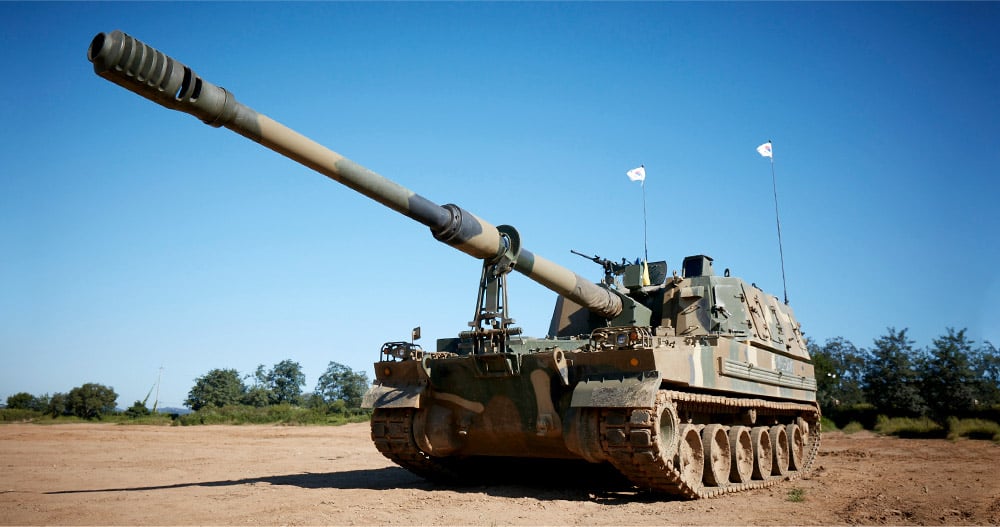
The US Army has taken a significant step forward in its self-propelled howitzer modernization efforts by awarding Hanwha Defense USA a research and development contract. This agreement aims to integrate a 58-caliber cannon into the existing K9 platform, enhancing the army’s artillery capabilities.
This Cooperative Research and Development Agreement (CRADA) comes on the heels of Hanwha’s announcement regarding a wheeled variant of the K9, specifically designed to incorporate the 58-caliber cannon. The K9 platform is based on a mobile system that is adaptable to various trucks, building on the established 52-caliber model of the K9A2 self-propelled wheeled howitzer. This modernization effort is particularly important given the capability gap created by the cancellation of the Extended-Range Cannon Artillery (ERCA) program.
Details remain sparse regarding the specific variants being evaluated under the CRADA. However, Hanwha has noted that the US Army Combat Capabilities Development Command Armaments Center will be responsible for integrating a US-designed 58-caliber cannon into its K9 vehicle family.
Mike Smith, Chief Operating Officer of Hanwha Defense USA, emphasized the importance of this collaboration, calling it a testament to the versatility of the K9 turret, which serves as a core component of Hanwha’s Long-Range Precision Fires platforms. He highlighted that the K9 is expected to fill critical gaps in artillery capability, including volume and rate of fire, range, and rapid resupply, ultimately improving the effectiveness and safety of American forces in combat situations.
The primary objective of this initiative is to broaden the artillery capabilities of the army’s self-propelled howitzers, extending their effective range from about 30 kilometers (19 miles) to potentially 70 kilometers (43 miles) following the cancellation of the ERCA program due to various technical challenges. The new effort will also focus on leveraging the 58-caliber barrel to achieve significant improvements in projectile range.
In addition to Hanwha, several other defense contractors, including BAE Systems, Rheinmetall, Elbit Systems, and General Dynamics, have been enlisted to demonstrate potential systems. BAE Systems, for instance, has entered into an agreement with the US Army to develop a 52-caliber version of the M109 self-propelled howitzer, while Rheinmetall is proposing its RCH 155 wheeled artillery system for consideration.
Hanwha’s modernization proposal includes the upgraded 52-caliber K9A2, which builds on the success of the K9 Thunder tracked howitzer currently in use around the world. This upgraded version would be paired with the K10 ammunition resupply vehicle, which can transport up to 104 rounds and transfer as many as 12 rounds per minute. This capability is expected to vastly improve sustained fire rates and overall battlefield efficiency.
Furthermore, Hanwha has expressed its readiness to modify the tracked variant to meet the specific requirements of the US Army, alongside a commitment to establish a fully domestic supply chain to support production and maintenance.
Michael Coulter, CEO of Hanwha Defense USA, emphasized that the K9 has already seen service in nearly all potential theaters of battle. Notably, four of the five NATO nations that share a land border with Russia currently rely on the K9 for their Long-Range Precision Fires needs. This widespread deployment underscores the K9’s role in creating a robust global sustainment network, making it likely that wherever the US Army operates, the K9 will be present to support its mission.


