




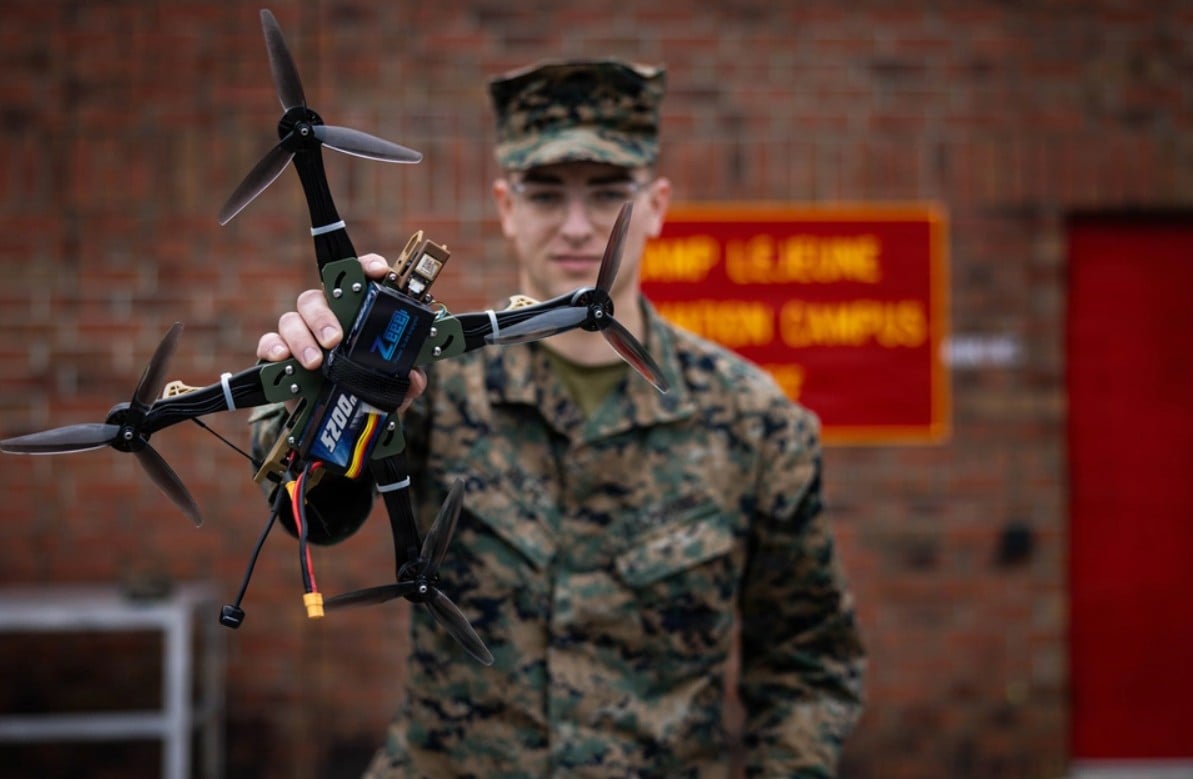
The 2nd Marine Logistics Group has recently unveiled the U.S. Marine Corps’ first 3D-printed drone that complies with the National Defense Authorization Act (NDAA), named HANX. This groundbreaking development is significant as being fully NDAA-compliant ensures that HANX is safeguarded against potential backdoors in electronic components, guaranteeing its reliability and security for use across all Marine units.
Designed and constructed at the II Marine Expeditionary Force Innovation Campus, the drone represents a shift toward in-house production of customizable, cost-effective aerial platforms that cater specifically to operational requirements without relying on external contracts.
The drone secured flight approval from the Small Unmanned Aerial Systems program office at Naval Air Systems Command, following extensive design, assembly, and testing phases that accumulated over 1,000 hours dedicated to ensuring compliance with NDAA components. After receiving this crucial approval, the Innovation Campus established guidelines for in-house production of these modular drones, empowering any U.S. Marine unit to manufacture, maintain, and deploy the technology directly.
The HANX’s modular design enhances its adaptability, enabling it to quickly shift roles for various missions—ranging from reconnaissance to logistics or even one-way assaults—further underscoring its flexibility as a low-cost solution to meet diverse operational needs. “Some explosive ordnance disposal Marines are about to buy 20 of these, and they’re going to be strapping explosives to it,” stated U.S. Marine Corps Sgt. Henry David Volpe, the automotive maintenance technician who spearheaded the development of HANX. Volpe emphasized the drone’s affordability and ease of modification, offering military personnel a versatile alternative to contractor-purchased drones that typically lack such flexibility.
The introduction of HANX aligns with a broader U.S. initiative to achieve “drone dominance,” aiming to expand low-cost loitering munition capabilities within military operations while simplifying acquisition processes. Recently, Washington announced a $1-billion Pentagon initiative designed to expedite domestic drone production, targeting the creation of approximately 300,000 drone systems over the next two years. This endeavor seeks to establish a sustainable manufacturing base for unmanned systems in the U.S., promoting rapid deployment of affordable and modular drones while reducing reliance on foreign technology and supply chains.


