




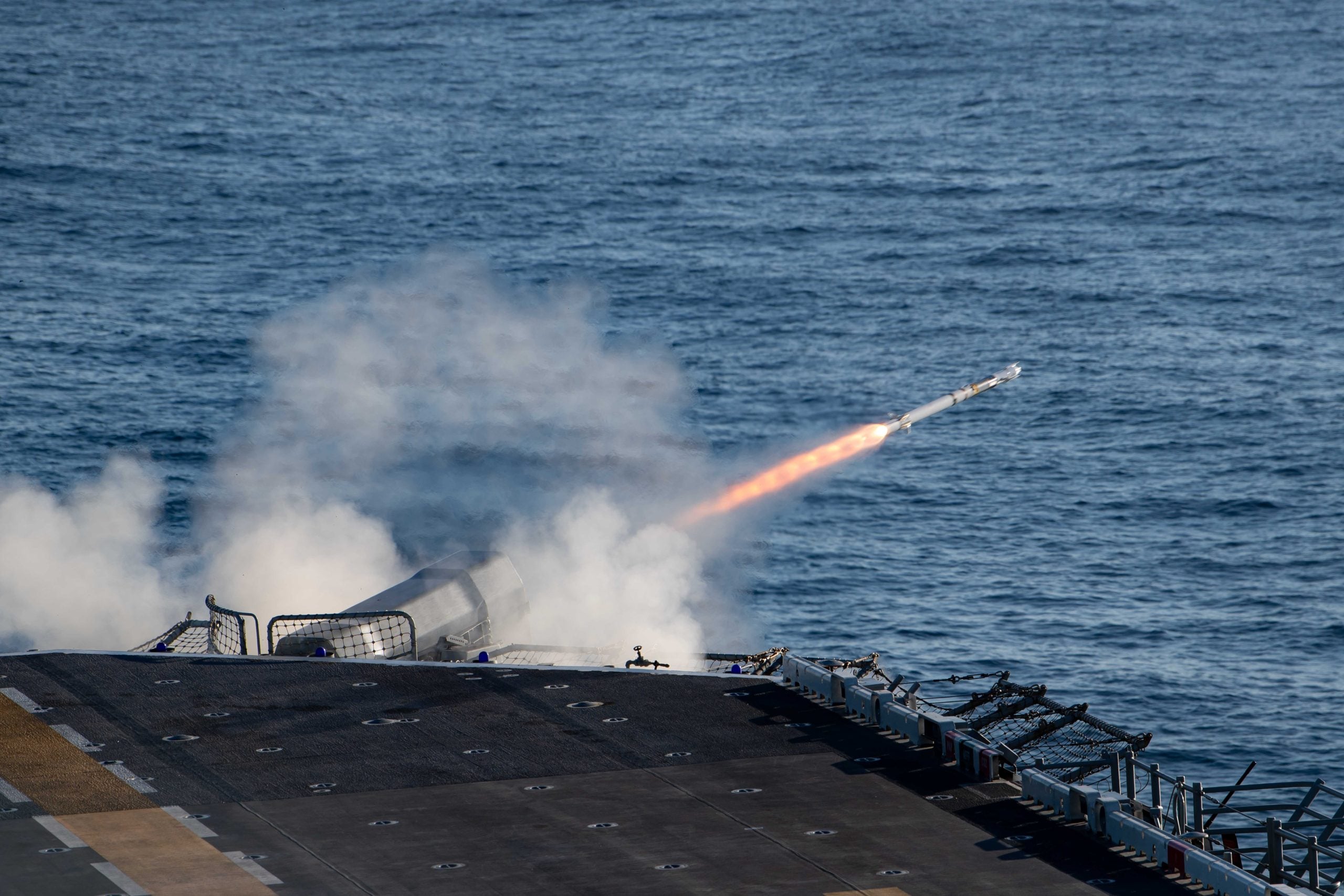
The Rolling Airframe Missile (RAM) represents a significant advancement in naval defense technology, emerging from a collaborative effort between the United States and Germany in the late 1970s. This project was initiated to address a critical need: a lightweight missile capable of swiftly and autonomously countering anti-ship threats.
Developed by General Dynamics and Germany’s Diehl Defence, RAM is specifically designed to thwart incoming missiles and drones during the critical final moments of an attack. Raytheon later assumed responsibility for its production and guidance systems, continuously enhancing its capabilities through upgrades and global adoption. As a result, RAM has become a vital component of layered maritime defense strategies.
The missile is designed for point defense against cruise missiles, aircraft, and smaller asymmetric threats, utilizing a fire-and-forget mechanism that allows it to operate autonomously after launch. This capability is complemented by its dual-mode guidance system, which initially employs passive radio-frequency (RF) homing before switching to infrared (IR) tracking in the terminal phase. Such features enable RAM to respond rapidly and with high precision, making it suitable for various naval platforms.
RAM’s small footprint allows for installation on numerous ships, forming an essential part of multi-tiered defense systems. The missile’s design incorporates a rolling-body aerodynamic structure for enhanced agility, and it boasts high success rates against sea-skimming and maneuvering targets.
Over the years, RAM has been refined through various versions, each enhancing its performance and adaptability. The different blocks include:
- Block 0 (RIM-116A): The original version with RF midcourse and IR terminal guidance.
- Block 1 (RIM-116B): Features improvements in seeker technology and countermeasure capabilities.
- Block 1A: Expanded target engagement capabilities through software upgrades.
- Block 2 (RIM-116C): Provides enhanced resistance against highly maneuvering threats with a more powerful motor and improved control mechanisms.
This progression underscores RAM’s capability to evolve in response to emerging maritime threats, reinforcing its position as a key protector of naval assets.
The inception of RAM was driven by the Cold War’s shifting landscape, where traditional naval defenses struggled against a new generation of high-speed anti-ship missiles. The necessity for a rapid-response missile that could autonomously track and neutralize threats just before impact became increasingly evident. Existing defense systems, constrained by their speed and complexity, could not meet the demands of modern naval engagements.
Globally, RAM’s strategic impact is notable, with numerous navies adopting the system. The US Navy actively deploys RAM across various ship classes, while Germany remains a key user. Nations including Japan, South Korea, Turkey, and Egypt have also integrated RAM into their maritime forces, highlighting its technical reliability and strategic importance.
As RAM continues to evolve, future developments may focus on enhancing seeker technology to improve target acquisition and adaptability against swarming or unmanned threats. This ongoing modernization is crucial, as anti-ship technology becomes more sophisticated, emphasizing RAM’s role in naval survivability.
Overall, the Rolling Airframe Missile exemplifies a successful integration of advanced technologies in naval defense. Its continuous evolution from a basic point-defense solution to a sophisticated self-defense system illustrates the importance of innovation in maintaining security against an increasingly complex array of maritime threats.


