




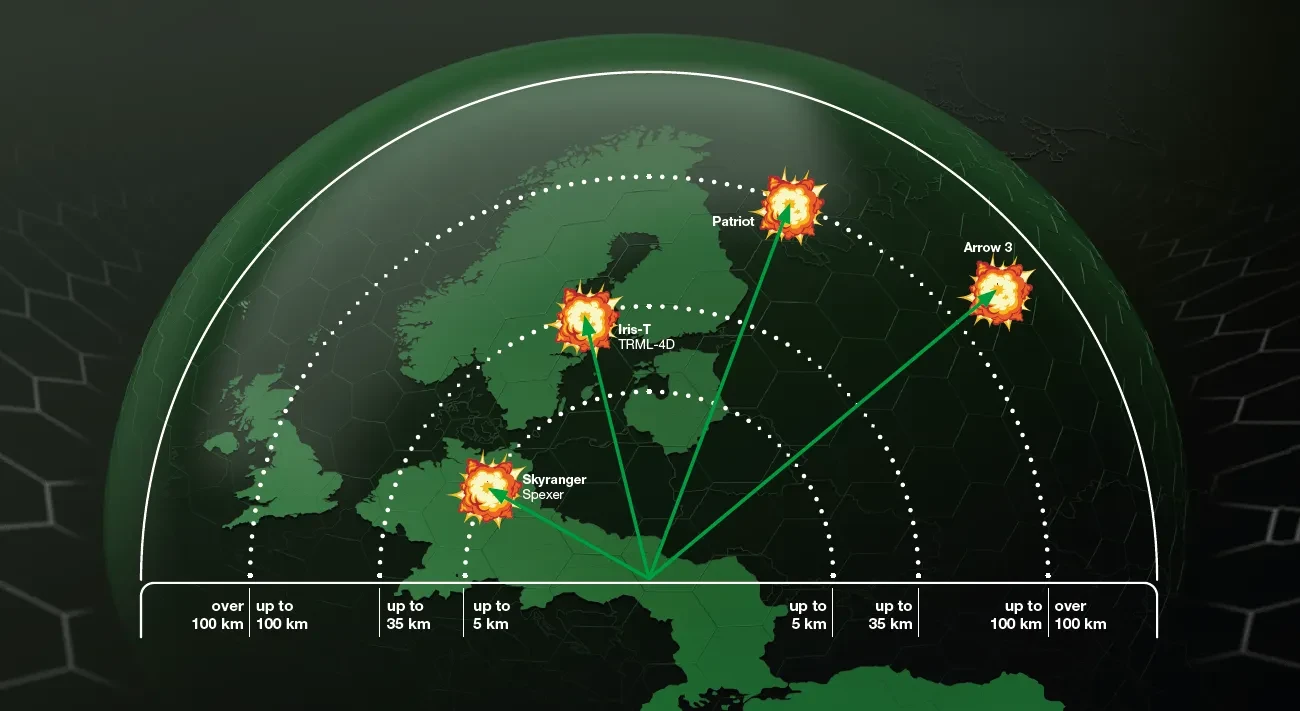
Europe’s national air forces are facing a pressing challenge: the realization that no single country can effectively defend against a range of aerial threats, including ballistic missiles, drones, cruise missiles, and advanced aircraft, on its own. In response, the European Sky Shield Initiative (ESSI) has emerged as a collaborative effort aimed at creating a shared air and missile defense network that utilizes pooled resources, integrated systems, and coordinated command structures.
ESSI serves as a multinational framework for integrated air and missile defense among European nations. Instead of each country relying on its own isolated defense systems, the initiative seeks to create interoperability and deliver a layered defense against aerial threats. The initiative is not merely a singular weapons system; it is a coordinated network of diverse systems that includes radar, missile interceptors, command-and-control mechanisms, and sensors. Participating member states, including Germany, Poland, Czechia, Slovenia, and the Netherlands, commit their capabilities and funding to this collective defense strategy.
A critical feature of ESSI is its alignment with NATO’s existing integrated air defense structures, which enables flexible contributions from participant nations. This strategic cooperation is rooted in a backdrop of geopolitical realities. The early 21st century has underscored the presence of genuine threats to Europe’s airspace, with rapid advancements in long-range precision weaponry exposing vulnerabilities in individual national air defenses. The ongoing conflicts, most notably Russia’s war in Ukraine, have further highlighted the impracticality of isolated defenses.
The political environment in Europe has also catalyzed the emergence of ESSI. It aligns with broader EU initiatives aimed at enhancing defense cooperation, such as the EU’s Permanent Structured Cooperation, which seeks to minimize redundancies in national defense procurement efforts. This collective approach is critical, particularly for smaller nations that may find it economically unfeasible to acquire advanced missile defense systems independently.
ESSI operates on a layered defense architecture designed to tackle a spectrum of threats. This architecture integrates short, medium, and long-range interceptors, advanced radars, and shared command and control systems, enabling effective threat engagement. Long-range defense systems are aimed at intercepting ballistic missiles and high-end cruise missiles, while mid-range interceptors safeguard critical infrastructure. Short-range systems focus on defending against drones and low-altitude threats. By linking sensors and command networks within a unified operational framework, ESSI allows for real-time data sharing, facilitating quicker threat detection and coordinated responses.
A significant benefit of the ESSI is the concept of shared procurement and cost-sharing among member nations. By pooling investments, countries can reduce the costs associated with acquiring high-end systems such as Patriot and IRIS-T, allowing for a more streamlined integration process and alleviating long-term sustainment burdens. This collaborative purchasing strategy not only cuts costs but also strengthens collective defense by forging a more cohesive air defense network.
ESSI enhances, rather than competes with, existing NATO air defense structures by filling coverage gaps and providing an additional regional layer of protection. By consolidating various national assets — from German Patriot batteries to Czech IRIS-T units — into a singular integrated framework, the initiative is positioned to respond more effectively to modern aerial threats.
As interest in ESSI continues to grow among European nations, the initiative’s reach may expand beyond its initial members. This approach becomes increasingly vital as new threats emerge, such as hypersonic missiles and drone swarms, underscoring the necessity for cooperative defense strategies. Looking forward, there is potential for integrating technologies such as directed-energy weapons and artificial intelligence for improved decision-making capabilities.
However, the initiative faces challenges, including the need to synchronize national procurement timelines and the necessity for equitable distribution of responsibilities amongst participants. The success of the ESSI will ultimately depend on the ability of European nations to work collaboratively toward a shared vision of air defense in an era marked by evolving threats.


