




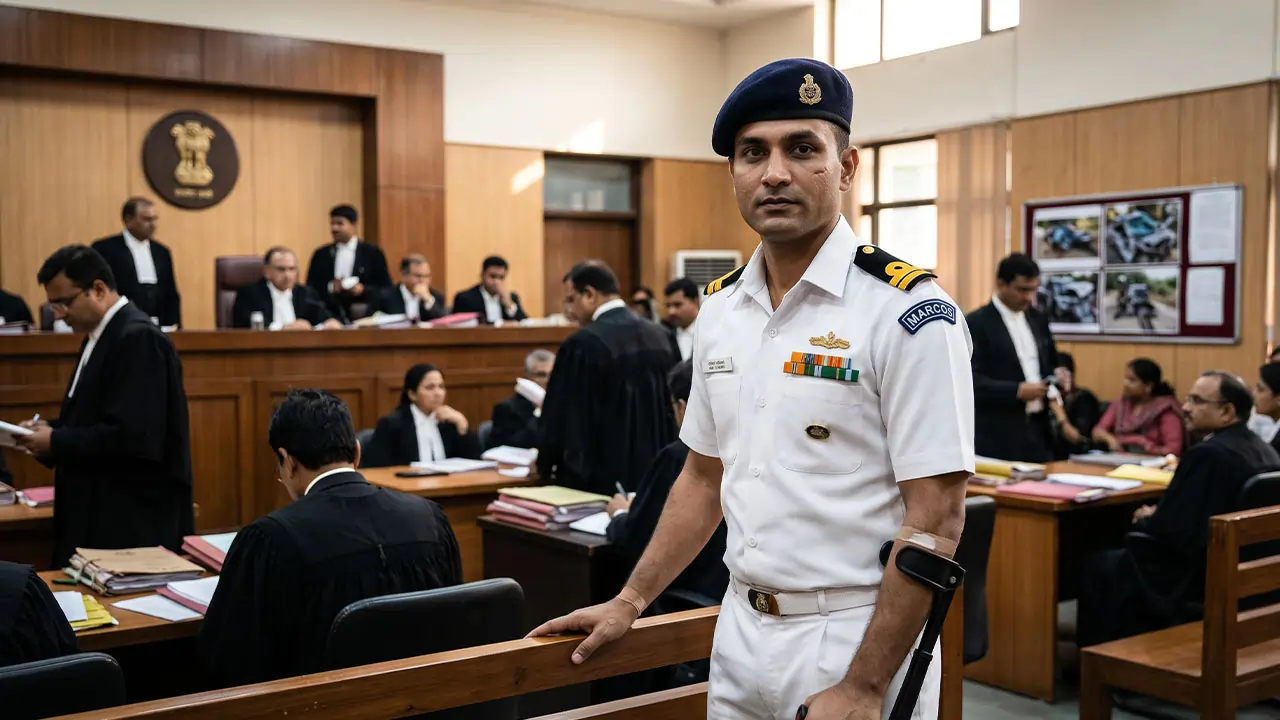
In a landmark judgment, the Motor Accident Claims Tribunal (MACT) at Patiala House Courts in Delhi has awarded a total compensation of approximately ₹2.46 crore to Sailor Lakhpat Singh, an injured Marine Commandos (MARCOS) diver from the Indian Navy. This ruling, delivered on June 7, 2026, emphasizes the long-lasting impact of road accidents on highly skilled military personnel. The compensation pertains to severe injuries sustained by Singh during a road accident that occurred on December 25, 2018, in Visakhapatnam, ultimately rendering him permanently unfit for his specialized duties.
Presiding Officer Abhilash Malhotra determined that Singh experienced a complete loss of earning capacity despite a medical board assessing his permanent disability at 88%. Although he continues to serve in a desk-based role, the tribunal concluded that the nature of his injuries had entirely eliminated his ability to perform underwater combat and diving operations. The Royal Sundaram General Insurance Company, the insurer of the offending vehicle, has been mandated to pay the compensation.
Lakhpat Singh, a member of the elite MARCOS unit known for executing high-risk maritime operations, had been stationed at INS Karna when the incident transpired. His extensive training had positioned him for advancement, including potential promotions and additional specialized training courses. Before the accident, records indicated that he could have obtained a monthly pension of approximately ₹69,509 upon retirement; however, that figure is now expected to drop to about ₹14,484 due to his medical downgrade.
The accident unfolded when Singh was riding a motorcycle with a fellow soldier. They were struck from behind by a speeding car, resulting in grievous injuries. The police charge sheet corroborated that the vehicle collided with the motorcycle due to rash and negligent driving. The driver failed to appear at the tribunal, prompting the court to draw negative inferences regarding accountability for the incident.
Singh’s injuries were severe, affecting multiple areas of his body and requiring significant medical intervention. Initially categorized as critically injured, he was transferred for specialized care and faced a prolonged recovery involving various surgeries and rehabilitation. The medical board ultimately assessed his permanent disability, confirming that he was unfit for his specialized duties within the MARCOS.
The tribunal evaluation included a thorough review of medical documents, service records, and evidence from the police report. The MACT acknowledged that Singh’s ongoing employment in a reduced capacity cannot negate the loss of future opportunities, promotions, and specialized training that were integral to his military career.
The total compensation of ₹2.46 crore was calculated based on loss of future income, missed career advancements, the effect of permanent disability, and other factors such as pain and suffering, loss of amenities, and need for assistive support. The tribunal directed that ₹50 lakh be released immediately to Singh, with the remaining funds to be secured in fixed deposit schemes for his long-term financial stability.
In its commentary, the MACT poignantly noted that financial restitution alone cannot heal the emotional and professional scars left by the accident. The tribunal emphasized that this case extends beyond a mere road incident; it represents the impact of negligence on a soldier trained for national service.
This ruling establishes important precedents regarding compensation for military professionals affected by road accidents. The recognition of total loss of earning capacity, irrespective of ongoing employment, sets a critical benchmark for similar future claims. The insurance company has been instructed to comply with the tribunal’s order promptly, and as of now, no appeal has been reported.
Overall, this case serves as a poignant reminder of the far-reaching implications of road safety, particularly in areas with a significant military presence, and highlights the profound injustice faced by individuals like Lakhpat Singh, whose careers and aspirations have been irrevocably altered due to irresponsible driving.


