




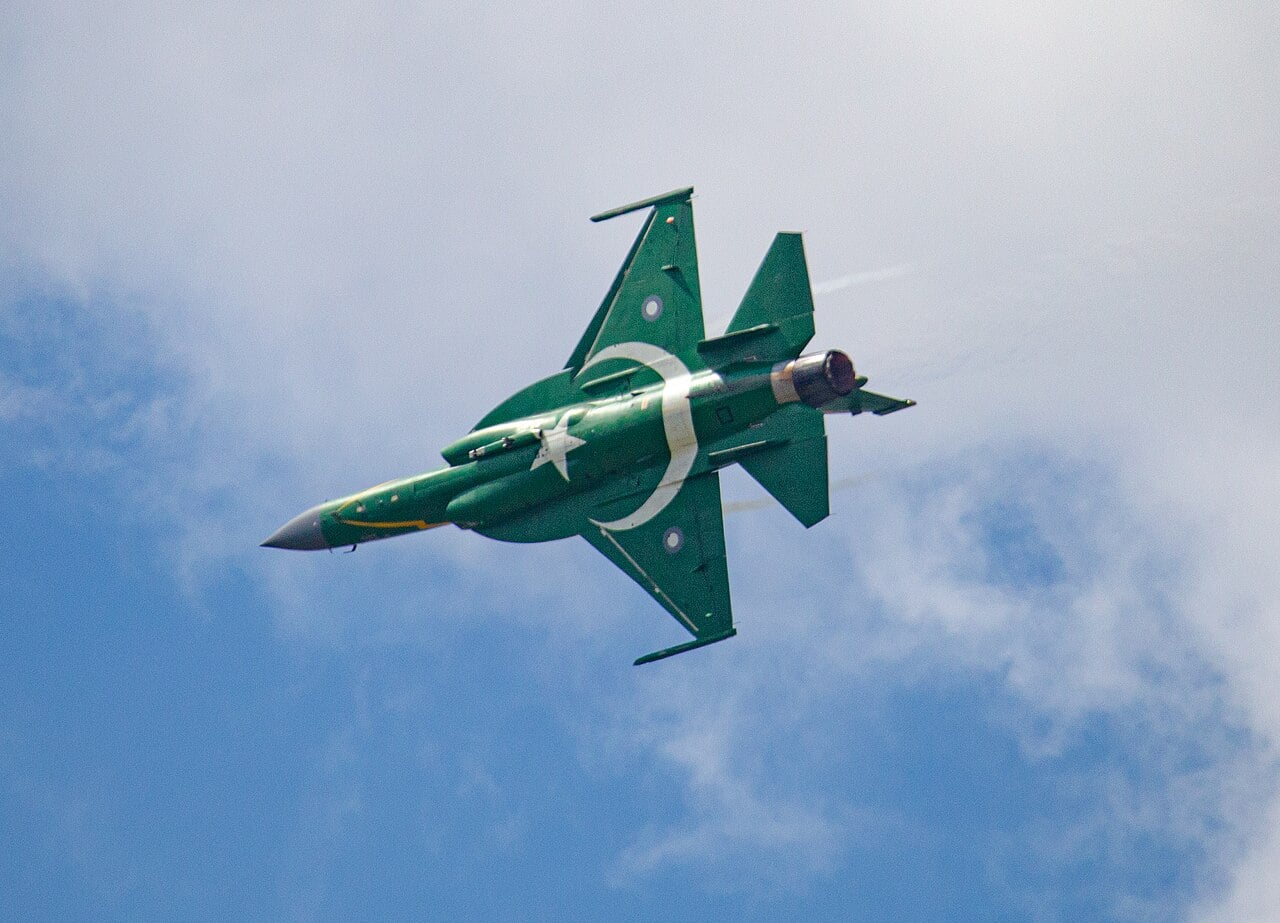
The JF-17 Thunder has become a pivotal component of Pakistan’s airpower strategy, built on the foundation of delivering credible combat capabilities while maintaining cost-effectiveness. This lightweight multirole fighter, developed by Chengdu Aircraft Industry Group in collaboration with the Pakistan Aeronautical Complex, aims to provide a robust alternative to high-end Western aircraft without the associated price tags.
Designed for a variety of roles—air superiority, interception, ground attack, and reconnaissance—the JF-17 is unique in its operational flexibility and affordability. The aircraft measures 14.9 meters in length with a wingspan of 9.5 meters, powered by the Klimov RD-93 turbofan engine that allows it to reach speeds up to Mach 1.6. With a combat radius of approximately 1,200 to 1,350 kilometers and a ferry range of around 3,000 kilometers, it is capable of long-distance operations. Additionally, it can operate at altitudes of up to 55,000 feet, where it can engage a range of modern weaponry including air-to-air missiles and precision-guided bombs.
The genesis of the JF-17 dates back to the 1990s, during a period when Pakistan sought to develop a domestically produced fighter aircraft amidst external sanctions and procurement restrictions. This pushed the country toward closer military collaboration with China, which had already envisioned a lightweight fighter through the earlier Super-7 project. The resultant FC-1/JF-17 program has evolved significantly, equipped to replace aging aircraft in the Pakistani fleet like the Mirage III and F-7, and later attracting interest from air forces in Myanmar, Nigeria, and Azerbaijan.
The JF-17 has undergone multiple upgrades to enhance its operational capabilities. The initial Block I version, operational since 2007, laid the groundwork for the platform, while the subsequent Block II introduced aerial refueling capabilities, elevating the aircraft’s mission reach. The recently developed Block III variant is seen as a step toward achieving near 4.5-generation fighter standards, featuring advanced technologies such as an active electronically scanned array radar that enhances detection and tracking abilities.
Key attributes of the JF-17 include its lightweight design, which reduces radar visibility and improves maneuverability, and its single-engine configuration that simplifies maintenance and lowers operational costs relative to twin-engine competitors. Advanced avionics updates in later models have improved pilot situational awareness through modern cockpit displays and enhanced data-link connectivity, allowing for efficient coordination between the aircraft and other platforms.
The strengths of the JF-17 extend to cost-effectiveness and export potential, especially appealing to nations with limited budgets. Its modular architecture permits gradual upgrades, enabling operators to keep pace with technological advancements without replacing the entire aircraft.
However, challenges do exist, notably its dependence on the Russian-made RD-93 engine, which raises concerns over supply chain vulnerabilities. Additionally, the JF-17 lacks the stealth capabilities characteristic of newer fifth-generation fighters, and its overall performance, while versatile, does not match that of larger advanced fighters.
Currently, the Pakistan Air Force remains the largest operator of the JF-17, employing it in air policing and counterterrorism missions while showcasing its capabilities in international air exercises. The aircraft’s export history began with Nigeria, followed by Myanmar—a significant acquisition amid international scrutiny due to political circumstances. Azerbaijan’s recent procurement of the JF-17 highlights a shifting landscape in the global fighter market, especially as it integrates a Chinese-Pakistani platform with its NATO affiliations.
Looking ahead, the JF-17 program is anticipated to evolve further with improvements in radar technology, electronic warfare systems, and weapons integration. The collaboration between Pakistan and China may also explore enhanced networking capabilities and concepts for unmanned team operations. While it may not challenge fifth-generation stealth fighters directly, the JF-17 serves an important niche by offering modern, capable air combat functionality at a fraction of the cost associated with elite Western alternatives—keeping it at the forefront of fighter jet discussions in the current market.


