




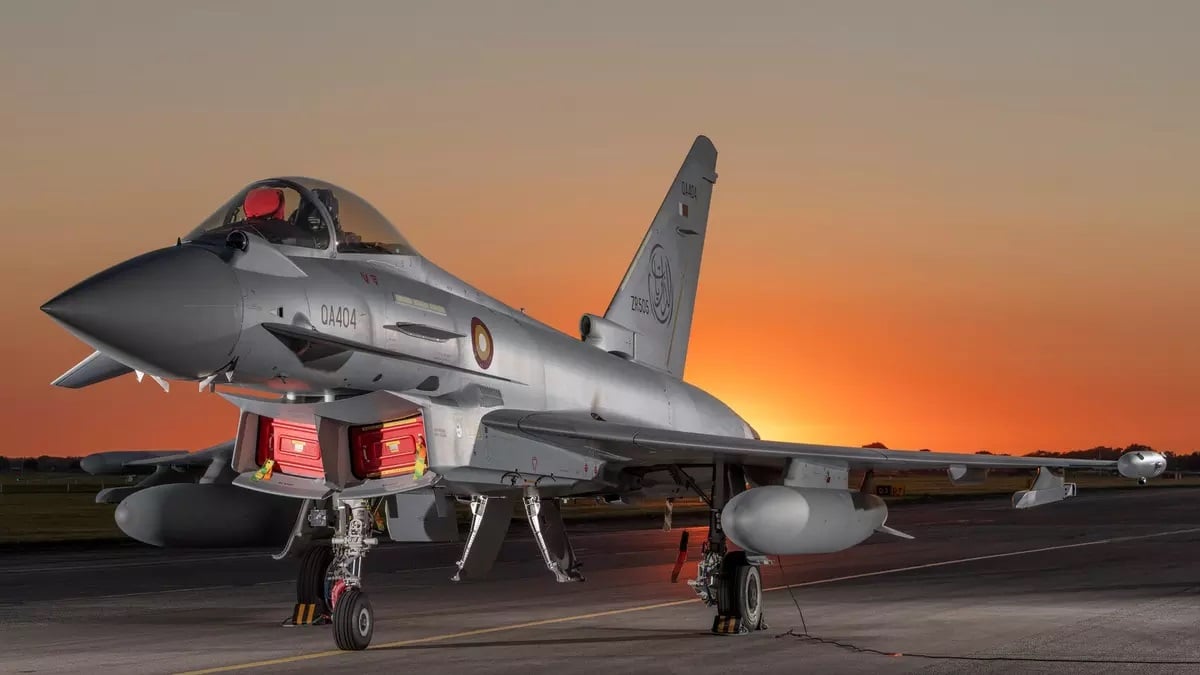
Modern air combat demands unparalleled flexibility, requiring fighter aircraft to transition seamlessly from air superiority roles to strike missions and reconnaissance support. The Eurofighter Typhoon exemplifies this versatility, remaining a cornerstone of European airpower amidst evolving threats.
Overview of the Eurofighter Typhoon
The Eurofighter Typhoon is a twin-engine, multirole fighter aircraft developed through a multinational collaboration among the UK, Germany, Italy, and Spain. Optimized for air dominance, it possesses impressive capabilities in precision strike operations, air superiority, interception, suppression of enemy air defenses, and reconnaissance.
Specifications:
- Type: Twin-engine multirole fighter aircraft
- Role: Air superiority and various support roles
- Maximum Speed: Over Mach 2 (2,470+ km/h or 1,535 mph)
- Combat Radius: Approximately 1,390 km (864 miles)
- Service Ceiling: Around 55,000 feet
- Weapons: A diverse arsenal including AIM-120 AMRAAM, Meteor, IRIS-T, and various precision-guided munitions.
Historical Context
The Eurofighter program commenced in the 1980s as European nations sought to replace their aging Cold War-era fleets. The initiative aimed to create a single aircraft capable of countering emerging Soviet threats while remaining adaptable for future challenges. Its milestones include:
- 1983-1986: Initial studies for a future fighter aircraft were conducted.
- 1986: Establishment of the Eurofighter consortium.
- 1994: First prototype flight.
- 2003: The aircraft’s initial operational service began.
The Eurofighter represents one of the most intricate multinational defense endeavors ever undertaken.
Design and Technical Features
The Typhoon was designed for air dominance, with contingency capabilities for multirole missions. Key features include:
- Aerodynamics: High agility for close-range air combat and sustained supersonic flight.
- Avionics: A digitally integrated cockpit featuring the advanced Captor-E AESA radar, sensor fusion for real-time battlefield awareness, and advanced targeting systems.
The aircraft supports NATO-compatible data links for enhanced operational coordination.
Performance Comparison
When compared to similar fighters such as the F-35 Lightning II, Dassault Rafale, and JAS 39 Gripen, the Eurofighter boasts exceptional agility and combat performance. Its capacity for supercruise and multirole efficacy sets it apart, though it lacks the stealth features of its fifth-generation counterparts.
Operational Deployment
The Eurofighter Typhoon has a robust operational footprint, actively involved in air policing and rapid interception, especially in NATO’s Baltic Air Policing missions. Key operators include the Royal Air Force, German Air Force, and Italian Air Force.
Notably, Saudi Arabia and Qatar are significant export customers, deploying the Typhoon for regional air defense and combat operations, including involvement in the Yemen conflict.
Future Outlook
As the UK, Italy, and Japan work towards a sixth-generation Global Combat Air Programme, the Typhoon will continue to play a critical role until at least the mid-2030s. Current upgrades are enhancing its capabilities with new radar systems, long-range missile integrations, and improved NATO connectivity.
However, with Germany and Spain also acquiring the F-35, the Typhoon’s role may shift towards air policing and interception rather than frontline multi-role engagement. Despite these changes, the aircraft’s future remains secure, particularly for operators in the Middle East who seek alternatives to fifth-generation platforms.
As the landscape of military aviation evolves, the Eurofighter Typhoon is poised to adapt and continue its significant contribution to European and allied airpower for years to come.


