




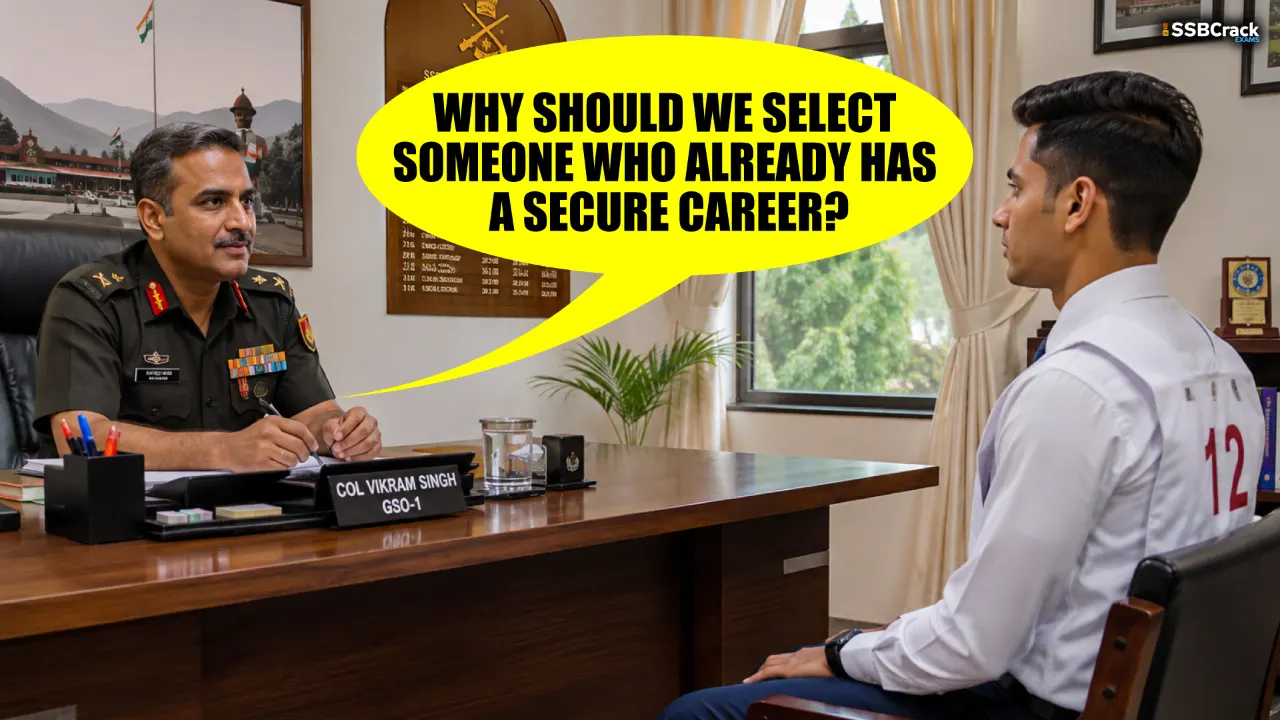
This session is specially designed for candidates who are currently working as Government Employees and aspire to become Commissioned Officers in the Indian Armed Forces. Whether you are employed in the Central Government, State Government, Railways, Public Sector Undertakings (PSUs), Postal Department, Banking Sector, Police, Education, or any other government organization, your professional experience often becomes an important part of your SSB Personal Interview.
The Interviewing Officer knows that you have already secured a stable government job. Therefore, one of the biggest questions in their mind is: “Why do you want to leave a secure career and join the Armed Forces?” Your answers should reflect maturity, clarity of purpose, leadership aspirations, and a genuine desire to serve rather than dissatisfaction with your current job.
Remember, the SSB Board is not judging your present profession. Instead, it wants to understand your motivation, decision-making ability, adaptability, leadership potential, and whether you possess the Officer Like Qualities required to lead men in uniform.
In this session, we will discuss 20 unique and interesting SSB Interview questions specifically for Government Employees. Along with each question, we will understand why it is asked, how to answer it effectively, and review a sample answer.
Question 1: You already have a secure government job. Why do you want to leave it?
Why is it asked?
To understand your real motivation and whether your decision is well thought out.
How to answer:
Focus on leadership, service, responsibility, and personal fulfilment rather than salary or dissatisfaction.
Sample Answer:
“My current job has provided me with valuable experience and stability, but I aspire to take on greater leadership responsibilities and serve the nation in a more challenging and dynamic environment. The Armed Forces offer opportunities for personal growth and meaningful service that align with my long-term goals.”
Question 2: What has your current government job taught you about responsibility?
Why is it asked?
To assess professional maturity.
How to answer:
Highlight accountability and commitment.
Sample Answer:
“My role has taught me that every decision affects people directly. Accuracy, accountability, and timely execution are essential because public service demands responsibility and trust.”
Question 3: Which quality from your present job will help you become a better officer?
Why is it asked?
To identify transferable skills.
How to answer:
Mention practical qualities relevant to military leadership.
Sample Answer:
“My experience in coordinating with different departments has strengthened my communication, planning, and teamwork skills, which are equally important for an officer.”
Question 4: If your department offered you a promotion tomorrow, would you still join the Armed Forces?
Why is it asked?
To assess conviction and long-term commitment.
How to answer:
Show that your decision is based on purpose rather than career progression.
Sample Answer:
“Yes. While I would appreciate the promotion, my aspiration to become a Commissioned Officer is based on my desire to lead, serve, and take on greater responsibilities.”
Question 5: What is one policy or practice in your department that you would improve?
Why is it asked?
To assess analytical thinking and problem-solving ability.
How to answer:
Offer constructive suggestions respectfully.
Sample Answer:
“I would encourage greater digital integration to reduce paperwork and improve efficiency while ensuring transparency in day-to-day administrative processes.”
Question 6: Have you ever disagreed with a senior officer at work?
Why is it asked?
To assess professionalism and emotional maturity.
How to answer:
Explain how you handled the situation respectfully.
Sample Answer:
“I once suggested an alternative approach to improve workflow. I shared my views respectfully, accepted the final decision, and continued performing my responsibilities professionally.”
Question 7: What has been your most satisfying achievement as a government employee?
Why is it asked?
To understand your values and sense of accomplishment.
How to answer:
Choose an achievement that reflects service and responsibility.
Sample Answer:
“I successfully coordinated a public service initiative that reduced processing time for citizens. Seeing the positive impact of our work was extremely satisfying.”
Question 8: What is more important—job security or job satisfaction?
Why is it asked?
To understand your career philosophy.
How to answer:
Provide a balanced perspective.
Sample Answer:
“Both are important, but long-term job satisfaction comes from meaningful work, continuous growth, and contributing positively to society.”
Question 9: What would your current supervisor say about your work ethic?
Why is it asked?
To cross-check your self-assessment.
How to answer:
Mention qualities supported by examples.
Sample Answer:
“I believe my supervisor would describe me as punctual, dependable, and sincere because I consistently complete assigned responsibilities within deadlines.”
Question 10: How has working with the public changed your personality?
Why is it asked?
To assess interpersonal skills.
How to answer:
Discuss patience, empathy, and communication.
Sample Answer:
“My job has improved my patience, listening skills, and ability to communicate with people from diverse backgrounds while remaining calm under pressure.”
Question 11: If selected, what professional habit from your current job would you carry into the Army?
Why is it asked?
To assess continuity of positive work habits.
How to answer:
Choose habits such as punctuality or planning.
Sample Answer:
“I would continue maintaining meticulous planning and disciplined time management because they contribute to effective teamwork and mission success.”
Question 12: Have you ever made a mistake at work? What did you learn from it?
Why is it asked?
To assess honesty and willingness to learn.
How to answer:
Accept responsibility and describe the lesson learned.
Sample Answer:
“I once overlooked an administrative detail while preparing a report. After correcting it, I introduced a personal checklist to avoid similar errors in the future.”
Question 13: What challenge do government employees face that people often do not understand?
Why is it asked?
To evaluate awareness and communication skills.
How to answer:
Provide a balanced explanation.
Sample Answer:
“Many people underestimate the responsibility of handling public services accurately and fairly while complying with established rules and procedures.”
Question 14: If your colleagues tried to discourage you from leaving your current job, how would you respond?
Why is it asked?
To assess confidence and decision-making.
How to answer:
Respect differing opinions while expressing your own conviction.
Sample Answer:
“I would appreciate their concern but explain that my decision is based on careful thought and my long-term aspiration to serve as a Commissioned Officer.”
Question 15: Which quality is more valuable for an officer—technical knowledge or leadership?
Why is it asked?
To assess judgment.
How to answer:
Balance both qualities.
Sample Answer:
“Both are essential. Technical knowledge enables informed decisions, while leadership inspires people to execute those decisions effectively.”
Question 16: What has your current job taught you about handling pressure?
Why is it asked?
To evaluate emotional stability.
How to answer:
Describe practical methods.
Sample Answer:
“I have learned to remain calm, prioritise urgent tasks, communicate clearly, and focus on solutions rather than reacting emotionally.”
Question 17: If you were not selected in the SSB, would you continue in your present job with the same dedication?
Why is it asked?
To assess professionalism and resilience.
How to answer:
Demonstrate commitment regardless of the outcome.
Sample Answer:
“Yes. I take pride in serving wherever I am posted. I would continue performing my duties sincerely while preparing myself better for future opportunities.”
Question 18: What leadership opportunity have you had in your current department?
Why is it asked?
To identify leadership potential.
How to answer:
Discuss coordination, mentoring, or project management.
Sample Answer:
“I have coordinated small teams during departmental projects by assigning responsibilities, monitoring progress, and ensuring timely completion.”
Question 19: What would your department lose if you resigned today?
Why is it asked?
To assess confidence without arrogance.
How to answer:
Objectively describe your contributions.
Sample Answer:
“My experience and institutional knowledge would be missed initially, especially in handling certain responsibilities efficiently. However, I have always believed in sharing knowledge with colleagues to ensure smooth continuity.”
Question 20: Apart from your government service, why should the SSB Board recommend you?
Why is it asked?
To evaluate your Officer Like Qualities beyond your professional experience.
How to answer:
Highlight leadership potential, adaptability, and character.
Sample Answer:
“I believe I possess discipline, integrity, responsibility, adaptability, and the ability to work effectively in teams. My government service has strengthened these qualities, and I am ready to apply them in the greater responsibility of leading soldiers as a Commissioned Officer.”
Working as a Government Employee gives you valuable professional experience, but the SSB Board is interested in much more than your designation. It wants to understand how your experiences have shaped your personality, strengthened your leadership abilities, and prepared you for the responsibilities of an officer. The focus should always remain on your growth, your motivation, and your potential, rather than the security or benefits of your current job.
Always answer honestly, avoid criticising your present employer, and explain your transition positively. Your maturity, clarity of purpose, integrity, and willingness to embrace greater responsibility will leave a lasting impression on the Interviewing Officer.
We hope these Government Employee-specific SSB Interview questions help you prepare confidently for your upcoming interview. Continue developing your Officer Like Qualities, remain physically fit, stay updated with current affairs, and reflect on the lessons your professional journey has taught you. Every responsibility you have handled so far is a stepping stone toward becoming a future military leader.
We wish you all the very best for your SSB Interview and your journey towards becoming a Commissioned Officer in the Indian Armed Forces.
Jai Hind!


