




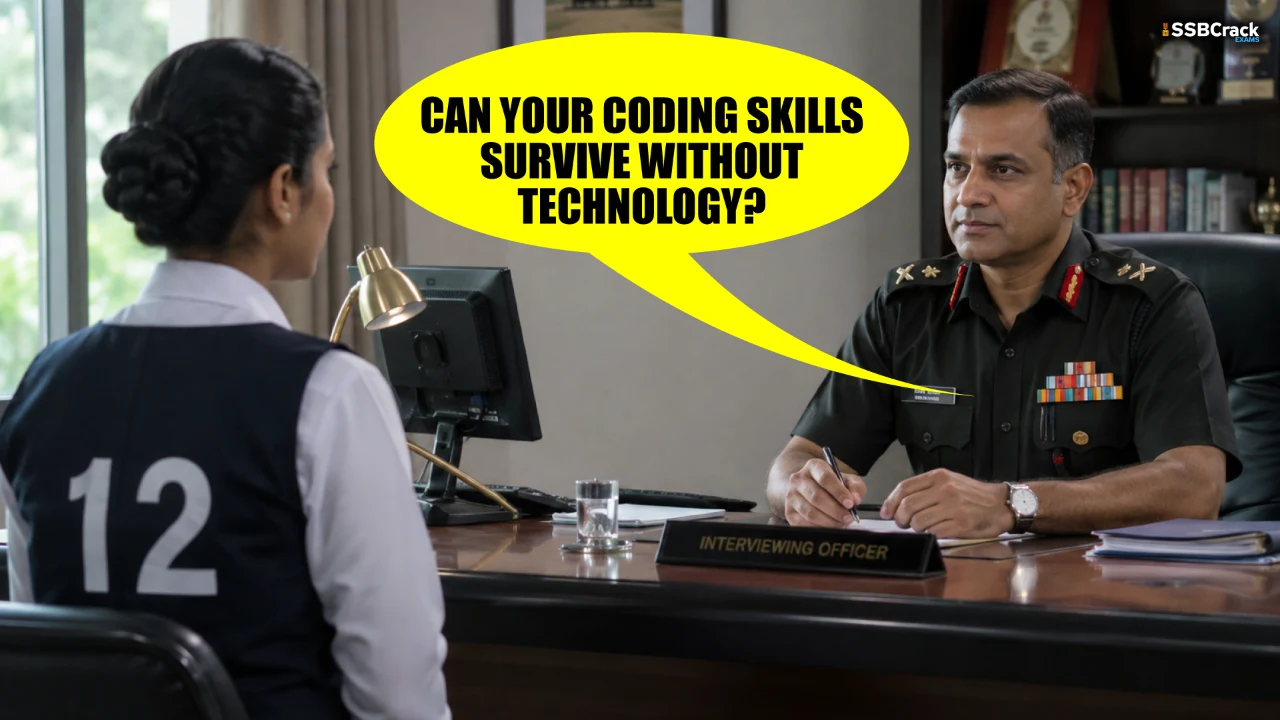
Computer Science is no longer limited to software development, coding, and applications. Today, technology plays a crucial role in cybersecurity, artificial intelligence, autonomous systems, communication networks, surveillance, electronic warfare, data analysis, and modern defence operations. Therefore, a Computer Science graduate appearing for the SSB Interview can expect questions that go far beyond programming languages and technical definitions.
The Interviewing Officer may want to know how your technical knowledge can contribute to national security, how you approach complex problems, whether you understand cybersecurity and emerging technologies, and how effectively you can lead people.
At the same time, remember that the SSB Interview is not a technical viva. Your technical knowledge is only one part of the assessment. The Board is also observing your Officer Like Qualities, including effective intelligence, reasoning ability, initiative, self-confidence, responsibility, adaptability, cooperation, decision-making, and the ability to influence and lead a group.
In this session, we will discuss 20 different, unique, and interesting SSB Interview questions specifically for Computer Science Graduates. For every question, we will understand why it is asked, how you should approach it, and a sample answer.
Question 1: You are a Computer Science graduate. Why do you want to become a military officer instead of joining the IT industry?
Why is it asked?
To understand your motivation and determine whether your decision to join the Armed Forces is genuine.
How to answer:
Do not criticise the IT industry or say that you dislike corporate life. Explain what attracts you towards military service.
Sample Answer:
“Computer Science has given me strong analytical and problem-solving abilities, but I want a career that combines technical knowledge with leadership, responsibility, teamwork, and service to the nation. The Armed Forces provide an environment where I can develop these qualities while contributing to national security.”
Question 2: If you were given a choice between developing a commercial app and working on a defence technology project, which would you choose and why?
Why is it asked?
To understand your motivation and awareness of the importance of technology in national security.
How to answer:
Explain your preference without suggesting that commercial technology is unimportant.
Sample Answer:
“I would prefer the defence technology project because it would allow me to apply my technical knowledge to problems directly connected with national security. I would also value the opportunity to work on systems where reliability and security have very high importance.”
Question 3: What is the biggest cybersecurity threat India faces today?
Why is it asked?
To test your awareness of contemporary technology and national security.
How to answer:
Avoid giving a single simplistic answer. Discuss a threat category and explain its implications.
Sample Answer:
“I would consider sophisticated cyberattacks, including attacks on critical infrastructure and sensitive information systems, among the major concerns. The increasing dependence on digital systems means that cybersecurity requires continuous monitoring, strong security practices, skilled personnel, and rapid incident response.”
Question 4: Imagine that a military communication network suddenly goes offline. What would be your first approach?
Why is it asked?
To assess your problem-solving ability and response under pressure.
How to answer:
Think systematically instead of immediately guessing the cause.
Sample Answer:
“I would first determine the scope of the problem—whether it affects one system or the entire network. Then I would check basic connectivity and system status, identify possible points of failure, coordinate with the technical team, and activate an authorised backup communication mechanism if required.”
Question 5: What is the difference between being a good programmer and being a good problem solver?
Why is it asked?
To assess your conceptual understanding and reasoning ability.
How to answer:
Explain that programming is a tool, while problem-solving is a broader capability.
Sample Answer:
“A good programmer can write efficient and reliable code, but a good problem solver first understands the actual problem, identifies constraints, considers alternatives, and chooses an appropriate solution. Programming is one tool used to implement that solution.”
Question 6: Which programming language would you choose if you had to solve a defence-related problem quickly?
Why is it asked?
To see whether you understand that technology selection depends on requirements rather than personal preference.
How to answer:
Do not claim that one language is universally superior.
Sample Answer:
“It would depend on the problem. For example, Python can be useful for rapid development, data analysis, and prototyping, while languages such as C or C++ can be suitable where performance and low-level control are important. I would select the technology according to the operational requirement.”
Question 7: Can artificial intelligence replace soldiers in the future?
Why is it asked?
To assess your understanding of AI and your ability to think critically about emerging technology.
How to answer:
Give a balanced answer rather than saying simply yes or no.
Sample Answer:
“AI can automate many tasks such as surveillance, data analysis, logistics, and certain autonomous functions, but I do not believe it can completely replace human soldiers. Military operations involve judgment, leadership, ethics, adaptability, and human interaction, which remain critical.”
Question 8: If an AI system gives you a recommendation that conflicts with your judgment, which one would you trust?
Why is it asked?
To assess judgment, responsibility, and understanding of technology’s limitations.
How to answer:
Explain that AI should support decision-making rather than replace responsible human judgment.
Sample Answer:
“I would examine the basis and reliability of the AI recommendation, compare it with available evidence and the operational situation, and then make the decision based on the overall context. Technology should support responsible decision-making rather than eliminate human accountability.”
Question 9: What is one cybersecurity habit every military officer should have?
Why is it asked?
To assess practical security awareness.
How to answer:
Choose a simple but important habit and explain its significance.
Sample Answer:
“Maintaining strong information discipline is essential. An officer should be careful about passwords, devices, access permissions, suspicious links, and the information shared through digital platforms.”
Question 10: Your friend asks you to help bypass a security system because it is only a college project. What would you do?
Why is it asked?
To assess ethics and responsible use of technical knowledge.
How to answer:
Show that technical capability must be guided by ethics and authorisation.
Sample Answer:
“I would first ensure that the activity is authorised and conducted in a controlled environment. If the request involved bypassing a real security system without permission, I would refuse and suggest a legitimate testing environment instead.”
Question 11: Tell me about a coding project that failed. What did you do next?
Why is it asked?
To assess resilience and practical intelligence.
How to answer:
Describe the problem, your troubleshooting process, and what you learned.
Sample Answer:
“During a college project, our application repeatedly crashed because of an issue in the database interaction. We isolated the problem, reviewed the code, tested individual components, and corrected the implementation. It taught me to approach technical failures systematically instead of making random changes.”
Question 12: What is more important in a defence software system—speed or security?
Why is it asked?
To assess your ability to balance competing priorities.
How to answer:
Avoid choosing one without considering the operational context.
Sample Answer:
“Both are important, but the required balance depends on the system. A security-critical system cannot sacrifice essential security merely for speed. At the same time, excessive security measures that make a system unusable or dangerously slow can also create operational problems.”
Question 13: If you had to explain cybersecurity to a soldier who was not technically trained, how would you explain it?
Why is it asked?
To evaluate communication skills and your ability to simplify complex concepts.
How to answer:
Use simple language and a practical analogy.
Sample Answer:
“I would explain cybersecurity like protecting a military camp. We control who can enter, protect sensitive areas, monitor suspicious activity, and respond quickly if someone tries to break in. Digital systems require similar layers of protection.”
Question 14: What is the most dangerous misconception people have about technology?
Why is it asked?
To assess critical thinking and awareness of technological limitations.
How to answer:
Give an observation that demonstrates maturity.
Sample Answer:
“I think one dangerous misconception is that technology automatically provides correct answers. Technology is only as reliable as its design, data, implementation, and human supervision.”
Question 15: If your team contains an excellent programmer who refuses to cooperate with others, what would you do?
Why is it asked?
To assess leadership and team management.
How to answer:
Show that individual brilliance cannot replace teamwork.
Sample Answer:
“I would first understand why the person is reluctant to cooperate. I would explain the team’s objective and assign responsibilities clearly. If necessary, I would have a private discussion with the individual and ensure that technical excellence is combined with professional teamwork.”
Question 16: If you had one year to learn a technology that could benefit the Armed Forces, what would you choose?
Why is it asked?
To assess curiosity, initiative, and awareness of emerging defence technologies.
How to answer:
Choose a technology you genuinely understand or are willing to study seriously.
Sample Answer:
“I would choose cybersecurity, particularly defensive cyber operations and secure network architecture, because modern defence systems increasingly depend on interconnected digital infrastructure. I would focus on developing practical skills rather than simply collecting certifications.”
Question 17: What can Computer Science contribute to battlefield logistics?
Why is it asked?
To assess your ability to apply technical knowledge to practical military problems.
How to answer:
Discuss areas such as data analysis, optimisation, tracking, forecasting, and decision support.
Sample Answer:
“Computer Science can support logistics through inventory management, route optimisation, demand forecasting, equipment tracking, data analysis, and decision-support systems. The objective would be to ensure that the right resources reach the right location at the right time.”
Question 18: Suppose your software works perfectly in the laboratory but fails in the field. What would you investigate?
Why is it asked?
To assess practical problem-solving and adaptability.
How to answer:
Think beyond the code itself.
Sample Answer:
“I would compare the field environment with the laboratory conditions and investigate differences in hardware, network connectivity, environmental conditions, user behaviour, system load, and configuration. I would reproduce the problem wherever possible and identify the actual failure point before modifying the system.”
Question 19: What is one ethical concern associated with using AI in defence?
Why is it asked?
To assess maturity and ethical reasoning.
How to answer:
Demonstrate that technological advancement must be accompanied by accountability and responsible use.
Sample Answer:
“One major concern is accountability for decisions made or influenced by autonomous systems. There must be clear human responsibility, appropriate safeguards, testing, and rules governing how such systems are used.”
Question 20: Your Computer Science degree tells us what you studied. What tells us that you can become an officer?
Why is it asked?
To distinguish academic qualification from Officer Like Qualities.
How to answer:
Do not simply mention coding skills. Connect your real experiences with leadership, initiative, responsibility, teamwork, adaptability, and decision-making.
Sample Answer:
“My Computer Science education has developed my logical reasoning and problem-solving abilities, but my suitability for officership comes from how I interact with people and respond to challenges. Through academic projects, teamwork, extracurricular activities, and difficult situations, I have developed initiative, responsibility, adaptability, and confidence. I want to combine these qualities with my technical knowledge to serve the nation as an officer.”
As a Computer Science graduate, remember that the SSB Interview is not a coding interview. The Interviewing Officer may ask you about programming, databases, operating systems, networking, cybersecurity, artificial intelligence, machine learning, cloud computing, or emerging technologies. But the purpose is not simply to test how much you remember from your textbooks.
The Officer may deliberately ask you a question that you cannot answer immediately. What matters then is how you react. Do you panic? Do you bluff? Do you remain composed and reason logically? Can you admit that you do not know something? Can you explain how you would find the answer?
These reactions reveal much more about your personality than a memorised technical definition.
Before appearing for SSB, revise your fundamental Computer Science subjects, especially Data Structures, Algorithms, Operating Systems, Computer Networks, Database Management Systems, Object-Oriented Programming, Computer Architecture, Cybersecurity, Artificial Intelligence, and your final-year project.
Be particularly prepared to explain your project in simple language. Know exactly what problem you solved, why you selected the technology, what your individual contribution was, what difficulties you encountered, and what you would improve if you did the project again.
Also remember that your technical knowledge should never make you appear arrogant. A good officer does not need to know everything. A good officer knows when to act, when to ask for help, when to verify information, and when to accept responsibility.
Your Computer Science background can be a tremendous advantage because it develops logical thinking, systematic problem-solving, adaptability, and comfort with complex systems. But the SSB Board ultimately wants to see the person behind the degree.
So, do not try to impress the Interviewing Officer with complicated terminology. Think clearly. Speak simply. Give genuine examples. And most importantly, remain yourself.
We hope these Computer Science-specific SSB Interview questions help you prepare effectively for your upcoming interview. Revise your technical fundamentals, understand your own academic and project experiences, stay updated with emerging defence technologies and cybersecurity developments, and continuously work on your Officer Like Qualities.
Remember: A computer can process information, but an officer must interpret situations, understand people, make decisions, and take responsibility.
We wish you all the very best for your SSB Interview and your journey towards becoming a technologically aware, responsible, and capable Commissioned Officer in the Indian Armed Forces.
Jai Hind!


