India’s defence modernisation plans received a significant push on Monday, with the Defence Acquisition Council (DAC) approving a large set of capital acquisition proposals for the Army, Navy and Air Force. The meeting, chaired by Defence Minister Rajnath Singh, granted Acceptance of Necessity (AoN) for proposals worth approximately ₹2.12 lakh crore (₹2,12,000 crore).
According to the Ministry of Defence, the clearances span helicopters, artillery systems, air defence weapons, surveillance drones, kamikaze drones, counter-drone systems and naval platforms. The ministry said about 82% of the approved procurement value will come from Indian industry, underlining the government’s emphasis on Aatmanirbhar Bharat and domestic defence production.
Indian Army Receives Approvals Across Mobility, Firepower and Surveillance
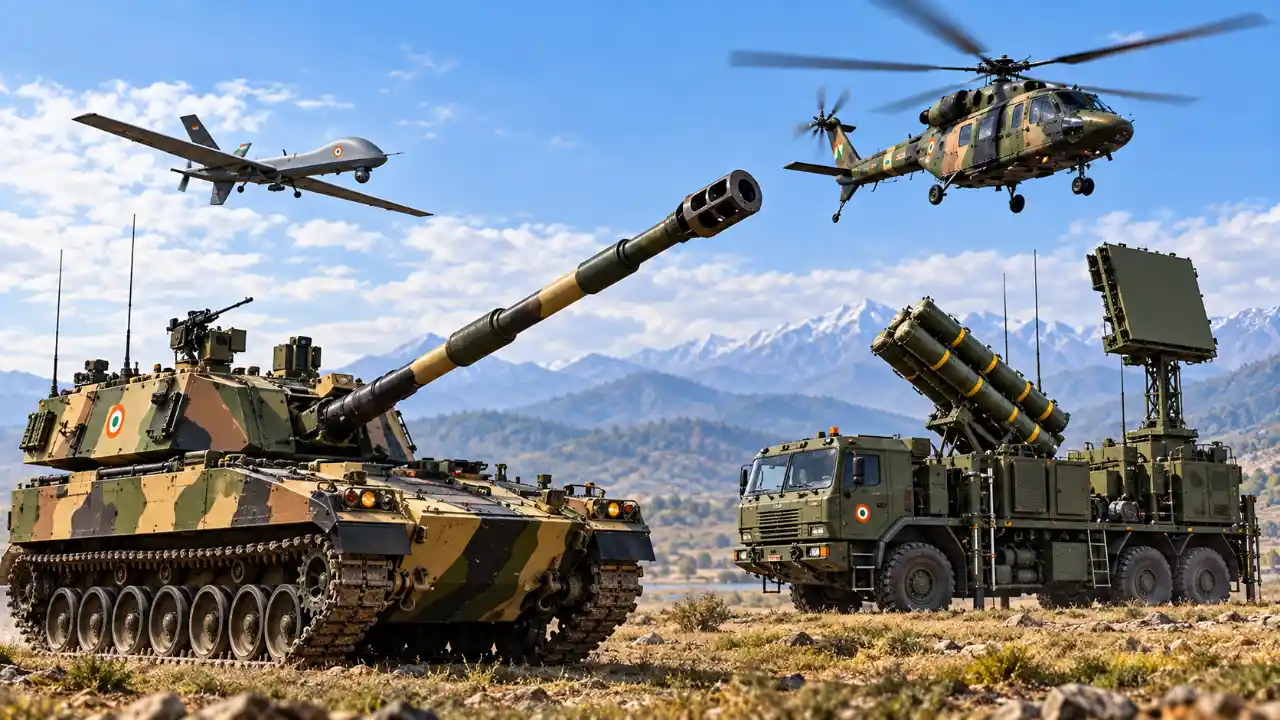
The Indian Army’s approved requirements include High Mobility Vehicles (HMVs), Self-Propelled Tracked Gun Systems, Gun Shot Response Systems (GSRS), Light Multi Role Helicopters (LMRH), Very Short-Range Air Defence Systems (VSHORADS), Platform-Based Counter Unmanned Aerial Systems (C-UAS), Unmanned Aerial System Brick Long Range, Surveillance UAVs, Integrated Surveillance and Strike Systems, and Long Range Kamikaze Drone Systems.
These platforms are aimed at improving mobility, battlefield awareness and protection against aerial threats. The High Mobility Vehicles are intended to support logistics and troop movement in difficult terrain, while the Self-Propelled Tracked Gun Systems are meant to give mechanised formations mobile firepower.
The Gun Shot Response System is described as a force multiplier that will provide real-time situational awareness and help troops react more effectively to threats on the battlefield.
The Light Multi Role Helicopters, which are intended for both the Indian Army and the Indian Air Force, will support reconnaissance, surveillance, combat missions, search and rescue operations, and humanitarian assistance and disaster relief tasks.
The Very Short-Range Air Defence Systems are meant to improve protection against small aerial threats, while platform-based counter-drone systems are expected to increase the survivability of tanks against unmanned aerial threats in modern combat conditions.
Long-range kamikaze drones, surveillance UAVs and integrated surveillance and strike systems were also approved, reflecting the growing role of unmanned warfare and precision targeting in military operations.
Navy to Get Decoy Systems and Indigenous Naval Platforms
For the Indian Navy, the DAC approved procurement of Active Offboard Decoy Systems (AODS) and other major naval platforms.
The Active Offboard Decoy System is designed to strengthen the Navy’s defensive capability against modern anti-ship missiles by improving missile countermeasure effectiveness. The approvals also cover major naval platforms that will be designed and constructed indigenously, with modern warfare capabilities intended to improve overall combat effectiveness and operational readiness.
These acquisitions are expected to add to India’s maritime defence capability as security challenges continue to evolve in the Indian Ocean Region.
Air Force to Receive Helicopters, Radars and Air Defence Equipment
The Indian Air Force will also benefit from the latest approvals, which include Special Utility Helicopters, air defence systems, weapons and Mobile X-Band Doppler Weather Radar Systems.
The Special Utility Helicopters are expected to address critical air transportation requirements and improve operational flexibility across different terrains. The Mobile X-Band Doppler Weather Radar Systems will provide high-resolution, localised weather surveillance in forward areas, supporting aviation activity and operational planning in difficult weather conditions.
Additional air defence systems and weapons are intended to improve the IAF’s combat readiness and strengthen its ability to counter emerging aerial threats.
Large Share of Procurement Value to Go to Indian Industry
One of the key features of the DAC’s latest approvals is the scale of indigenous sourcing. The Ministry of Defence said approximately 82% of the total approved procurement value will be sourced from Indian industry.
This is expected to create opportunities for domestic manufacturers and further reduce dependence on foreign military equipment. The approvals also reflect the armed forces’ focus on newer battlefield technologies, including unmanned aerial systems, precision-strike weapons, counter-drone solutions, advanced surveillance equipment and integrated air defence systems.
AoN Is an Administrative Step, Not a Final Contract
The ₹2.12 lakh crore approvals mark an important step in strengthening the operational capability of the Indian Army, Navy and Air Force. However, Acceptance of Necessity is only an in-principle administrative approval and does not mean procurement contracts have already been signed.
The proposals will now move through the next stages of the acquisition process before contracts are finalised. Once completed, the procurements are expected to improve India’s preparedness across land, sea and air while also giving a major boost to domestic defence manufacturing.