


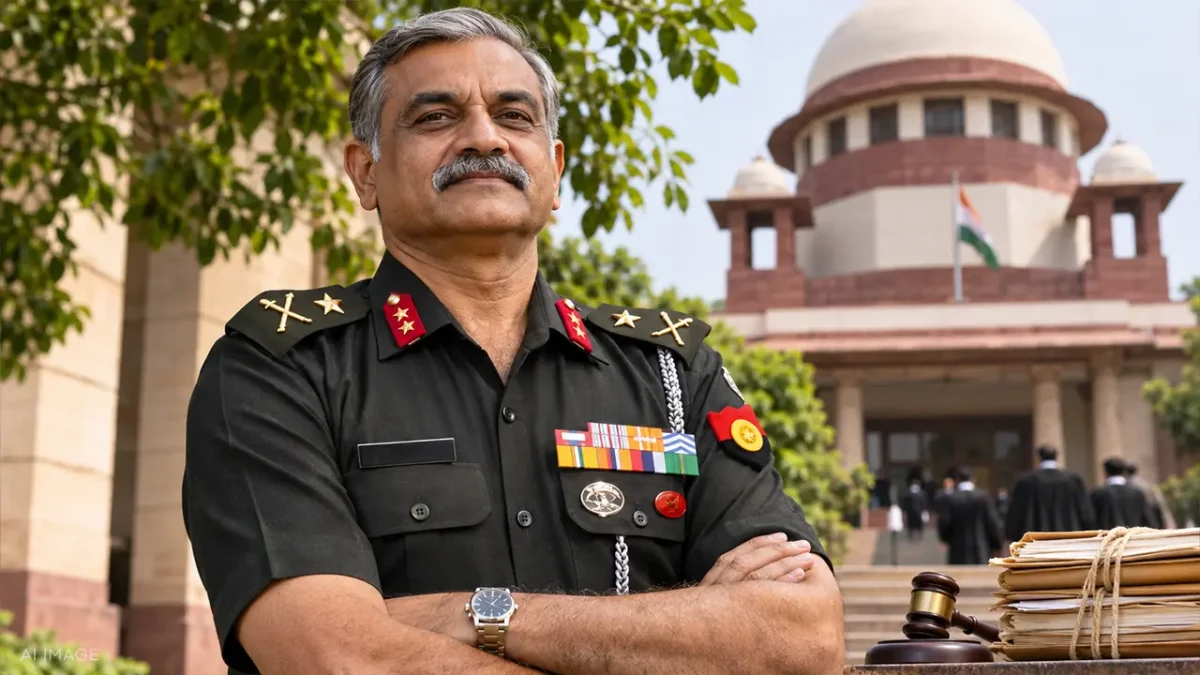
The Supreme Court has left undisturbed the acquittal of retired Major General Anand Kumar Kapur, dismissing two Special Leave Petitions brought by the Central Bureau of Investigation (CBI) over a disproportionate-assets case under the Prevention of Corruption Act, 1988.
The bench of Justice J.B. Pardiwala and Justice K. Vinod Chandran said it found “no good ground to interfere with the impugned order passed by the High Court” after hearing the parties and reviewing the material on record. The ruling preserves the Delhi High Court’s July 1, 2026 judgment, which set aside Kapur’s conviction, prison sentence and consequential confiscation of assets.
Case history and trial court ruling
The CBI alleged that Kapur accumulated assets beyond his known sources of income from November 14, 1971, to October 10, 2007. He had joined the Indian Army in 1971. The agency registered an FIR on October 8, 2007, and filed a chargesheet on October 26, 2009.
The CBI initially put the alleged disproportionate assets at approximately ₹3.37 crore. After examining 80 prosecution witnesses, the Special CBI Court at Patiala House Courts assessed the amount at ₹2.22 crore. On September 27, 2016, the trial court convicted Kapur and sentenced him to one year of rigorous imprisonment and a fine of ₹50,000. A later order directed the confiscation of assets.
Kapur appealed to the Delhi High Court. On July 1, 2026, Justice Jasmeet Singh allowed his appeals, finding that the prosecution had not proved its case beyond reasonable doubt. The High Court identified concerns about the prosecution sanction, Kapur’s opportunity to present defence evidence and the evidence supporting the alleged assets.
High Court findings on the trial
The High Court found that the sanctioning authority had not received all the investigative material, including documents favourable to Kapur. It concluded that the sanction for prosecution had been granted without proper application of mind.
The court also examined how the defence stage of the trial had proceeded. Kapur had proposed nine defence witnesses, but only four were examined before the trial court closed the defence evidence during a lawyers’ strike in September 2016.
While acknowledging the trial court’s efforts to comply with directions for expeditious disposal, the High Court said procedural deadlines could not override the constitutional guarantee of a fair trial under Article 21. It described a fair trial as the “heart of criminal jurisprudence.”
On the assets, the High Court found that investments, properties and cash holdings had been attributed to Kapur despite evidence indicating they belonged to, or had been funded by, his mother or other family members. It also found insufficient admissible evidence for the valuation of certain properties.
CBI petitions and connected prosecution
In its challenge before the Supreme Court, the CBI argued that the High Court had selectively assessed the evidence and had not adequately considered the trial court’s assessment of various assets, including properties in Delhi’s Defence Colony and Goa.
Solicitor General Tushar Mehta, Additional Solicitor General Suryaprakash V. Raju and senior advocate Zoheb Hossain appeared for the CBI. Senior advocate Mukta Gupta represented Kapur with a team of advocates. The Supreme Court dismissed both petitions without undertaking a detailed, independent examination of the individual grounds raised by the CBI.
The matter had also led to a separate money-laundering prosecution initiated by the Enforcement Directorate. In August 2026, a Delhi court acquitted Kapur in that connected case, holding that the alleged assets could not be treated as proceeds of crime once the underlying criminal offence no longer survived. The court also directed the release of attached properties.
The Supreme Court’s decision leaves the High Court’s acquittal in force, nearly 19 years after the FIR was registered in 2007.




