The Constitution of India provides special provisions to deal with extraordinary situations that may threaten the country’s security, constitutional governance or financial stability.
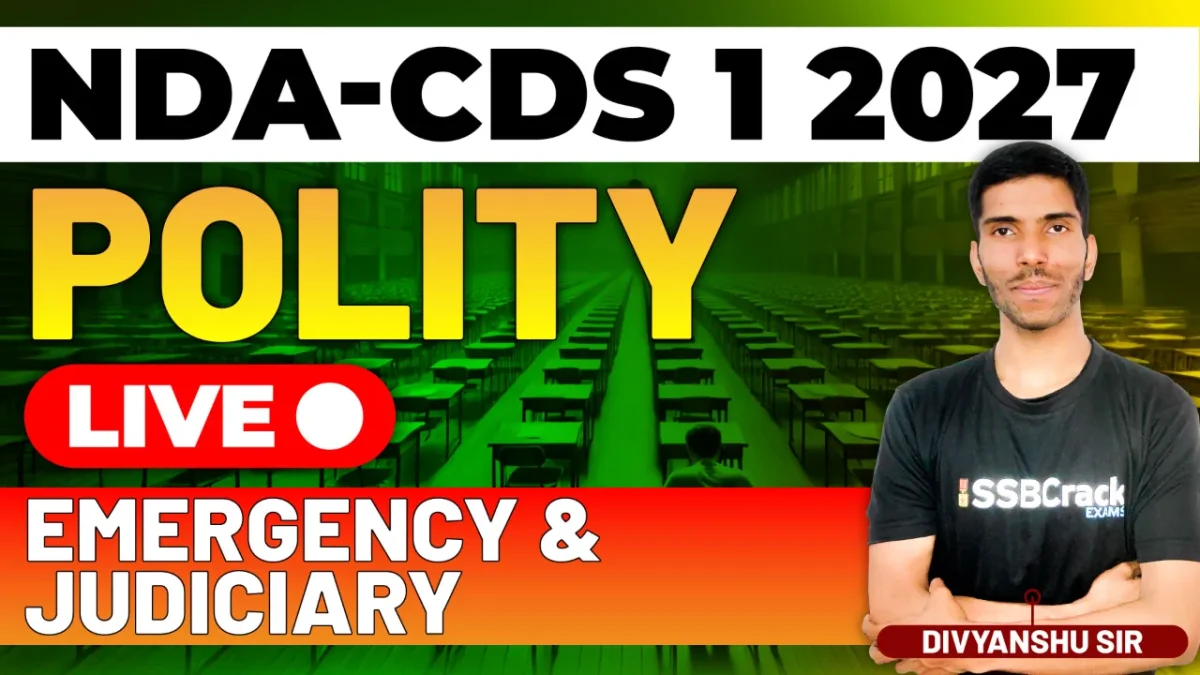
NDA & CDS 1 2027 Exam GK – Polity – Emergency & Judiciary
The Constitution of India provides special provisions to deal with extraordinary situations that may threaten the country’s security, constitutional governance or financial stability.
These provisions are included in Part XVIII of the Constitution, Articles 352 to 360.
The Constitution recognises three types of emergencies:
- National Emergency – Article 352
- President’s Rule or State Emergency – Article 356
- Financial Emergency – Article 360
The President of India formally proclaims an emergency, subject to the constitutional conditions and parliamentary approval applicable to each type.
2. National Emergency – Article 352
Article 352 empowers the President to proclaim a National Emergency when the security of India or any part of its territory is threatened by:
- War
- External aggression
- Armed rebellion
A proclamation may cover the entire country or only a specified part of its territory.
Important features:
- The President can issue a proclamation only after receiving the written decision of the Union Cabinet.
- The proclamation must be approved by both Houses of Parliament within one month.
- Approval requires a special majority: a majority of the total membership of each House and at least two-thirds of members present and voting.
- Once approved, the Emergency continues for six months at a time and can be extended through further parliamentary approval.
- The President must revoke the proclamation if the Lok Sabha passes a resolution disapproving its continuation.
- A special sitting of the Lok Sabha must be held within 14 days if the required notice for disapproval is given by at least one-tenth of its total members.
3. President’s Rule – Article 356
Article 356 deals with the failure of constitutional machinery in a State. It is commonly known as President’s Rule or State Emergency.
The President may issue a proclamation if satisfied that the State Government cannot function in accordance with the provisions of the Constitution. This satisfaction may be based on a report from the Governor or other information.
Important features:
- The President may assume certain functions of the State Government.
- The powers of the State Legislature may be exercised by or under the authority of Parliament.
- The powers of a High Court cannot be taken over or suspended under this provision.
- The proclamation must be approved by both Houses of Parliament within two months.
- After approval, it remains in force for six months at a time.
- It can generally continue for a maximum of three years, subject to additional constitutional conditions for extensions beyond one year.
Important Supreme Court Case:
S. R. Bommai v. Union of India (1994)
The Supreme Court held that the proclamation of President’s Rule under Article 356 is subject to judicial review. The judgment placed important constitutional limits on the use of this provision.IndiaCode+1
4. Financial Emergency – Article 360
Article 360 provides for a Financial Emergency when the financial stability or credit of India, or any part of its territory, is threatened.
Important features:
- The President may proclaim a Financial Emergency.
- The proclamation must be approved by both Houses of Parliament within two months.
- Once approved, the Constitution does not prescribe a fixed maximum period for its continuation.
- The Union Government may issue directions to States regarding financial matters.
- The President may direct the reduction of salaries and allowances of persons serving the Union or States, including judges of the Supreme Court and High Courts.
- State Money Bills and other financial Bills may be required to be reserved for the consideration of the President.
Important fact: No Financial Emergency has been proclaimed in India so far.IndiaCode+1
5. Important Articles Related to Emergency Provisions
| Article | Subject |
|---|---|
| 352 | Proclamation of National Emergency |
| 353 | Effect of proclamation of Emergency |
| 354 | Application of provisions relating to distribution of revenues during Emergency |
| 355 | Duty of the Union to protect States against external aggression and internal disturbance |
| 356 | Failure of constitutional machinery in States |
| 357 | Exercise of legislative powers under Article 356 |
| 358 | Suspension of provisions of Article 19 during certain emergencies |
| 359 | Suspension of enforcement of certain Fundamental Rights during Emergency |
| 360 | Financial Emergency |
6. Difference Between the Three Types of Emergencies
| Basis | National Emergency | President’s Rule | Financial Emergency |
|---|---|---|---|
| Article | 352 | 356 | 360 |
| Reason | War, external aggression or armed rebellion | Failure of constitutional machinery in a State | Threat to financial stability or credit |
| Parliamentary approval | Within 1 month | Within 2 months | Within 2 months |
| Duration after approval | 6 months at a time | 6 months at a time | No fixed maximum period |
| Maximum duration | No fixed overall maximum | Generally 3 years, subject to conditions | No fixed maximum period |
| Main effect | Centre’s powers expand | State administration comes under the constitutional arrangement of President’s Rule | Centre can issue financial directions to States |
7. Historical National Emergencies in India
India has experienced three National Emergencies:
| Year | Reason | Background |
|---|---|---|
| 1962 | External aggression | India-China War |
| 1971 | External aggression | India-Pakistan War |
| 1975 | Internal disturbance (the expression used at that time) | Proclaimed on 25 June 1975 |
Important examination point: The 44th Constitutional Amendment Act, 1978 replaced the expression internal disturbance with armed rebellion in Article 352.India Code+1
8. Important Constitutional Amendments Related to Emergency
38th Constitutional Amendment Act, 1975
- Made the President’s satisfaction in proclaiming an Emergency immune from judicial review.
- Its relevant provisions were subsequently reversed by the 44th Amendment.
42nd Constitutional Amendment Act, 1976
- Made several changes to the Constitution during the Emergency period.
- Expanded the scope of certain emergency-related provisions.
44th Constitutional Amendment Act, 1978
- Replaced “internal disturbance” with “armed rebellion” in Article 352.
- Required the written decision of the Union Cabinet for proclaiming a National Emergency.
- Introduced the special majority requirement for parliamentary approval.
- Reduced the initial parliamentary approval period for National Emergency from two months to one month.
- Protected Articles 20 and 21 from suspension of their enforcement under Article 359.
India Code+1
PART 2: INDIAN JUDICIARY
1. Introduction
The Indian Judiciary is one of the three major organs of the Government, alongside the Legislature and the Executive. It is responsible for interpreting laws, resolving disputes, protecting Fundamental Rights and ensuring that government actions remain within constitutional limits.
India has a single integrated judicial system, which administers both Union and State laws.
The Supreme Court is at the top of the judicial hierarchy, followed by the High Courts and subordinate courts.
The independence of the judiciary is considered a part of the Basic Structure of the Constitution.India
2. Structure of the Indian Judiciary
The Indian judicial system has the following structure:
- Supreme Court of India: The highest judicial authority in the country.
- High Courts: The highest courts at the State or regional level.
- District and Subordinate Courts: Courts functioning at the district and lower levels.
- Gram Nyayalayas: Courts established under the Gram Nyayalayas Act, 2008, to provide access to justice in rural areas.
3. Supreme Court of India
The Supreme Court of India is the apex court of the country. It was inaugurated on 28 January 1950, two days after the Constitution came into force.
It replaced the Federal Court of India, which had been established in 1937.
Constitutional Provisions:
- Article 124 – Establishment and constitution of the Supreme Court.
- Article 125 – Salaries of Supreme Court judges.
- Article 126 – Appointment of an Acting Chief Justice.
- Article 127 – Appointment of ad hoc judges.
- Article 128 – Attendance of retired judges.
- Article 129 – Supreme Court as a Court of Record.
- Article 130 – Seat of the Supreme Court.
- Article 131 – Original jurisdiction.
- Article 132 – Appellate jurisdiction in constitutional matters.
- Article 133 – Appellate jurisdiction in civil matters.
- Article 134 – Appellate jurisdiction in criminal matters.
- Article 136 – Special Leave Petition.
- Article 137 – Review of judgments or orders.
- Article 141 – Law declared by the Supreme Court is binding on all courts in India.
- Article 143 – Advisory jurisdiction of the Supreme Court.
- Article 145 – Rules of the Supreme Court.
4. Appointment and Qualifications of Supreme Court Judges
Supreme Court judges are appointed by the President of India under Article 124, following the constitutionally established appointment process.
Under the collegium system, recommendations for appointments are made through the judiciary.
Qualifications for appointment as a Supreme Court Judge:
A person must:
- Be a citizen of India.
- Have been a judge of a High Court for at least five years; or
- Have been an advocate of a High Court for at least ten years; or
- Be, in the opinion of the President, a distinguished jurist.
Tenure and Removal:
- Retirement age: 65 years.
- A Supreme Court judge can resign by writing to the President.
- A judge can be removed by the President following a parliamentary address supported by the required special majority in each House, on grounds of proved misbehaviour or incapacity.
IndiaCode+1
5. Jurisdiction of the Supreme Court
The Supreme Court exercises different types of jurisdiction:
A. Original Jurisdiction – Article 131
The Supreme Court can directly hear certain disputes involving:
- Government of India and one or more States.
- Government of India and States on opposite sides.
- Two or more States.
Article 32 also gives the Supreme Court original jurisdiction for the enforcement of Fundamental Rights.
B. Writ Jurisdiction – Article 32
The Supreme Court can issue writs for the enforcement of Fundamental Rights.
C. Appellate Jurisdiction
The Supreme Court hears appeals against judgments of High Courts and other courts in constitutional, civil and criminal matters, subject to constitutional and statutory requirements.
D. Advisory Jurisdiction – Article 143
The President may refer questions of law or fact of public importance to the Supreme Court for its advisory opinion.
E. Review Jurisdiction – Article 137
The Supreme Court has the power to review its own judgments or orders, subject to applicable rules.India+1
6. High Courts in India
The High Court is the highest judicial authority at the State or regional level.
Important Constitutional Articles:
| Article | Provision |
|---|---|
| 214 | High Courts for States |
| 215 | High Courts as Courts of Record |
| 216 | Constitution of High Courts |
| 217 | Appointment and conditions of office of High Court judges |
| 222 | Transfer of a judge from one High Court to another |
| 226 | Power of High Courts to issue writs |
| 227 | Power of superintendence over subordinate courts |
| 231 | Establishment of a common High Court for two or more States or Union Territories |
India Code+1
Qualifications of High Court Judges
A person appointed as a High Court judge must:
- Be a citizen of India.
- Have held a judicial office in India for at least ten years; or
- Have been an advocate of a High Court or of two or more such courts in succession for at least ten years.
Tenure:
- Retirement age: 62 years.
- Judges are appointed by the President of India.
- They can be removed through the same constitutional procedure applicable to Supreme Court judges.
India+1
7. Difference Between Supreme Court and High Court Writ Jurisdiction
| Basis | Supreme Court | High Court |
|---|---|---|
| Article | 32 | 226 |
| Purpose | Enforcement of Fundamental Rights | Enforcement of Fundamental Rights and for other purposes |
| Territorial jurisdiction | Throughout India | Within its territorial jurisdiction, subject to Article 226 |
| Nature | Article 32 itself is a Fundamental Right | Article 226 is a constitutional power |
Important: The writ jurisdiction of High Courts under Article 226 is wider in scope than that of the Supreme Court under Article 32 because High Courts can issue writs for Fundamental Rights as well as for other legal purposes.
8. Five Types of Writs in India
The Constitution empowers the Supreme Court and High Courts to issue five types of writs.
| Writ | Meaning | Purpose |
|---|---|---|
| Habeas Corpus | To have the body | Protects a person against unlawful detention |
| Mandamus | We command | Directs a public authority to perform its legal duty |
| Prohibition | To forbid | Prevents a lower court or tribunal from exceeding its jurisdiction |
| Certiorari | To be certified | Quashes an order of a lower court or tribunal when legally justified |
| Quo Warranto | By what authority | Questions the legal authority of a person holding a public office |
Easy way to remember: H-M-P-C-Q.
9. Subordinate Judiciary
Subordinate courts function under the administrative and judicial supervision of the High Courts.
Important constitutional provisions:
| Article | Subject |
|---|---|
| 233 | Appointment of district judges |
| 234 | Recruitment of persons other than district judges to the judicial service |
| 235 | Control over subordinate courts |
| 236 | Interpretation |
| 237 | Application of provisions to certain classes of magistrates |
District and Sessions Judge:
- The District Judge is the principal civil court judge at the district level.
- When exercising criminal jurisdiction, the same judicial officer functions as the Sessions Judge.
- District courts deal with civil and criminal cases according to their jurisdiction.