Do you think too much before making even a small decision? Do you keep analysing the same situation again and again? Do you sometimes imagine the worst possible outcome even before something happens?
If yes, then you might be an overthinker.
Overthinking is something many candidates experience, especially when they are preparing for an important examination, facing uncertainty or dealing with challenging situations.
However, during the SSB Interview, the Interviewing Officer may explore how you make decisions, handle uncertainty, manage pressure and respond when there is limited time to think.
Remember, thinking carefully is a positive quality. But when thinking turns into unnecessary worry, delays action or affects confidence, it can become a weakness.
In today’s article, we will discuss 20 important SSB Interview questions for overthinkers, along with why each question is asked, how you should answer it and a sample answer.
So, let’s get started!
1. Do you consider yourself an overthinker?
Why is this question asked?
The officer wants to understand your level of self-awareness and whether you recognise your tendency to think excessively about situations.
How should you answer?
Be honest. If you overthink, acknowledge it without presenting it as something that completely controls your life. Explain how you are trying to manage it.
Sample Answer
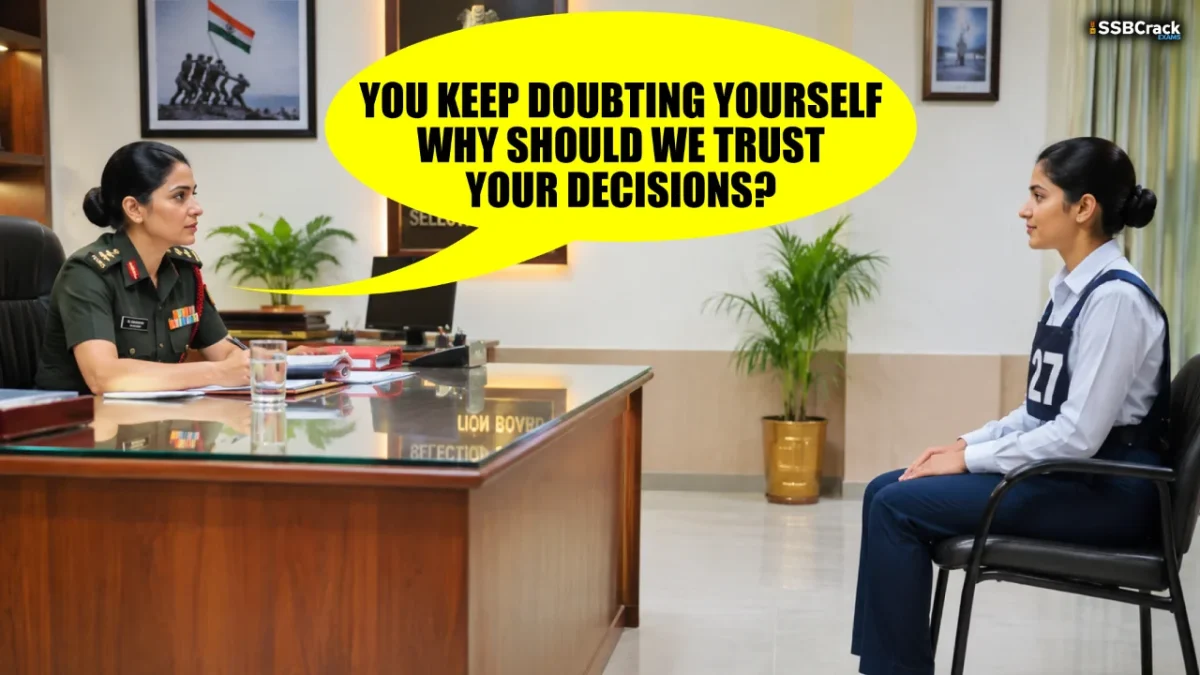
“Yes, Sir/Ma’am, I sometimes tend to overthink situations, especially when the outcome is important to me. I often consider different possibilities before making a decision. However, I have realised that excessive thinking can waste time, so I am trying to focus more on facts and take timely decisions.”
2. Why do you think you overthink?
Why is this question asked?
The officer wants to understand whether you know the reasons behind your behaviour and whether you can identify situations that trigger excessive thinking.
How should you answer?
Mention genuine reasons, such as fear of making mistakes, uncertainty or wanting everything to be perfect. Avoid giving a complicated psychological explanation.
Sample Answer
“Sir/Ma’am, I think I sometimes overthink because I want my decisions to be correct and I don’t want to make unnecessary mistakes. At times, I spend too much time considering possible outcomes. I am learning that not every situation requires perfect planning and that some decisions have to be taken with the information available.”
3. Does overthinking affect your decision-making?
Why is this question asked?
The officer wants to assess whether excessive analysis makes you hesitant or prevents you from taking timely decisions.
How should you answer?
Acknowledge any difficulty you experience and explain how you are improving your decision-making process.
Sample Answer
“Yes, Sir/Ma’am, sometimes it does. I may spend more time than necessary comparing different options. To improve this, I now identify the most important factors, consider the available information and set a reasonable time limit for making a decision.”
4. Do you often imagine negative outcomes before taking any action?
Why is this question asked?
The officer wants to understand how you respond to uncertainty and whether fear of failure affects your confidence.
How should you answer?
Explain that considering risks is useful, but assuming that everything will go wrong is not practical.
Sample Answer
“Sir/Ma’am, I sometimes think about what could go wrong before starting something new. However, I have understood that focusing only on negative possibilities can reduce confidence. I now try to identify the actual risks and prepare solutions instead of worrying about every possible outcome.”
5. Have you ever missed an opportunity because you were thinking too much?
Why is this question asked?
The officer wants to know whether overthinking has affected your willingness to take initiative or act when an opportunity arises.
How should you answer?
If you have experienced this, mention a genuine example and explain what you learned from it.
Sample Answer
“Yes, Sir/Ma’am. There was an occasion when I hesitated to participate in an activity because I kept thinking about whether I would perform well. Later, I realised that I had missed an opportunity to learn something new. Since then, I have been trying to participate even when I am not completely sure about the outcome.”
6. How much time do you take to make an ordinary decision?
Why is this question asked?
The officer wants to understand whether you can make routine decisions efficiently or whether you complicate simple situations.
How should you answer?
Explain that the time depends on the importance of the decision. Show that you do not spend unnecessary time on minor matters.
Sample Answer
“Sir/Ma’am, for ordinary decisions, I generally try to decide quickly. For example, I don’t spend much time deciding how to organise my daily activities. However, for important decisions, I consider the relevant factors before reaching a conclusion. I am also learning not to spend excessive time on matters that have limited consequences.”
7. What do you do when you are confused between two options?
Why is this question asked?
The officer wants to assess your ability to compare alternatives, evaluate priorities and reach a conclusion.
How should you answer?
Explain a practical decision-making method rather than saying that you keep thinking until you feel completely certain.
Sample Answer
“Sir/Ma’am, I compare both options based on their advantages, disadvantages and long-term impact. I also consider the available time and resources. Once I have enough information to make a reasonable choice, I take the decision instead of repeatedly comparing the same points.”
8. Do you worry about what other people think of you?
Why is this question asked?
The officer wants to understand whether concern about others’ opinions affects your confidence, behaviour and ability to express yourself.
How should you answer?
Show that you value constructive feedback but do not allow unnecessary judgement to control your decisions.
Sample Answer
“Sir/Ma’am, I sometimes think about how others perceive my actions, especially in unfamiliar situations. However, I understand that I cannot satisfy everyone. I value genuine feedback because it helps me improve, but I try to make decisions based on my responsibilities and judgement.”
9. Do you replay past conversations or incidents in your mind?
Why is this question asked?
The officer wants to understand whether you remain unnecessarily occupied with past events instead of learning from them and moving forward.
How should you answer?
Acknowledge that reflection can be useful, but explain how you avoid repeatedly analysing something that cannot be changed.
Sample Answer
“Yes, Sir/Ma’am, sometimes I think about past conversations and consider whether I could have expressed myself better. However, I try to identify one useful lesson from the experience and apply it in the future. I don’t want to waste time repeatedly thinking about something that has already happened.”
10. How do you react when you have to make a decision under time pressure?
Why is this question asked?
The officer wants to assess your ability to think clearly and act when there is limited time and incomplete information.
How should you answer?
Explain how you identify priorities, consider essential facts and choose a practical course of action.
Sample Answer
“Sir/Ma’am, I first identify what needs immediate attention and focus on the most important information. I consider the available options and their possible consequences, then choose the most practical one. I understand that under time pressure, delaying a decision in search of complete certainty may create more problems.”
11. Do you find it difficult to sleep because of excessive thinking?
Why is this question asked?
The officer may be trying to understand whether overthinking affects your daily routine, rest and ability to maintain a balanced lifestyle.
How should you answer?
Be truthful. If it happens occasionally, say so. Explain the practical steps you take to manage your routine.
Sample Answer
“Sir/Ma’am, occasionally, I keep thinking about pending work or something that happened during the day. However, I am trying to maintain a proper sleep routine. I usually make a list of important tasks for the next day so that I don’t have to keep thinking about them while going to bed.”
12. What happens when someone asks you an unexpected question?
Why is this question asked?
The officer wants to assess how you respond to unfamiliar situations and whether you become unnecessarily anxious when you do not have an immediate answer.
How should you answer?
Explain that you take a moment to understand the question and respond with whatever you genuinely know. Do not pretend to know everything.
Sample Answer
“Sir/Ma’am, I sometimes take a few seconds to organise my thoughts when I am asked an unexpected question. I try to understand what is being asked and then answer based on my knowledge. If I don’t know something, I prefer to admit it rather than give an incorrect answer.”
13. Do you find it difficult to trust your own decisions?
Why is this question asked?
The officer wants to understand your confidence in your judgement and whether you repeatedly doubt decisions after making them.
How should you answer?
Show that you are open to reviewing your decisions when new information becomes available, but do not unnecessarily question every decision you make.
Sample Answer
“Sir/Ma’am, earlier I sometimes used to doubt my decisions even after considering the available information. Now I try to make decisions after proper evaluation and take responsibility for them. If new facts emerge, I am willing to reconsider my decision, but I avoid unnecessary self-doubt.”
14. What would you do if your plan failed despite careful preparation?
Why is this question asked?
The officer wants to assess your flexibility, problem-solving ability and response to unexpected outcomes.
How should you answer?
Explain that you would identify the reason for failure, modify your approach and focus on the next practical step.
Sample Answer
“Sir/Ma’am, I would first understand why the plan failed. I would identify what went wrong and whether the situation requires a completely new approach or a few changes. I would not continue worrying about the failure because my priority would be to find an alternative solution.”
15. Do you keep comparing your progress with others?
Why is this question asked?
The officer wants to understand whether comparison affects your motivation, confidence and ability to focus on your own development.
How should you answer?
Explain that you may observe others’ achievements and learn from them, but you focus on your own goals and progress.
Sample Answer
“Sir/Ma’am, sometimes I compare my progress with that of my friends, particularly when they achieve something before me. However, I have realised that everyone has a different journey. I try to learn from their achievements and focus on improving my own performance rather than worrying about the comparison.”
16. What would you do if you were given an important responsibility but were unsure about your ability to complete it?
Why is this question asked?
The officer wants to assess your confidence, willingness to take responsibility and ability to handle uncertainty.
How should you answer?
Show that you would understand the task, identify what you need to learn and take initiative instead of avoiding the responsibility.
Sample Answer
“Sir/Ma’am, I would first understand the responsibility and identify the skills or resources required to complete it. If I need guidance, I would seek it from the appropriate person. I would then prepare a plan and begin working rather than waiting until I feel completely confident.”
17. How do you handle situations where you don’t have all the information?
Why is this question asked?
The officer wants to assess your judgement and ability to act sensibly despite uncertainty.
How should you answer?
Explain that you gather essential information, distinguish facts from assumptions and make the best possible decision based on the circumstances.
Sample Answer
“Sir/Ma’am, I first identify what information is essential and try to collect it within the available time. If some details are still unavailable, I consider the possible risks and make a practical decision based on the facts I have. I also remain ready to modify my approach if new information becomes available.”
18. What is the difference between careful thinking and overthinking?
Why is this question asked?
The officer wants to understand whether you can distinguish productive analysis from unnecessary worry and indecision.
How should you answer?
Explain that careful thinking leads to a decision or solution, whereas overthinking repeatedly analyses the same possibilities without meaningful progress.
Sample Answer
“Sir/Ma’am, careful thinking involves analysing the important facts, considering possible outcomes and reaching a decision. Overthinking happens when we repeatedly consider the same possibilities without taking action. I believe thinking is useful when it helps us solve a problem, but it should not prevent us from moving forward.”
19. What steps are you taking to overcome overthinking?
Why is this question asked?
The officer wants to assess your self-improvement efforts, discipline and ability to work on your weaknesses.
How should you answer?
Mention specific habits you are practising. Avoid saying that you have completely overcome overthinking unless that is genuinely true.
Sample Answer
“Sir/Ma’am, I am trying to set time limits for making decisions, prioritise my tasks and focus on facts rather than assumptions. I also maintain a daily schedule and try to complete one task at a time. When I notice that I am repeatedly thinking about the same issue, I shift my attention towards finding a practical solution.”
20. Why should the Armed Forces select an overthinker like you?
Why is this question asked?
The officer wants to assess your confidence, self-awareness and understanding of the importance of timely decisions, responsibility and emotional balance in military life.
How should you answer?
Do not glorify overthinking or claim that it is automatically an advantage. Acknowledge the weakness and explain how you are developing a more practical approach.
Sample Answer
“Sir/Ma’am, I understand that excessive thinking can sometimes delay decisions, which is not desirable in the Armed Forces. However, I am aware of this tendency and am working on improving my decision-making speed and confidence. I try to analyse situations carefully without allowing unnecessary doubts to affect my actions. I am willing to learn, accept feedback and take responsibility for my decisions.”
Important Tips for Candidates Who Overthink
- Set a time limit for decisions. Don’t spend twenty minutes deciding something that requires only two minutes.
- Separate facts from assumptions. Ask yourself whether your concern is based on actual information or something you are imagining.
- Stop searching for perfect decisions. Focus on making a sensible and practical decision with the information available.
- Take action instead of repeatedly planning. Planning is useful only when it leads to execution.
- Learn to accept uncertainty. Not every situation will have a guaranteed outcome.
- Avoid unnecessary comparisons. Focus on your own progress rather than constantly measuring yourself against others.
- Practise speaking without preparation. Participate in group discussions and practise answering unexpected questions.
- Develop confidence through preparation. Regular practice can reduce unnecessary doubts about your abilities.
- Maintain a daily routine. Organise your tasks so that you don’t keep worrying about what needs to be done.
- Write down your concerns. If a problem keeps coming back to your mind, write it down and identify one practical step you can take.
- Learn from mistakes. Analyse what went wrong, take the lesson and move forward instead of repeatedly blaming yourself.
- Focus on one task at a time. Avoid thinking about several unrelated problems simultaneously.
- Practise decision-making. Take responsibility for small everyday decisions instead of depending on others for everything.
- Accept constructive criticism. Feedback is an opportunity to improve, not necessarily a judgement of your abilities.
- Don’t confuse overthinking with intelligence. Thinking more does not always mean thinking better.
- Participate in outdoor activities and sports. They can help you develop practical thinking, teamwork and confidence.
- Don’t hesitate to ask for clarification. Sometimes uncertainty can be reduced simply by asking the right question.
- Develop a solution-oriented mindset. Instead of repeatedly asking yourself what could go wrong, ask what you can do if it happens.
- Take care of your well-being. Maintain healthy sleep habits, exercise regularly and seek professional support if excessive worrying becomes difficult to manage or interferes with daily life.
- Show improvement through your actions. During the SSB Interview, demonstrate that you can listen, understand, decide and act without unnecessary hesitation.
Closing Lines
So, these were 20 important SSB Interview questions for overthinkers, along with why each question is asked, how to answer it and sample answers.
Before we end, remember one important thing:
An officer needs to think before taking action, but should not think so much that action never happens.
The Armed Forces require individuals who can analyse situations, understand risks, make decisions and take responsibility for their actions.
Being thoughtful is a strength. Being careful is a strength. But allowing unnecessary doubts and imaginary situations to control your decisions can become a limitation.
So, if you are an overthinker, don’t consider it a permanent weakness. Work on your decision-making, develop confidence, practise taking initiative and learn to accept that no decision comes with a guarantee of a perfect outcome.
And remember, don’t memorise the sample answers from this video. Understand the purpose behind each question and frame your responses according to your own experiences, behaviour and personality.
Keep learning, keep improving and believe in your ability to make the right decisions.
Think clearly, decide confidently and act responsibly. All the best for your SSB journey!