If you are preparing for NDA, CDS, AFCAT or the SSB interview, there is a good chance you have watched a video of Indian commandos in action and wondered what they were carrying. Defence equipment questions turn up in GK papers and SSB interviews, especially if you list special forces as an interest in your PIQ form.
India’s main special forces are the Army’s Parachute Regiment (Special Forces), better known as Para SF, the Indian Navy’s Marine Commandos (MARCOS), the Indian Air Force’s Garud Commando Force and the National Security Guard (NSG), the Black Cat counter-terror force under the Ministry of Home Affairs. Unlike regular infantry, these units are allowed to choose weapons that suit their missions, so their armouries include imported rifles, compact sub-machine guns and long-range sniper systems that ordinary units rarely carry.
Here are 10 weapons used by Indian special forces, with the key facts every defence aspirant should know. Weapon inventories are not always made public, so we have relied on official statements and widely reported procurements, and we have left out figures that could not be confirmed.
1. IWI Tavor TAR-21 Assault Rifle
Type: Bullpup assault rifle
Origin: Israel (Israel Weapon Industries); also made under licence in India by PLR Systems, Gwalior
Calibre: 5.56×45 mm NATO
Used by: Para SF, MARCOS, Garud Commando Force
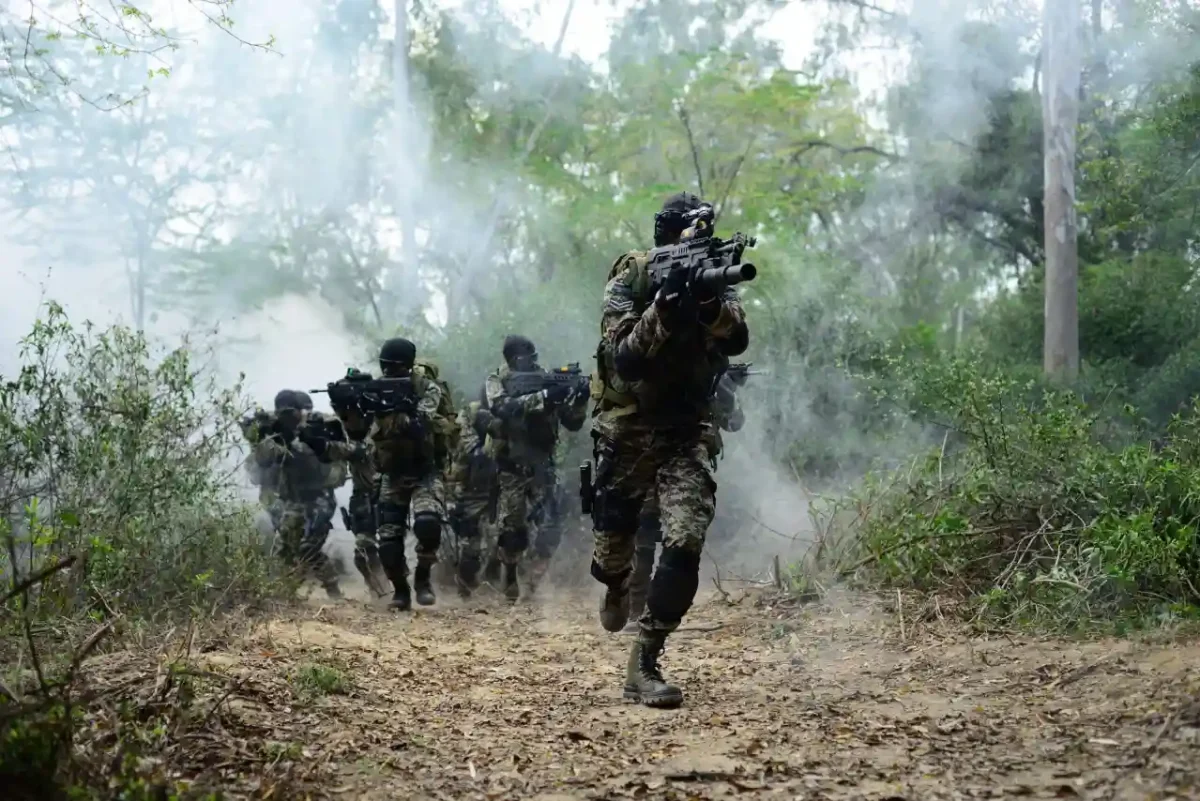
If one rifle has become the face of Indian special forces, it is the Tavor TAR-21. It is a bullpup design, which means the magazine and firing mechanism sit behind the pistol grip. This keeps the overall weapon short while retaining a full-length barrel, an advantage when commandos operate inside buildings, vehicles and helicopters.
India signed a deal in late 2002 for about 3,070 TAR-21 rifles for its special forces. Early rifles needed modifications after trials, and the cleared consignment was later delivered. MARCOS received a consignment of over 500 Tavors in December 2010. Today the Tavor is the standard rifle of Para SF, and Garud and MARCOS operators are regularly seen with it. In official IAF photographs of Garud commandos, the Tavor is often the rifle in their hands.
2. SIG Sauer SIG716 Rifle
Type: 7.62 mm battle rifle (AR-pattern)
Origin: United States (SIG Sauer)
Calibre: 7.62×51 mm NATO
Used by: Garud Commando Force, Indian Army frontline units; also reported with Para SF
The SIG716 entered Indian service through a fast-track contract signed on 12 February 2019 for 72,400 rifles: 66,400 for the Army, 4,000 for the Indian Air Force and 2,000 for the Navy. It was bought mainly to equip troops in forward and counter-insurgency areas with a harder-hitting 7.62 mm rifle in place of the 5.56 mm INSAS.
Although it is not a special forces-only weapon, the SIG716 is part of the Garud armoury. In December 2022, IAF officials said the Garud Special Forces had been equipped with American SIG Sauer rifles and Russian AK-103 rifles. The heavier 7.62×51 mm round gives more reach and stopping power than 5.56 mm, which matters in the mountains and along the borders.
3. M4A1 Carbine
Type: Gas-operated carbine
Origin: United States
Calibre: 5.56×45 mm NATO
Used by: Para SF (reported in SOPMOD Block I configuration)
The M4A1 is one of the most widely used special forces carbines in the world, and Para SF are reported to use it alongside the Tavor. Indian operators have been photographed with M4A1s fitted with the SOPMOD (Special Operations Peculiar Modification) Block I kit, which adds rails, optics, lasers and the option of an under-barrel grenade launcher.
The M4’s main strengths are its light weight, modular design and the huge range of accessories available for it. For an aspirant, it is also a useful reminder of how closely Indian special forces train with their American counterparts. Para SF and the US Army’s Special Forces have conducted the Vajra Prahar joint exercise for years, and such exercises give both sides experience with each other’s weapons and tactics.
4. AK-103 Assault Rifle
Type: Assault rifle
Origin: Russia (Kalashnikov)
Calibre: 7.62×39 mm
Used by: MARCOS, Garud Commando Force, Indian Air Force units
The AK-103 is a modern member of the Kalashnikov family, chambered for the same 7.62×39 mm round as the famous AK-47. It is known for working reliably in mud, sand and salt water, which is why MARCOS, who operate at sea, along coasts and in places like the Wular Lake area of Jammu and Kashmir, have long kept it in their armoury.
In August 2021, the Indian Air Force signed an emergency contract for 70,000 AK-103 rifles from Russia, and in December 2022 IAF officials confirmed that the Garud Special Forces were using AK-103s. The rifle is the predecessor of the AK-203, which is now being produced in India at Korwa in Amethi, Uttar Pradesh, by Indo-Russian Rifles Private Limited, a joint venture.
5. IWI Negev Light Machine Gun
Type: Light machine gun
Origin: Israel (Israel Weapon Industries); NG-7 now also made in India by PLR Systems
Calibre: 5.56×45 mm (Negev) and 7.62×51 mm (Negev NG-7)
Used by: Para SF, Garud Commando Force, MARCOS; NG-7 also with Army infantry
Every special forces team needs a weapon that can put down sustained fire, and for Indian commandos that role is filled by the Negev. The 5.56 mm Negev has long served as the light machine gun of Indian special forces, while the heavier 7.62 mm Negev NG-7 has been bought in large numbers for the Army as a whole. An order for 16,479 NG-7s was placed in March 2020 to replace the INSAS LMG, and further NG-7s are being built in India at the Small Arms Complex near Gwalior.
The Negev also has a place in Garud history. During the counter-terror operation at Chandergeer village in Hajin, Bandipora district, in November 2017, the Garud team used the Negev, and Corporal Jyoti Prakash Nirala engaged the terrorists with his light machine gun. He was killed in the operation and was posthumously awarded the Ashoka Chakra, India’s highest peacetime gallantry award, in 2018.
6. Heckler & Koch MP5 Sub-Machine Gun
Type: Sub-machine gun
Origin: Germany (Heckler & Koch)
Calibre: 9×19 mm Parabellum
Used by: NSG, MARCOS, Para SF
The MP5 is perhaps the most famous counter-terrorism weapon ever made. It fires the same 9 mm pistol round as a handgun, but with a longer barrel, a stock and fully automatic fire. This makes it accurate, easy to control and less likely to over-penetrate walls in crowded places such as hotels, aircraft and buses.
These qualities make the MP5 a natural choice for hostage rescue, the core task of the NSG. The NSG has used it for years, and it also serves with MARCOS and Para SF for close-quarter battle. Many state police commando units use it as well.
7. Micro Uzi Machine Pistol
Type: Machine pistol / compact sub-machine gun
Origin: Israel
Calibre: 9×19 mm Parabellum
Used by: Para SF
The Uzi is one of the best-known Israeli weapons, and its smallest version, the Micro Uzi, is almost the size of a large pistol while still firing on full automatic. That makes it a good backup weapon for commandos who need both hands free for climbing, rappelling or driving, but still want firepower close at hand.
The full-size Uzi was once carried by India’s Special Protection Group (SPG), which replaced it with the Belgian FN P90 in 2008. Para SF, however, are reported to still use the Micro Uzi.
8. Glock 17 Pistol
Type: Semi-automatic pistol
Origin: Austria (Glock)
Calibre: 9×19 mm Parabellum
Used by: Garud Commando Force (standard pistol), NSG, Para SF, MARCOS
No commando goes into an operation without a sidearm, and the Glock 17 is the pistol most associated with Indian special forces. Its polymer frame makes it light, it has very few parts, and it has earned a strong reputation for reliability. Its standard magazine holds 17 rounds of 9 mm ammunition.
The Glock is the standard pistol of the Garud Commando Force and is widely used by the NSG, Para SF and MARCOS. In 2018, the NSG also added Glock combat knives to its kit as part of a modernisation drive. For aspirants, remember that a pistol is a secondary weapon. It is used when the primary rifle jams, runs out of ammunition or is too bulky for the space.
9. IWI Galil Sniper Rifle (Galatz)
Type: Semi-automatic sniper rifle
Origin: Israel (IMI / Israel Weapon Industries)
Calibre: 7.62×51 mm NATO
Used by: Para SF, Garud Commando Force, MARCOS
The Galil Sniper, also called the Galatz, is a semi-automatic rifle built on the Galil design. Unlike a bolt-action rifle, it can fire a quick follow-up shot without the sniper working the bolt. This is useful when a team faces several targets or a moving enemy.
It is a long-standing sniper rifle of Para SF, and the Garud Commando Force uses it as its standard sniper rifle. IAF officials have described it as able to engage targets at about 800 to 1,000 metres. MARCOS received around 30 Galil sniper rifles in December 2010, along with their Tavor consignment. In 2019, Para SF were also reported to be receiving long-range Finnish Sako sniper rifles.
10. Barrett M95 Anti-Materiel Rifle
Type: Bolt-action anti-materiel / sniper rifle
Origin: United States (Barrett)
Calibre: .50 BMG (12.7×99 mm)
Used by: Elite units and specialist snipers of the Indian Army, especially along the LoC
The Barrett M95 is a bullpup, bolt-action rifle that fires the huge .50 BMG cartridge, the same round used in heavy machine guns. It is called an anti-materiel rifle because it is designed to hit equipment as well as people. It can damage vehicles, radar and communication equipment, and can penetrate light cover at long range. It weighs about 10 kg unloaded and feeds from a five-round magazine.
The Indian Army bought a limited number of Barrett M95s, along with Beretta’s .338 Lapua Magnum Scorpio TGT rifles, through the Northern Army Commander’s emergency financial powers in early 2019. Elite units and selected snipers on the Line of Control received specialist training before they were deployed with these rifles. Reports put the M95’s effective range at up to about 1,800 metres, far beyond the Dragunov rifles it supplemented.
Other Weapons in the Special Forces Armoury
The list above is not the full inventory. Indian special forces also use under-barrel and multi-shot grenade launchers, the Carl Gustaf 84 mm recoilless rifle (which India has used since the 1970s), the Heckler & Koch PSG1 marksman rifle (reportedly with the NSG and MARCOS), and corner-shot systems that let a commando see and fire around corners without exposing himself. India is also building more of its own designs. Examples include the ASMI 9 mm machine pistol, designed by an Indian Army officer with DRDO, and DRDO’s own corner-shot weapon system.
Why This Topic Matters for Defence Aspirants
For written exams, focus on the basics: which country a weapon comes from, its calibre and type, and which force uses it. Questions like “Garud commandos belong to which service?” or “Which force is known as the Black Cats?” are common. Recent procurements such as the SIG716, Negev NG-7 and AK-203 also make good current-affairs material.
In the SSB interview, if you mention special forces as an interest, the interviewing officer may ask simple follow-up questions about their role, training or equipment. You are not expected to know classified details, and you should never pretend to. A clear, honest answer, such as knowing that the Tavor is a bullpup rifle or that the NSG is a Ministry of Home Affairs force, shows genuine interest. Remember, too, that weapons are only one part of what makes these units elite. Selection, training and mental toughness matter far more, and those are exactly the qualities the SSB looks for.
Conclusion
From the Tavor TAR-21 and M4A1 in the hands of Para SF to the AK-103s of MARCOS, the Negev LMGs and Galil sniper rifles of the Garuds and the MP5s of the NSG, Indian special forces carry a mix of the world’s most proven small arms. Over the last few years, growing licensed production in India, from Tavors and Negevs at Gwalior to AK-203s at Amethi, has also begun to change where these weapons come from. Knowing these weapons, and the units that use them, will help you in GK papers, in group discussions on defence modernisation and in conversations at the SSB.
Frequently Asked Questions
1. What is the main assault rifle used by Indian special forces?
The Israeli IWI Tavor TAR-21, a 5.56 mm bullpup rifle, is the standard rifle of Para SF and is also widely used by MARCOS and the Garud Commando Force. India first ordered it for special forces in 2002.
2. Which special forces unit used the Negev in the Hajin operation of 2017?
The IAF’s Garud Commando Force. The Garuds used Negev light machine guns in the November 2017 counter-terror operation in Hajin, Bandipora, in which Corporal Jyoti Prakash Nirala was killed. He was posthumously awarded the Ashoka Chakra.
3. Which sub-machine gun is used by the NSG?
The NSG is best known for using the German Heckler & Koch MP5, a 9 mm sub-machine gun designed for counter-terrorism and hostage rescue. MARCOS and Para SF also use it.
4. Which service does each special force belong to?
Para SF belong to the Indian Army, MARCOS to the Indian Navy and the Garud Commando Force to the Indian Air Force. The NSG is a federal counter-terror force under the Ministry of Home Affairs.
5. Are any special forces weapons made in India?
Yes. The Tavor and Negev NG-7 are produced under licence by PLR Systems near Gwalior, and the AK-203, successor to the AK-103, is made at Korwa in Amethi by Indo-Russian Rifles. Indian designs such as the ASMI machine pistol are also being inducted.