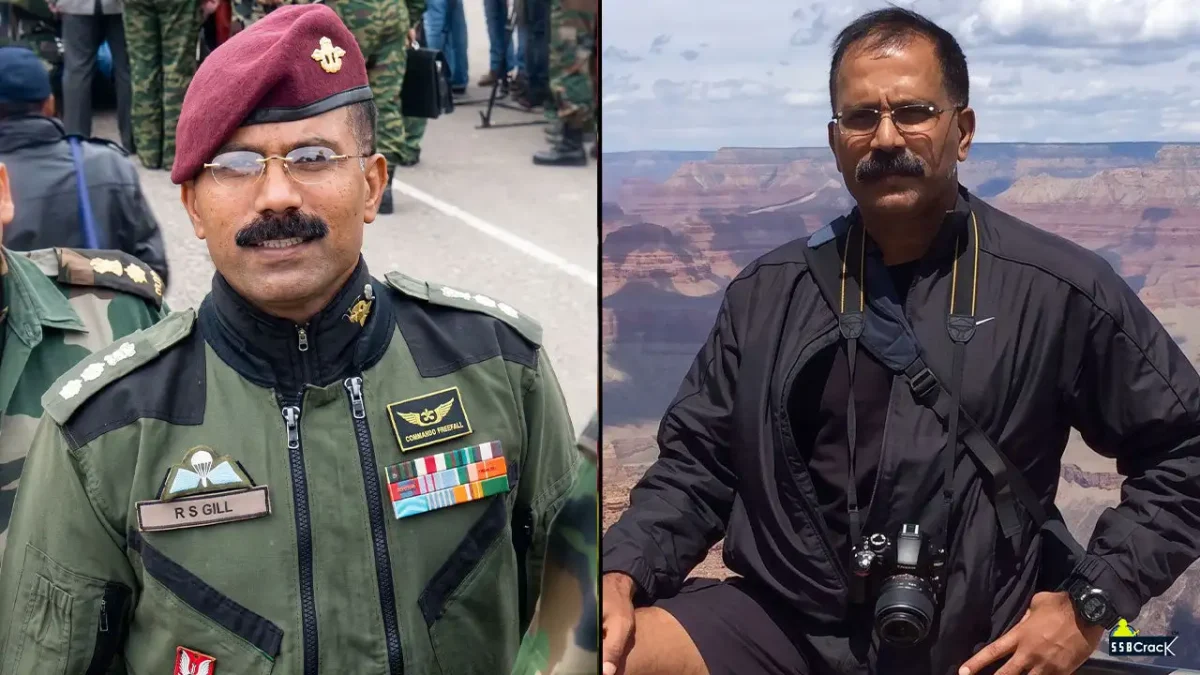
Gallantry citations are usually written in flat, official language, yet a few of them read like scenes from a war film. The Shaurya Chakra citation of Captain Ramvinder Singh Gill of 9th Battalion, the Special Forces Regiment, is one of them. On a rainy night in June 1995, high in the Shamshabari range of Jammu and Kashmir, he shot a militant sentry, charged a hideout under heavy fire, killed a militant in a trench and then fought the last surviving militant with his bare hands, strangling him.
The young Captain went on to become a Colonel and, after retiring, the man in charge of security for one of India’s best-known business families. This article looks at what the official record and reputable reports tell us about Colonel Ramvinder Singh Gill, Shaurya Chakra, and what defence aspirants can learn from his journey.
Colonel Ramvinder Singh Gill at a Glance
| Detail | Information |
|---|---|
| Name | Colonel Ramvinder Singh Gill, SC (Retd) |
| Personal number | IC-48069 |
| Unit at the time of the action | 9th Battalion, the Special Forces Regiment (today’s 9 Para SF) |
| Gallantry award | Shaurya Chakra |
| Date of the act | 24 June 1995 |
| Place | Jakar Nake jungles, Shamshabari range, Jammu and Kashmir |
| Award notified | Presidential notification of 15 August 1996, published in the Gazette of India on 30 November 1996 |
| After the Army | President, Reliance Global Corporate Security, and security in-charge of the Ambani residence Antilia (as reported in 2021-2023) |
| Endurance feat | Finished Ironman Switzerland 2017 in 15:06:02 |
Early Career and the Road to Special Forces
Little has been published about Colonel Gill’s childhood, schooling or the exact year and route of his commissioning, so this article does not guess at them. What is on record is his personal number, IC-48069, and the fact that by the mid-1990s he was a Captain with the 9th Battalion of what the official gazette called the Special Forces Regiment. This is the unit known today as 9 Para (Special Forces), one of the oldest Special Forces battalions of the Indian Army and long associated with operations in the mountains of Jammu and Kashmir.
Published accounts state that he had earlier served with the Indian Peace Keeping Force (IPKF) in Sri Lanka, which operated there between 1987 and 1990, gaining early exposure to counter-insurgency and jungle operations. Reports on his later civilian career describe him as a veteran of more than two decades with the Army’s para special forces, trained in counter-insurgency. Like every Para SF officer, he would have volunteered for the Special Forces and passed its notoriously tough probation before earning the maroon beret.
The Night of 24 June 1995
By 1995, militants were regularly infiltrating from Pakistan-occupied Kashmir into the forests of north Kashmir, using hideouts in thick jungle and steep nalas. On 24 June 1995, Bravo Team of the 9th Battalion was sent out to capture militants who were using hideouts in the Jakar Nake jungles.
According to the official citation, Captain Gill moved with his team along the rugged, high-altitude Shamshabari mountain at night, in heavy rain. After sustained surveillance, the team located the militants in a thickly wooded nala. Captain Gill volunteered to clear the hideouts and moved ahead to search the nala.
Contact at the hideout
Spotting a sentry at the hideout, Captain Gill moved forward and shot him. The sound of firing alerted the remaining militants, who brought intense fire on the troops. He ordered his men to return fire, lobbed a grenade and charged ahead, as the citation puts it, “oblivious of his personal safety”. He killed a militant manning a trench with a burst of rifle fire.
The bare-handed fight
Then came the moment that made the action famous. In the words of the citation, “undaunted by the hail of bullets”, Captain Gill grappled with the last living militant, strangling him with his bare hands. Published accounts add that he had run out of ammunition at this point; the citation itself does not mention the reason he closed in, so that detail should be read as a later retelling.
The citation sums up his conduct as showing “gallantry, indomitable courage, leadership of outstanding merit and deep concern for his comrades”. The last phrase matters. Special Forces operations are judged not only by the enemy neutralised but by whether the team comes home, and the citation makes clear that his first instinct was to take the danger on himself.
The Shaurya Chakra
The President approved the award of the Shaurya Chakra to Captain Ramvinder Singh Gill in a notification dated 15 August 1996, which was published in the Gazette of India on 30 November 1996. The effective date of the award is 24 June 1995, the day of the action. The Shaurya Chakra is India’s third-highest peacetime gallantry award, after the Ashoka Chakra and the Kirti Chakra, and is given for gallantry otherwise than in the face of the enemy.
Rising to Colonel
Captain Gill continued to serve for many more years and retired as a Colonel. Published profiles state that he later commanded 9 Para (SF), the battalion in which he had won his gallantry award as a young officer. Official records of this appointment are not publicly available, but if accurate it would complete a rare circle: the officer who led a team into the Shamshabari jungles returning to lead the entire unit.
Life After Uniform: Guarding Antilia
After leaving the Army, Colonel Gill moved into corporate security. A PTI report from June 2023 described retired Colonel Ramvinder Singh Gill as the president of Reliance Global Corporate Security and the security in-charge of Antilia, the Mumbai residence of Mukesh Ambani. Bloomberg Businessweek, in a February 2023 feature, described him as an ex-colonel of the Indian special forces who oversaw a security force of about 300 people protecting the industrialist and his family.
That role put him at the centre of a major national story. In February 2021, an SUV carrying gelatin sticks and a threatening note was found parked near Antilia. Bloomberg reported that Gill was the one who noticed the strange car near the residence, and the National Investigation Agency later cited his statement as a witness in the case. In that statement, as reported, he said that a scheduled movement of Nita Ambani from Antilia to the airport was delayed and later cancelled after he informed Mukesh Ambani about the explosives. Noticing the one detail that does not fit is a habit Special Forces training builds, and here it set off the investigation.
An Ironman in His Fifties
Colonel Gill’s fitness did not end with his uniform. Published race results for Ironman Switzerland 2017 list Ramvinder Gill of India in the men’s 50-54 age group, finishing the full-distance event of a 3.8 km swim, 180 km cycle ride and a marathon in 15 hours, 6 minutes and 2 seconds. His splits were 1:42:20 for the swim, 7:52:09 on the bike and 5:10:01 for the run. Completing an Ironman at that age is a reminder that the endurance built in the Special Forces is a lifelong habit, not a phase.
Lessons for Defence Aspirants
- Volunteer for the hard task. The citation records that Captain Gill volunteered to clear the hideout. The SSB looks for candidates who step forward when the job is difficult, not those who wait to be told.
- Patience comes before action. The decisive moment came only after a night approach in heavy rain and sustained surveillance. Good planning and patience make bold action possible.
- Keep going when the plan breaks. Close combat rarely goes to plan. Composure and the will to finish the task are qualities that cannot be faked.
- Look after your team. “Deep concern for his comrades” appears in the citation for a reason. Leadership in the Army begins with the welfare of the people you lead.
- Fitness is for life. Finishing an Ironman more than two decades after his gallantry action shows that physical discipline built early can last a lifetime.
Frequently Asked Questions
Who is Colonel Ramvinder Singh Gill?
He is a retired Indian Army Special Forces officer who, as a Captain with 9th Battalion, the Special Forces Regiment (now 9 Para SF), was awarded the Shaurya Chakra for an action in Jammu and Kashmir on 24 June 1995.
Why was he awarded the Shaurya Chakra?
During an operation against infiltrating militants in the Jakar Nake jungles of the Shamshabari range, he shot a sentry, charged the hideout under intense fire, killed a militant in a trench and strangled the last surviving militant with his bare hands.
When was his award notified?
The award was approved by the President in a notification dated 15 August 1996 and published in the Gazette of India on 30 November 1996, with effect from 24 June 1995.
What did he do after retiring from the Army?
He headed security for the Reliance group as president of Reliance Global Corporate Security and was the security in-charge of the Ambani residence Antilia, according to PTI and Bloomberg reports.
How can I join the Para Special Forces?
Officers first join the Army through entries such as the NDA, CDS, OTA or technical schemes, clearing the SSB interview on the way. Officers and soldiers can then volunteer for the Para SF and must complete its demanding probation to be accepted.
Conclusion
Colonel Ramvinder Singh Gill’s story is anchored in one remarkable night in June 1995, but it does not end there. The Captain who fought a militant with his bare hands rose to Colonel, went on to protect one of India’s most closely guarded families, spotted the car that triggered a high-profile terror investigation, and finished an Ironman in his fifties. For aspirants preparing for the SSB, his record carries a simple message: courage, patience and care for your team are the real foundations of leadership, in uniform and beyond it.