Do you find it difficult to express your thoughts clearly? Do you hesitate while speaking in front of others? Do you struggle to find the right words during a conversation? Or do you sometimes know the answer but fail to communicate it confidently?
If you experience any of these difficulties, then today’s article is especially important for you.
Communication is an important skill for every defence aspirant. An officer needs to interact with seniors, guide juniors, coordinate with team members, give instructions and communicate effectively in different situations.
However, struggling with communication does not automatically mean that you cannot become a good officer. Communication is a skill that can be developed through regular practice, confidence and the willingness to improve.
During the SSB Interview, the Interviewing Officer may ask questions to understand how you express yourself, interact with others, handle conversations and overcome communication difficulties.
In today’s article, we will discuss 20 important SSB Interview questions for candidates who struggle with communication, along with why each question is asked, how you should answer it and a sample answer.
Let’s begin!
1. Do you think you have good communication skills?
Why is this question asked?
The officer wants to assess your self-awareness and understand how you evaluate your ability to communicate with others.
How should you answer?
Be honest about your strengths and weaknesses. If you struggle with communication, acknowledge it and mention the areas you are working to improve.
Sample Answer
“Sir/Ma’am, I would say that my communication skills are still developing. I can communicate comfortably in familiar situations, but sometimes I hesitate when speaking in front of unfamiliar people or a large group. I am working on improving my confidence and expressing my thoughts more clearly.”
2. Why do you think you struggle with communication?
Why is this question asked?
The officer wants to understand whether you have identified the reasons behind your communication difficulties.
How should you answer?
Mention genuine reasons such as hesitation, lack of practice, nervousness, difficulty organising thoughts or limited exposure to certain speaking situations.
Sample Answer
“Sir/Ma’am, I think one of the main reasons is that I sometimes take too much time to organise my thoughts before speaking. I also become slightly conscious of making mistakes while speaking. However, I am trying to overcome this by participating in conversations and practising speaking regularly.”
3. Do you hesitate while speaking to strangers?
Why is this question asked?
The officer wants to understand how comfortably you interact with unfamiliar people and adapt to new social situations.
How should you answer?
Acknowledge your hesitation if it exists, but explain how you initiate or maintain conversations.
Sample Answer
“Yes, Sir/Ma’am, I sometimes hesitate when approaching strangers, especially in unfamiliar situations. However, once the conversation begins, I gradually become comfortable. I am trying to improve by initiating small conversations and interacting with people from different backgrounds.”
4. Do you find it difficult to express your thoughts in front of a group?
Why is this question asked?
The officer wants to assess your confidence in group communication, participation and ability to express your opinions.
How should you answer?
Explain whether you hesitate, struggle to organise your thoughts or feel nervous. Mention how you are improving your participation.
Sample Answer
“Sir/Ma’am, I sometimes find it difficult to express my thoughts in front of a large group because I become conscious of how others might respond. However, I am trying to participate more actively in group discussions. I also prepare a few key points before speaking so that I can communicate my ideas more clearly.”
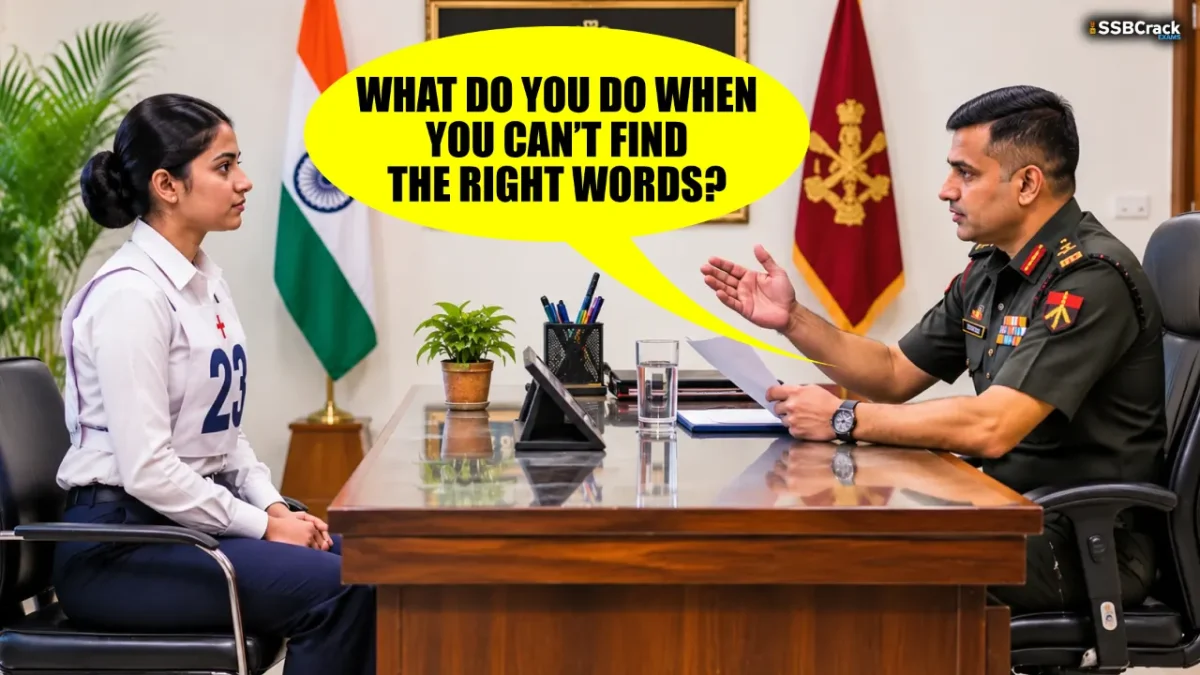
5. What do you do when you cannot find the right words while speaking?
Why is this question asked?
The officer wants to understand how you handle communication difficulties and whether you can continue expressing yourself when you face a temporary problem.
How should you answer?
Show that you remain calm, use simple words and focus on conveying your message instead of becoming unnecessarily nervous.
Sample Answer
“Sir/Ma’am, if I cannot find the exact word, I try to explain the same idea using simpler words. I don’t want to interrupt the flow of communication just because I cannot remember a particular expression. I am also working on improving my vocabulary through reading and regular speaking practice.”
6. Are you comfortable speaking in English?
Why is this question asked?
The officer wants to understand your comfort level with English communication, particularly if you are responding in English during the interview.
How should you answer?
Be honest about your proficiency. Do not exaggerate your fluency or apologise unnecessarily for making grammatical mistakes. Explain your efforts to improve.
Sample Answer
“Sir/Ma’am, I can communicate in English, but I am not completely fluent yet. Sometimes I take a little time to frame my sentences. I am improving through regular reading, listening and speaking practice. I believe that communicating clearly is more important than using complicated vocabulary.”
7. Do you feel nervous when someone asks you an unexpected question?
Why is this question asked?
The officer wants to assess how you respond to unfamiliar questions and whether nervousness affects your ability to communicate.
How should you answer?
Explain that you may need a few moments to organise your thoughts, but you try to answer honestly and logically.
Sample Answer
“Sir/Ma’am, sometimes I become slightly nervous when I am asked a completely unexpected question. However, I try to listen carefully, understand what is being asked and organise my thoughts before answering. If I don’t know the answer, I prefer to admit it rather than give incorrect information.”
8. Do you prefer communicating through messages rather than face-to-face conversations?
Why is this question asked?
The officer wants to understand your preferred communication style and whether you avoid direct interaction.
How should you answer?
Explain your actual preference without suggesting that using digital communication is a weakness. Show that you can communicate face-to-face when required.
Sample Answer
“Sir/Ma’am, I sometimes find it easier to organise my thoughts through messages because I get time to frame my response. However, I understand the importance of face-to-face communication. I am making an effort to interact more directly with people instead of depending only on digital conversations.”
9. Have you ever remained silent even when you had an opinion to share?
Why is this question asked?
The officer wants to understand whether hesitation or lack of confidence prevents you from expressing your views.
How should you answer?
If this has happened, acknowledge it and explain what you learned from the experience.
Sample Answer
“Yes, Sir/Ma’am. There have been situations where I had an opinion but did not express it because I was unsure how others would react. Later, I realised that my participation could have contributed to the discussion. Now I try to express my views respectfully, even when they are different from those of others.”
10. How do you react when someone interrupts you while speaking?
Why is this question asked?
The officer wants to assess your patience, confidence and ability to manage conversations without becoming aggressive or losing your composure.
How should you answer?
Show that you can listen to others while also expressing your point when appropriate.
Sample Answer
“Sir/Ma’am, I usually allow the other person to complete their point. If I still need to explain something, I politely request an opportunity to finish what I was saying. I believe a conversation should provide space for everyone to express their views.”
11. Do you find it difficult to initiate conversations?
Why is this question asked?
The officer wants to understand whether you take initiative in social interactions or depend on others to start conversations.
How should you answer?
Acknowledge any hesitation and explain how you make an effort to interact with people.
Sample Answer
“Sir/Ma’am, I sometimes hesitate to initiate conversations, particularly with people I have just met. However, I am trying to overcome this by starting conversations about common interests, studies or everyday situations. I have realised that communication becomes easier when I take the first step.”
12. What would you do if your team members did not understand your instructions?
Why is this question asked?
The officer wants to assess your ability to communicate clearly, check understanding and coordinate with a team.
How should you answer?
Explain that you would repeat or simplify the instructions, use examples where necessary and confirm that everyone understands their responsibilities.
Sample Answer
“Sir/Ma’am, I would explain the instructions again using simpler and clearer language. I would also divide the task into smaller steps if necessary and ask the team members whether they have understood their responsibilities. My priority would be to ensure that everyone knows what needs to be done.”
13. Have you ever been misunderstood because you could not express yourself properly?
Why is this question asked?
The officer wants to understand whether communication difficulties have affected your relationships or interactions and whether you learn from such experiences.
How should you answer?
Share a genuine example if possible. Explain how you clarified the misunderstanding and what you learned.
Sample Answer
“Yes, Sir/Ma’am. Once, I could not explain my point properly during a discussion with a friend, and my words were misunderstood. Later, I clarified what I actually meant. That incident taught me that having an idea is not enough; I also need to communicate it clearly.”
14. How would you communicate with a person who does not understand your language?
Why is this question asked?
The officer wants to assess your adaptability, patience and ability to communicate with people from different linguistic and cultural backgrounds.
How should you answer?
Show that you would use simple language, gestures, visual explanations or translation support where appropriate.
Sample Answer
“Sir/Ma’am, I would first try to identify which language the person understands. If we do not share a common language, I would use simple gestures, visual references or translation support if available. I would remain patient and make sure that the important information is understood.”
15. What would you do if you were asked to address a large group without preparation?
Why is this question asked?
The officer wants to assess your ability to communicate spontaneously and handle situations where prior preparation is not possible.
How should you answer?
Explain how you would organise your thoughts quickly, identify the main message and speak in a simple and structured manner.
Sample Answer
“Sir/Ma’am, I might feel slightly nervous initially, but I would try to remain calm. I would identify the main points I need to communicate and arrange them in a logical order. I would use simple language and focus on conveying the message rather than worrying about making every sentence perfect.”
16. How do you respond when someone gives you negative feedback about your communication skills?
Why is this question asked?
The officer wants to assess your ability to accept criticism, identify areas for improvement and work on your weaknesses.
How should you answer?
Show that you are willing to listen to feedback without becoming defensive. Explain how you would use it to improve.
Sample Answer
“Sir/Ma’am, I would try to understand the specific areas where I need improvement. If someone tells me that I speak too softly or fail to explain my ideas clearly, I would take that feedback seriously. I would practise those areas and ask for feedback again to understand whether I have improved.”
17. Do you think poor communication can affect teamwork?
Why is this question asked?
The officer wants to understand whether you recognise the importance of communication in coordination, cooperation and achieving common objectives.
How should you answer?
Explain how unclear instructions, misunderstandings or failure to share information can affect team performance.
Sample Answer
“Yes, Sir/Ma’am. Poor communication can create misunderstandings, confusion and unnecessary delays within a team. Even if every member is capable, the team may struggle if information is not shared properly. I believe clear instructions, active listening and regular coordination are essential for effective teamwork.”
18. How would you communicate an important message during an emergency?
Why is this question asked?
The officer wants to assess your ability to communicate essential information clearly and calmly during stressful situations.
How should you answer?
Emphasise clarity, accuracy, prioritisation and confirmation that the message has been understood.
Sample Answer
“Sir/Ma’am, I would first identify the most important information that needs to be communicated. I would use short and clear sentences, avoid unnecessary details and ensure that the instructions are understood. I would also communicate any important changes immediately so that confusion can be avoided.”
19. What steps are you taking to improve your communication skills?
Why is this question asked?
The officer wants to assess your initiative, self-improvement and willingness to work on a personal weakness.
How should you answer?
Mention specific activities you are actually practising instead of giving general statements such as ‘I am trying to improve’.
Sample Answer
“Sir/Ma’am, I am practising speaking in English regularly and trying to participate more actively in group discussions. I also read newspapers and articles to improve my vocabulary and general awareness. Sometimes, I record myself speaking so that I can identify problems with my clarity, speed and confidence.”
20. Why should the Armed Forces select a candidate who struggles with communication?
Why is this question asked?
The officer wants to assess your confidence, self-awareness and understanding of the communication responsibilities associated with military leadership.
How should you answer?
Do not deny your weakness or claim that communication is unimportant. Acknowledge its importance and explain how you are actively working to improve.
Sample Answer
“Sir/Ma’am, I understand that communication is an essential skill for an officer because it is important for giving instructions, coordinating with team members and handling responsibilities. I currently have some areas that need improvement, particularly my confidence while speaking in unfamiliar situations. However, I am actively working on them through regular practice and interaction. I am willing to learn, accept feedback and improve my communication skills to meet the responsibilities expected of an officer.”
Important Tips for Candidates Who Struggle With Communication
- Read aloud every day. Spend at least 10–15 minutes reading newspapers, articles or books aloud to improve clarity and speaking confidence.
- Practise speaking regularly. Don’t wait for an important interview or group discussion to start practising.
- Think in the language you want to speak. Gradually reduce the habit of translating every sentence from your mother tongue before speaking.
- Use simple and clear sentences. You do not need complicated vocabulary to communicate effectively.
- Record your own voice. Listen to your recordings and identify problems with pronunciation, speed, clarity and sentence formation.
- Participate in group discussions. Start with familiar topics and gradually challenge yourself with unfamiliar subjects.
- Practise impromptu speaking. Choose a random topic and speak about it for one or two minutes without preparing a complete script.
- Improve your listening skills. Good communication is not only about speaking; it also involves understanding what others are saying.
- Avoid unnecessary hesitation. Do not worry excessively about making small grammatical mistakes while communicating.
- Develop your vocabulary gradually. Learn a few useful words every day and practise using them in sentences.
- Maintain appropriate eye contact. It helps you communicate attentiveness and confidence during conversations.
- Speak at a comfortable pace. Speaking too quickly can make your message difficult to understand.
- Don’t imitate someone else’s speaking style. Develop a natural communication style that suits your personality.
- Ask questions when necessary. If you don’t understand something, politely ask the other person to clarify it.
- Interact with different people. Conversations with people from different backgrounds can improve your adaptability and confidence.
- Avoid memorising complete answers. Practise organising your thoughts so that you can respond naturally to unexpected questions.
- Work on non-verbal communication. Your posture, facial expressions and gestures also contribute to effective communication.
- Accept your mistakes. A grammatical error or momentary hesitation does not mean that the entire conversation has failed.
- Build confidence through small achievements. Start by speaking in front of a friend or family member and gradually increase the size of your audience.
- Focus on communication, not perfection. Your objective should be to convey your thoughts clearly, confidently and appropriately.
Closing Lines
So, these were 20 important SSB Interview questions for candidates who struggle with communication, along with the reasons behind each question, answering strategies and sample answers.
Before we end, remember something very important:
A good communicator is not necessarily someone who speaks continuously or uses impressive vocabulary. A good communicator is someone who can express ideas clearly, listen carefully and ensure that the message is understood.
If you struggle with communication, don’t assume that you are unsuitable for the Armed Forces. Instead, identify the areas where you need improvement and work on them consistently.
You don’t have to become an excellent public speaker overnight. Start with small conversations, participate in discussions, practise expressing your opinions and gradually develop confidence.
And remember, during the SSB Interview, don’t pretend to be a fluent speaker if you are not. Be natural, be honest and demonstrate your willingness to improve.
Don’t memorise the sample answers from this video. Use them as guidance and frame your responses according to your actual experiences and personality.
Keep practising, keep improving and believe in yourself.
Your communication skills can improve with practice. Your first step is simply to start speaking.
All the best for your SSB journey!