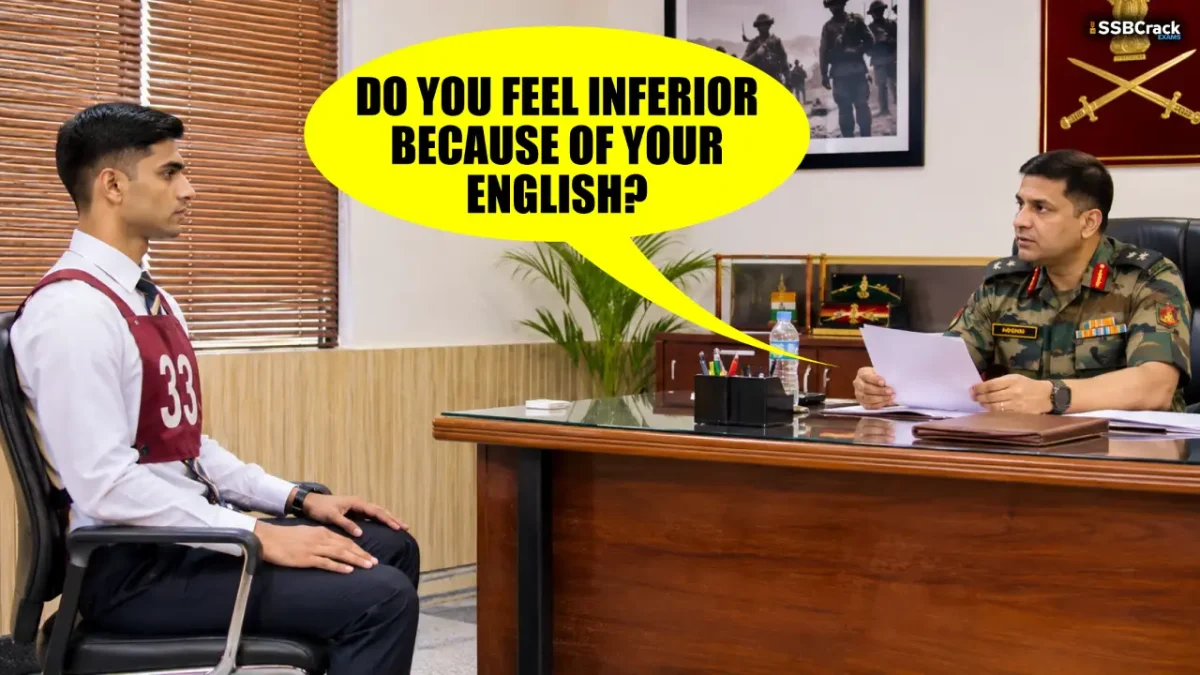
Are you worried about your English-speaking skills before appearing for the SSB Interview? Do you understand English but struggle to speak fluently? Do you make grammatical mistakes while speaking? Or do you sometimes know the answer but hesitate because you are afraid of speaking incorrect English?
If you face any of these problems, then today’s article is especially important for you.
Many defence aspirants believe that having weak English can become a major obstacle during the SSB Interview. However, you must understand that being fluent in English and being a capable officer are two different things.
Communication is certainly important in the Armed Forces. An officer must be able to understand instructions, communicate with team members, give directions and express ideas clearly. However, you do not need to use complicated vocabulary or speak with an artificial accent to demonstrate effective communication.
What matters is your ability to communicate your thoughts clearly, your willingness to improve and your confidence in handling different situations.
In today’s article, we will discuss 20 important SSB Interview questions for candidates with weak English, along with why each question is asked, how you should answer it and a sample answer.
Let’s get started!
1. Are you comfortable speaking in English?
Why is this question asked?
The officer wants to understand your present level of English proficiency and how confidently you communicate in the language.
How should you answer?
Be honest about your comfort level. If you struggle with fluency, acknowledge it and explain whether you are making efforts to improve.
Sample Answer
“Sir/Ma’am, I can understand English quite well, but sometimes I hesitate while speaking. I may take a little time to frame my sentences. However, I am practising regularly to improve my fluency and confidence.”
2. Why is your English not very fluent?
Why is this question asked?
The officer wants to understand the reasons behind your limited fluency and whether you have taken responsibility for improving your language skills.
How should you answer?
Mention genuine reasons such as limited opportunities to speak English, studying in a regional-language medium or lack of regular practice. Avoid making excuses.
Sample Answer
“Sir/Ma’am, I have not had many opportunities to communicate in English in my everyday environment. Most of my conversations have been in my mother tongue. Because of this, my speaking fluency has developed slowly. However, I am now making a conscious effort to practise English every day.”
3. Do you think weak English can affect your performance in the SSB Interview?
Why is this question asked?
The officer wants to assess your understanding of communication requirements and whether you allow your language limitations to affect your confidence.
How should you answer?
Acknowledge that language can influence communication, but explain that clarity, understanding and confidence also matter.
Sample Answer
“Sir/Ma’am, I think limited English fluency can sometimes make communication challenging, especially in unfamiliar situations. However, I believe clear expression and proper understanding are equally important. I am working on improving my English so that I can communicate more effectively during the SSB process.”
4. Do you make grammatical mistakes while speaking English?
Why is this question asked?
The officer wants to understand your awareness of your language limitations and whether you are comfortable acknowledging your mistakes.
How should you answer?
Don’t deny making mistakes if you do. Explain how you are trying to improve your grammar through practice.
Sample Answer
“Yes, Sir/Ma’am, I sometimes make grammatical mistakes, particularly when I speak quickly. I am working on improving my sentence formation by reading English newspapers, revising basic grammar rules and practising everyday conversations.”
5. What do you do when you cannot find the right English word while speaking?
Why is this question asked?
The officer wants to assess how you handle communication difficulties and whether you can continue expressing your thoughts without becoming nervous.
How should you answer?
Show that you use simple words or reframe your sentence instead of stopping the conversation unnecessarily.
Sample Answer
“Sir/Ma’am, if I cannot remember a particular word, I try to explain the same idea using simpler words. I believe communicating the message is more important than using difficult vocabulary. I also make a note of unfamiliar words so that I can learn them later.”
6. Why did you study in a regional-language medium if you wanted to join the Armed Forces?
Why is this question asked?
The officer may want to understand your educational background, exposure to English and the efforts you have made to prepare yourself for your career goals.
How should you answer?
Explain your educational circumstances without treating your medium of instruction as a disadvantage or making excuses.
Sample Answer
“Sir/Ma’am, I studied in a regional-language medium because that was the educational environment available to me. It helped me develop a strong understanding of my subjects. However, I understand the importance of English communication, particularly in professional life, and I am making efforts to improve my proficiency.”
7. Do you feel embarrassed when someone corrects your English?
Why is this question asked?
The officer wants to assess your attitude towards criticism and whether you are willing to learn from your mistakes.
How should you answer?
Show that you welcome genuine corrections and do not take them personally.
Sample Answer
“Sir/Ma’am, earlier I sometimes felt uncomfortable when someone corrected my English. However, I have realised that corrections help me identify my mistakes. Now I try to understand the correct usage and apply it in future conversations.”
8. Do you prefer speaking in your mother tongue rather than English?
Why is this question asked?
The officer wants to understand your language preference and whether you can adapt to situations where English communication is required.
How should you answer?
Be honest about your preference while demonstrating that you are willing to communicate in different languages according to the situation.
Sample Answer
“Sir/Ma’am, I am more comfortable speaking in my mother tongue because I have used it since childhood. However, I can communicate in English as well, although I am still improving my fluency. I believe knowing multiple languages is useful, and I am working on becoming more comfortable with English.”
9. What would you do if you did not understand a question asked in English?
Why is this question asked?
The officer wants to assess whether you can handle communication difficulties sensibly instead of pretending to understand something.
How should you answer?
Explain that you would politely request clarification or repetition.
Sample Answer
“Sir/Ma’am, if I do not understand a question properly, I would politely request you to repeat or rephrase it. I would rather clarify the question than give an irrelevant answer because of a misunderstanding.”
10. Have you ever avoided participating in an activity because you were afraid of speaking English?
Why is this question asked?
The officer wants to understand whether your language limitations affect your confidence, initiative and willingness to participate.
How should you answer?
If you have avoided such opportunities, acknowledge it and explain how you are trying to overcome the hesitation.
Sample Answer
“Yes, Sir/Ma’am. There have been occasions when I hesitated to participate in discussions because I was worried about making grammatical mistakes. However, I realised that avoiding such opportunities would not improve my English. Now I try to participate even if my sentences are not perfect.”
11. How do you prepare yourself for an English-speaking environment?
Why is this question asked?
The officer wants to assess your initiative and whether you take practical steps to improve your communication skills.
How should you answer?
Mention specific habits you follow, such as reading, listening, speaking practice and interaction with others.
Sample Answer
“Sir/Ma’am, I read English newspapers and articles regularly. I also listen to English news and practise speaking for a few minutes every day. Whenever possible, I try to communicate with my friends in English. These activities are gradually improving my confidence.”
12. What would you do if your team members communicated only in English and you found it difficult to understand them?
Why is this question asked?
The officer wants to assess your adaptability, teamwork and ability to handle communication challenges in a professional environment.
How should you answer?
Explain that you would listen carefully, ask for clarification when necessary and learn the terminology relevant to the task.
Sample Answer
“Sir/Ma’am, I would listen carefully and try to understand the instructions. If I could not understand something important, I would politely ask the concerned person to explain it again. I would also learn the commonly used terms related to the task so that I could coordinate better with my team.”
13. Do you think speaking fluent English makes someone a better officer?
Why is this question asked?
The officer wants to understand whether you can distinguish language proficiency from leadership ability, professional competence and overall personality.
How should you answer?
Acknowledge the importance of English without treating fluency as the only measure of an officer’s ability.
Sample Answer
“Sir/Ma’am, fluent English can certainly help an officer communicate effectively in many professional situations. However, I don’t think fluency alone makes someone a better officer. Leadership, decision-making, discipline, responsibility and the ability to work with people are also important. At the same time, an officer should continuously improve communication skills.”
14. How would you give instructions to your team if you were not confident about your English?
Why is this question asked?
The officer wants to assess your ability to communicate responsibilities clearly, particularly when you are required to guide or coordinate with others.
How should you answer?
Focus on clarity and understanding. Explain that you would use simple and direct language rather than complicated expressions.
Sample Answer
“Sir/Ma’am, I would use simple and clear sentences to explain what needs to be done. I would divide the instructions into smaller steps if necessary and confirm whether everyone has understood their responsibilities. My priority would be to communicate the instructions correctly.”
15. What would you do if someone laughed at your English-speaking mistakes?
Why is this question asked?
The officer wants to understand how you handle embarrassment, criticism and uncomfortable social situations.
How should you answer?
Demonstrate emotional maturity. Explain that you would not allow someone’s reaction to discourage you from learning.
Sample Answer
“Sir/Ma’am, I might feel uncomfortable initially, but I would not allow it to discourage me. Everyone makes mistakes while learning something new. I would try to identify my mistake, correct it and continue practising. I believe confidence develops when we are willing to learn despite making mistakes.”
16. Can you express your opinions confidently even if your English is not perfect?
Why is this question asked?
The officer wants to assess your confidence, willingness to participate and ability to communicate ideas despite language limitations.
How should you answer?
Explain that you try to focus on the message rather than worrying excessively about grammatical perfection.
Sample Answer
“Yes, Sir/Ma’am, I try to express my opinions even if my English is not perfect. Sometimes I take a little more time to frame my sentences, but I believe it is important to communicate my thoughts. I am gradually becoming more confident through regular practice.”
17. How would you handle an emergency situation if you were unable to communicate effectively in English?
Why is this question asked?
The officer wants to assess your ability to prioritise clear communication and take appropriate action during an urgent situation.
How should you answer?
Explain that you would use clear and simple language, communicate essential information and use other appropriate means of communication if required.
Sample Answer
“Sir/Ma’am, during an emergency, my first priority would be to communicate the essential information clearly and quickly. I would use simple words and short instructions. If language became a barrier, I would use appropriate gestures or seek assistance from someone who could help communicate the message. I would ensure that important instructions are understood.”
18. What is more important: fluency or clarity in communication?
Why is this question asked?
The officer wants to assess your understanding of effective communication and whether you focus on conveying information accurately.
How should you answer?
Explain that fluency is useful, but clarity and correct understanding are essential.
Sample Answer
“Sir/Ma’am, I believe clarity is more important because the purpose of communication is to make the message understood. Fluency helps a person communicate smoothly, but even a fluent speaker may fail to communicate effectively if the message is unclear. Ideally, both should be developed together.”
19. What steps are you taking to improve your English?
Why is this question asked?
The officer wants to assess your self-improvement efforts, consistency and willingness to overcome your weaknesses.
How should you answer?
Mention specific activities that you genuinely follow. Avoid making unrealistic claims about your progress.
Sample Answer
“Sir/Ma’am, I am following a regular practice routine. I read English newspapers, learn new words, revise basic grammar and listen to English news. I also practise speaking for a few minutes every day and try to use English in everyday conversations. I know improvement takes time, so I am focusing on consistency.”
20. Why should the Armed Forces select a candidate whose English is weak?
Why is this question asked?
The officer wants to assess your confidence, self-awareness and understanding of the communication responsibilities of an officer.
How should you answer?
Do not argue that English is unimportant. Acknowledge that communication is essential and explain your willingness to improve.
Sample Answer
“Sir/Ma’am, I understand that effective communication is important in the Armed Forces, and English is useful in many professional situations. Although my English fluency is not yet at the level I want it to be, I am making consistent efforts to improve. I can understand instructions, express my thoughts and work with others, and I am willing to learn and develop the communication skills required for the responsibilities of an officer.”
Important Tips for Candidates With Weak English
- Don’t panic about your English. Nervousness can make it even more difficult to express yourself. Focus on communicating your thoughts.
- Read English newspapers daily. Start with simple news reports and gradually move towards editorials and longer articles.
- Practise speaking every day. Even 10–15 minutes of regular speaking practice can help you become more comfortable.
- Learn useful everyday vocabulary. Focus on words that you can actually use in conversations rather than memorising complicated words.
- Revise basic grammar. Pay attention to tenses, subject-verb agreement, articles, prepositions and sentence formation.
- Listen to English conversations. Watch interviews, news discussions and educational videos to understand pronunciation and sentence patterns.
- Speak in simple English. Short, grammatically sound sentences are better than complicated sentences that you cannot complete confidently.
- Practise thinking in English. Describe your daily activities, surroundings and plans to yourself in English.
- Record your speaking practice. Listen to your recordings and identify areas where you need improvement.
- Don’t be afraid of making mistakes. Every mistake gives you an opportunity to learn.
- Participate in group discussions. Practise expressing your opinions on current affairs and everyday topics.
- Improve your pronunciation gradually. Focus on speaking clearly rather than imitating a particular accent.
- Develop listening skills. Understand the question properly before attempting to answer it.
- Don’t translate every sentence word by word. Try to frame simple sentences directly in English.
- Practise answering common SSB questions. Prepare ideas and experiences, not memorised paragraphs.
- Interact with people who speak English. Regular conversations can help reduce hesitation.
- Use a dictionary effectively. Learn the meaning, pronunciation and usage of new words.
- Don’t compare your English with others. Your progress should be measured against your own previous performance.
- Be honest about your proficiency. Never pretend to have excellent English if you are still learning.
- Focus on effective communication. Your ultimate objective should be to express your thoughts clearly, understand others and respond appropriately.
Closing Lines
So, these were 20 important SSB Interview questions for candidates with weak English, along with why each question is asked, how to answer it and sample answers.
Before we end, I want every defence aspirant watching this video to remember something very important:
Weak English does not mean weak personality, and fluent English does not automatically mean strong leadership ability.
Yes, English communication is important, and you should continuously work towards improving it. But don’t allow your fear of grammatical mistakes, pronunciation or vocabulary to destroy your confidence.
You don’t need to speak like a native English speaker. You need to develop the ability to understand instructions, express your thoughts clearly, communicate with your team and respond appropriately in different situations.
So, start practising today. Read a little, listen a little and speak a little every day. Don’t wait until your English becomes perfect before you start communicating.
And remember, during the SSB Interview, be natural and honest. Don’t memorise the sample answers from this video. Use them as guidance and frame your responses according to your actual experiences and language proficiency.
Keep practising, stay confident and never stop learning.
Your English can improve with practice, but your confidence must begin with you.
All the best for your SSB journey!