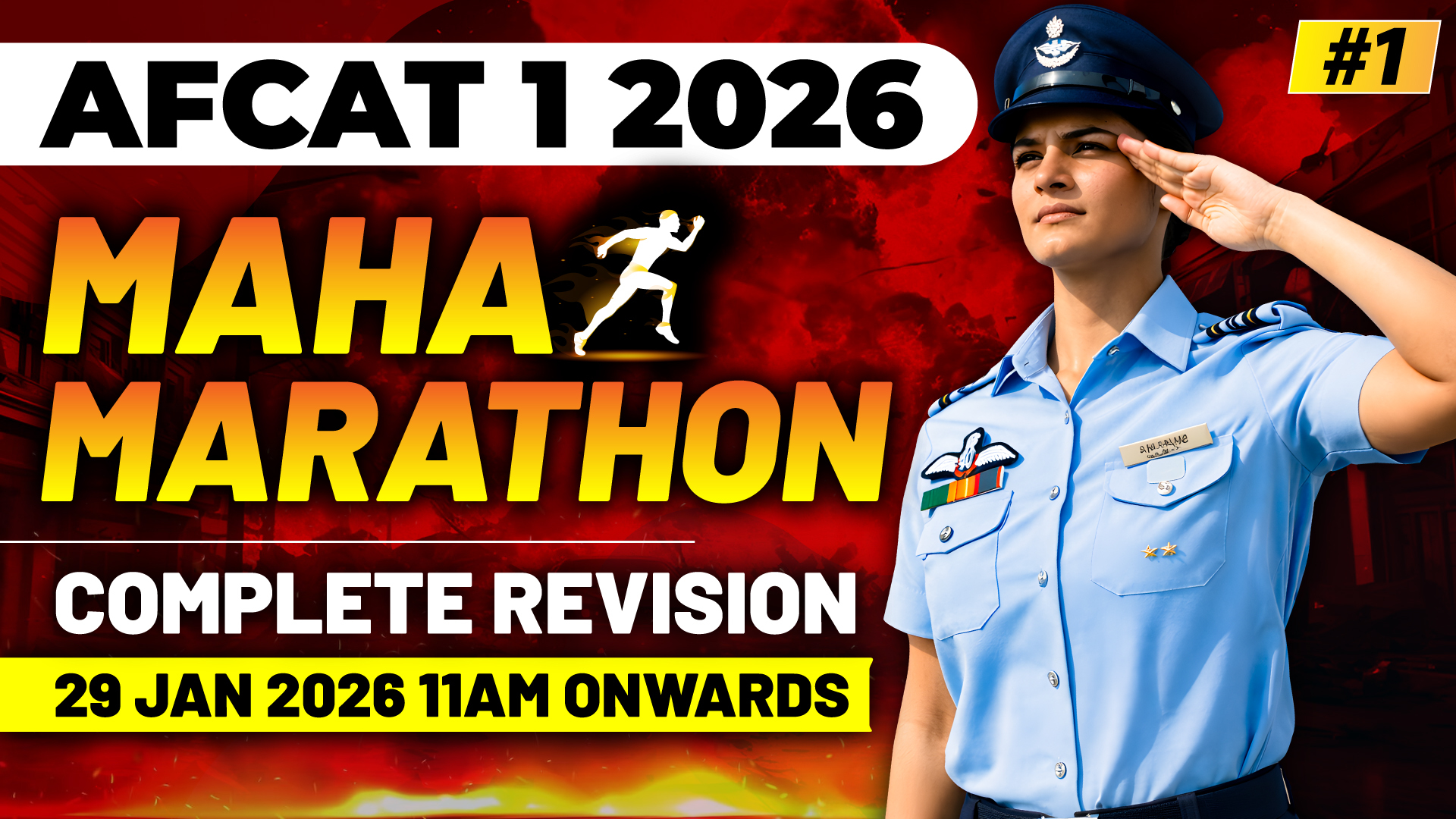
With the AFCAT 1 2026 examination scheduled on Saturday, 31 January 2026, aspirants entered the final and most crucial phase of preparation. To provide last-minute revision, clarity, and confidence, the Maha Marathon Live Session – Part 1 was conducted on 29 January 2026, focusing on exam-specific multiple choice questions (MCQs) from all four sections of the AFCAT exam:
- English
- General Awareness
- Reasoning
- Numerical Ability
This session was designed as a high-intensity, high-yield revision class, simulating real exam conditions and helping candidates fine-tune their final strategy.
Purpose of the Maha Marathon Live Session
The core objectives of the session were to:
- Revise high-probability topics across all sections
- Practise AFCAT-level MCQs under time pressure
- Strengthen accuracy and speed
- Identify common traps and avoid last-minute mistakes
- Build exam-day confidence and mental readiness
Rather than theory, the focus was on application, elimination techniques, and exam temperament.
English Section: Exam-Specific MCQs
The English segment covered frequently asked and scoring areas of AFCAT, with MCQs designed to reflect the actual exam pattern.
Key Areas Covered
- Vocabulary-based questions (synonyms, antonyms, word usage)
- Error detection and sentence improvement
- Fill in the blanks
- Reading-based comprehension questions
- Contextual meaning of words
Focus of the Session
- Selecting answers based on meaning and context
- Avoiding confusion between similar options
- Improving reading speed and accuracy
- Smart elimination of incorrect choices
Special emphasis was laid on quick decision-making, which is crucial in AFCAT’s time-bound format.
General Awareness Section: Smart Revision Approach
The General Awareness segment focused on selective and relevant MCQs, helping candidates revise without overloading their memory at the last moment.
Key Areas Touched
- Current affairs (recent months)
- Defence-related awareness
- Static GK frequently repeated in AFCAT
- Basic science and environment concepts
Exam Strategy Highlighted
- Avoid overthinking factual questions
- Attempt only sure-shot questions
- Manage time wisely by skipping doubtful MCQs
The aim was to maximise score while minimising negative marking risk.
Reasoning Section: Speed and Accuracy
The Reasoning segment trained candidates to handle logical questions efficiently, which often consume excessive time if not approached strategically.
Types of Questions Practised
- Series and pattern recognition
- Analogy and classification
- Coding-decoding
- Blood relations
- Direction sense and logical reasoning
Key Takeaways
- Identify patterns quickly
- Apply shortcut techniques
- Avoid lengthy calculations
- Maintain balance between speed and accuracy
The session reinforced the idea that reasoning questions should be solved smartly, not mechanically.
Numerical Ability Section: Calculation under Control
The Numerical Ability part focused on concept-based yet calculative MCQs, keeping in mind AFCAT’s moderate difficulty level.
Topics Covered
- Percentage, ratio, and proportion
- Time, speed, and distance
- Simple interest and profit-loss
- Average and basic arithmetic
Important Emphasis
- Choosing the right approach before calculation
- Avoiding time-consuming questions
- Estimation techniques where applicable
Candidates were advised to prioritise accuracy over blind attempts.
Integrated Exam Strategy Shared
Throughout the session, students were guided on:
✔ Section-wise time management
✔ Order of attempting sections
✔ Handling negative marking
✔ Maintaining composure during the exam
✔ Avoiding last-minute panic
This holistic guidance helped aspirants align their knowledge with execution.
Importance of Maha Marathon Sessions Before AFCAT
Maha Marathon sessions are crucial because they:
- Consolidate months of preparation in a short time
- Expose candidates to real exam-like MCQs
- Strengthen confidence before the actual exam
- Help in identifying strengths and weak areas
- Sharpen exam-day mindset
For AFCAT aspirants, such sessions act as a final performance rehearsal.
Conclusion
The Maha Marathon Live Session – Part 1 for AFCAT 1 2026, conducted on 29 January 2026, served as a powerful last-minute revision platform for aspirants appearing in the AFCAT exam on 31 January 2026. By covering English, General Awareness, Reasoning, and Numerical Ability through exam-specific MCQs, the session helped candidates fine-tune their preparation, boost confidence, and approach the exam with clarity and control.
Such focused marathon sessions play a vital role in transforming preparation into performance on the final exam day.