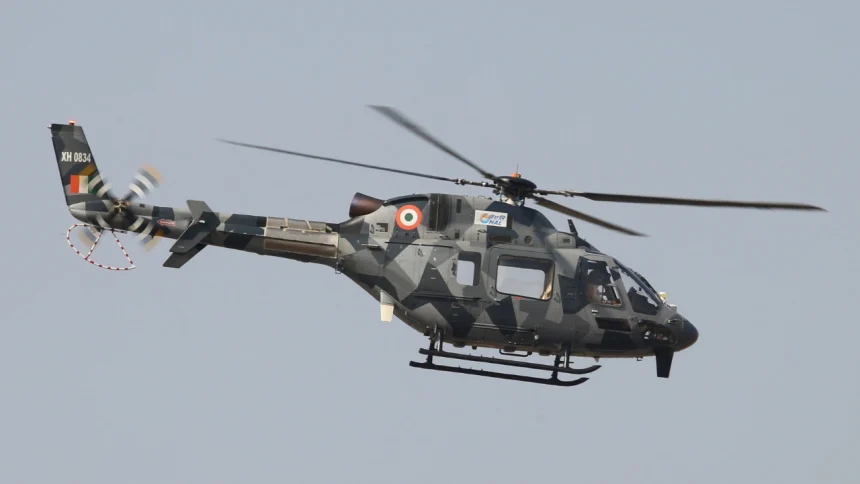
India’s Army aviation and the Indian Air Force are moving closer to a large-scale helicopter recapitalisation plan, with around 200 indigenous Light Utility Helicopters (LUH) from Hindustan Aeronautics Limited (HAL) now expected to be ordered as the services work to replace their ageing Cheetah and Chetak fleets. Defence officials said HAL has already built 12 LUH aircraft, while another 187 units are in the pipeline, taking the total to about 199 helicopters and placing the programme at more than ₹20,000 crore.
DAC approval and proposed procurement mix
The requirement sits within a much larger demand for roughly 400 light helicopters across the two services. On October 26, the Defence Acquisition Council (DAC), chaired by Defence Minister Rajnath Singh, granted Acceptance of Necessity for 200 Light Multirole Helicopters (LMRH) at an estimated cost of about ₹20,000 crore. Officials said the Indian Army is expected to issue the tender for the platforms, with Indian companies such as Tata, in partnership with Airbus, and the Adani Group, in partnership with Leonardo of Italy, expected to team up with global original equipment manufacturers for production in India.
Bell Helicopters of the United States is also expected to participate. The contract is likely to be split between the L1 and L2 bidders. Reports indicate that about 120 helicopters may be allotted to the Army and 80 to the Air Force.
Three types of light helicopters likely in service
Officials said the Army and Air Force are expected to end up operating three different types of light helicopters, with roughly 50 per cent coming from private-sector firms and the rest from public-sector manufacturers such as HAL. This arrangement is intended to address the long-pending need to retire around 400 Cheetah and Chetak helicopters over the coming years.
What the HAL LUH offers
The HAL LUH is a new-generation 3-ton class helicopter designed specifically as a replacement for the Cheetah and Chetak. It has a glass cockpit with multi-function displays and is powered by a single Ardiden-1U turboshaft engine, which HAL says provides the required power margin for demanding high-altitude missions. According to HAL, the helicopter’s maximum speed is around 220–235 km/h, its service ceiling is 6.5 km, and it has a range of 350 km with a 500 kg payload. Its maximum take-off weight is 3,150 kg, and it can carry a crew of two and up to six passengers.
The aircraft is meant for reconnaissance and surveillance, logistics support, troop movement, casualty evacuation, training, and humanitarian assistance and disaster relief, especially in high-altitude areas from Siachen to the Northeast.
Testing status and production plans
The LUH programme has already gone through extensive trials, including high-altitude testing. Certification is now in its final stages, and HAL plans to deliver the first limited-series production batch of 12 helicopters, six each for the Army and the Air Force, in FY 2027–28. Production is being carried out at HAL’s dedicated facility in Tumakuru, Karnataka.
Earlier efforts to replace the Cheetah and Chetak fleets, including the selection of the Russian Ka-226T in 2014 and other tenders, did not materialise. That has left the services dependent on the ageing helicopters for critical frontier operations.
The latest move is expected to improve operational capability along India’s northern and northeastern borders while also supporting the domestic helicopter manufacturing ecosystem, including medium and small-scale industries, under the Atmanirbhar Bharat initiative. Separately, the Indian Navy is procuring light maritime helicopters for search-and-rescue and other roles.