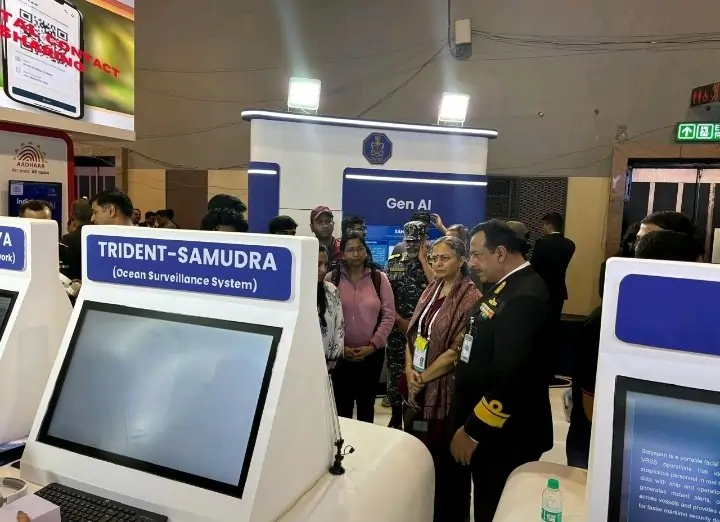
The Indian Navy has introduced TRIDENT-SAMUDRA, a cutting-edge artificial intelligence (AI)-powered ocean surveillance system, designed to enhance maritime domain awareness and security across the Indian Ocean Region (IOR). The advanced system was presented during the AI Impact Summit 2026 held in New Delhi.
In collaboration with technology partners including Blurgs Innovations, TRIDENT-SAMUDRA is crafted as a next-generation intelligence, surveillance, and reconnaissance (ISR) platform. Its primary capabilities include the ability to identify, track, and analyze maritime activities in real-time, making it a vital tool for naval operations.
The surveillance system employs sophisticated AI algorithms and machine learning models to handle extensive data gathered from satellites, sensors, underwater arrays, and other surveillance platforms. By analyzing these data streams, TRIDENT-SAMUDRA can identify suspicious maritime behavior and promptly flag anomalies, which may signal potential threats. This functionality enables the Navy and Coast Guard to effectively monitor commercial shipping traffic, fishing activities, and possible adversarial movements, creating a comprehensive operational overview of the maritime domain.
TRIDENT-SAMUDRA significantly enhances situational awareness by consolidating information from various sources into a unified surveillance network. The automation aspect of the system drastically minimizes the need for manual surveillance of coastal and maritime areas, thereby facilitating faster threat detection and enabling quicker decision-making for commanders.
Notably, the system is equipped with edge computing capabilities that ensure low-latency data processing, even in complex operational environments. This feature offers naval forces a critical time advantage during emerging security situations.
One of the focal points of TRIDENT-SAMUDRA is bolstering underwater security, especially in sensitive regions like the Bay of Bengal and the Andaman and Nicobar Islands. The system is specifically designed to track unusual underwater activities, including potential submarine movements, thus addressing growing undersea threats.
As an indigenous solution developed under the Atmanirbhar Bharat initiative, TRIDENT-SAMUDRA is intended for seamless integration with frontline naval platforms and command networks. Its deployment can be implemented in modern warships, such as INS Surat, thereby providing AI-assisted real-time operational support.
Moreover, the system is anticipated to work in tandem with the Navy’s broader digital infrastructure, including the Information Management and Analysis Centre (IMAC) and satellite-based communication networks.
Given India’s extensive 7,500-kilometer coastline and vast Exclusive Economic Zone, advanced surveillance capabilities are crucial for monitoring maritime traffic, safeguarding sea lanes, and countering emerging threats like unmanned underwater vehicles or hostile intrusions.
The launch of TRIDENT-SAMUDRA signifies a notable advancement in the Indian Navy’s shift towards AI-enabled, network-centric maritime operations, reinforcing India’s strategic capabilities in an increasingly competitive security landscape in the Indo-Pacific region.