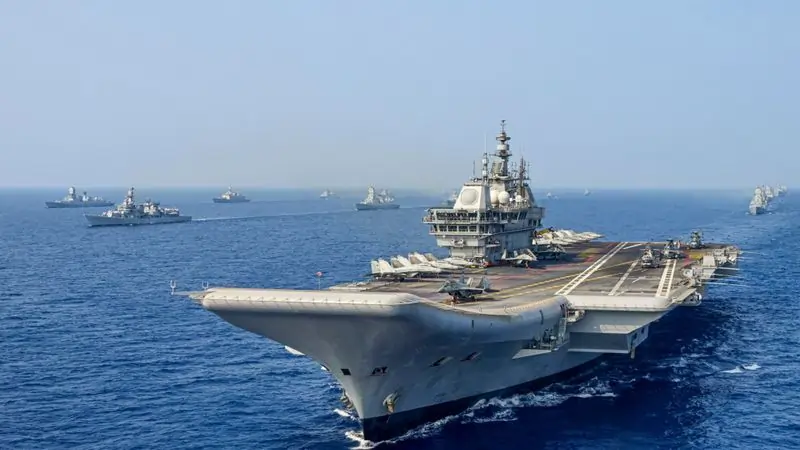
The Indian Navy is preparing to commission an impressive 19 warships in 2026, marking a significant milestone in its naval expansion efforts. This unprecedented induction represents the largest force enhancement in a single year to date, highlighting the burgeoning capabilities of India’s indigenous shipbuilding sector. The upcoming number of vessels surpasses last year’s induction of 14 units, which included a submarine.
Sources within the defense establishment have characterized the current pace of production as unprecedented, indicating that 2026 will witness the peak of naval development in recent history. This surge in warship commissioning is attributed to sustained investments in modern design tools and advanced construction techniques, coupled with enhanced collaboration across both public and private shipyards.
Among the noteworthy additions expected this year are the Nilgiri-class multi-role stealth frigates. The lead ship of this class was commissioned in January 2025, with INS Himgiri and INS Udaygiri scheduled to enter service in August 2025. At least two additional Nilgiri-class frigates are anticipated to join the fleet in 2026.
In addition to these frigates, the Navy is set to induct a survey vessel from the Ikshak class as well as a diving support vessel from the Nistar class. These new vessels will bolster India’s capabilities in hydrographic surveying, deep-sea operations, and overall fleet support, enhancing the Navy’s operational readiness.
The remarkable output of vessels is facilitated by an integrated construction strategy that was adopted by the Ministry of Defence approximately a decade ago. This modular approach involves the assembly of hulls, superstructures, and internal systems into ~250-tonne blocks, allowing for pre-installed cabling and piping to align with precision during welding.
Modern shipyards now capitalize on advanced design software and artificial intelligence to streamline the assembly process. This technology aids in optimizing material sourcing, predicting project timelines, and simulating machinery layouts alongside fluid dynamics, resulting in notable reductions in build timelines from the previous range of eight to nine years down to approximately six years.
Strategically, this accelerated induction aligns with India’s broader maritime objectives. The increased naval capacity will play a critical role in countering regional naval ambitions, safeguarding key sea lanes, strengthening partnerships with Quad and ASEAN nations, and enhancing India’s power projection in the Indo-Pacific region.
Despite this significant boost to naval capabilities, officials acknowledge that India still lags behind China in terms of shipbuilding scale. Public estimates suggest that the People’s Liberation Army Navy could operate around 395 ships and submarines by the end of 2025, with projections indicating this number could climb to 435 by 2030.
Nonetheless, the commissioning of 19 warships in a single year is indicative of a substantial evolution in India’s naval and industrial capabilities. With faster construction times, increased indigenous content, and a steady flow of advanced platforms, the modernization of the Indian Navy is entering a crucial phase, significantly enhancing maritime security and deterrence across its extended neighborhood.