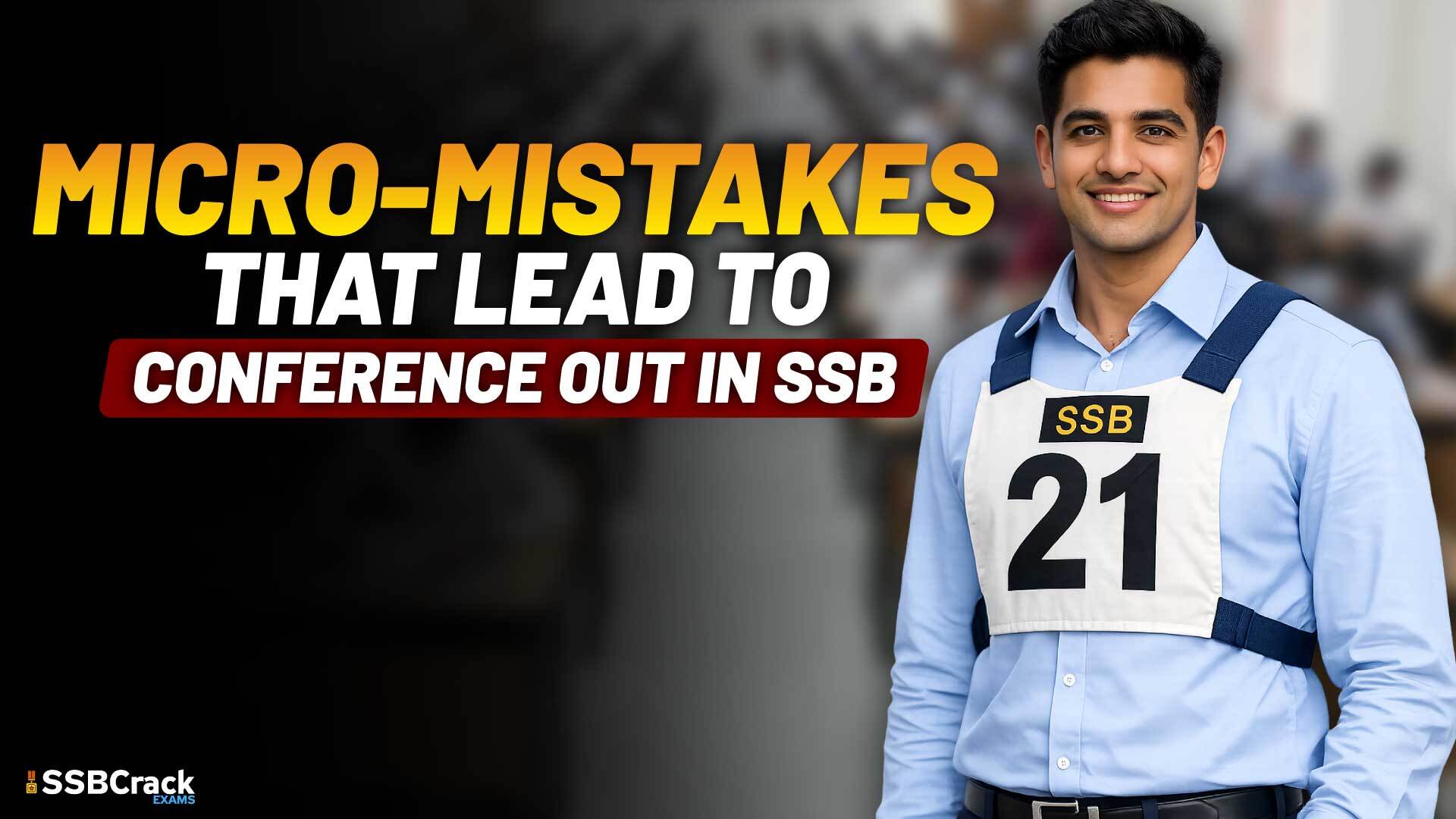
Many SSB candidates believe that only major mistakes lead to rejection—such as failing in group tasks, giving wrong answers in interviews, or performing poorly in psychological tests.
However, experienced assessors know something different.
In many cases, candidates who are reasonably capable still get Conference Out because of a series of small behavioural slips.
These are not dramatic failures.
They are micro-mistakes—tiny signals that gradually create doubt in the minds of the assessors.
SSB assessors rarely reject a candidate for one big mistake.
They reject candidates when many small signals do not match officer-like behaviour.
In this article, we will understand the subtle micro-mistakes that quietly push candidates toward Conference Out.
What Are Micro-Mistakes?
Micro-mistakes are small behavioural patterns that may appear harmless individually but collectively indicate weak Officer Like Qualities (OLQs).
These mistakes usually occur because candidates:
- Overthink the process
- Try to impress artificially
- Lose emotional balance
- Misunderstand what assessors observe
Let us look at the most common micro-mistakes.
1. Speaking Only When Asked
Some candidates remain quiet in group activities and only speak when someone invites them.
This behaviour may indicate:
- Low initiative
- Lack of confidence
- Weak social adaptability
Recommended candidates naturally participate without waiting for permission.
2. Speaking Too Much Without Listening
The opposite mistake is equally harmful.
Candidates who:
- Interrupt frequently
- Repeat their points
- Ignore other ideas
may appear dominating rather than cooperative.
The military values leaders who listen before leading.
3. Poor Situational Awareness
In GTO tasks, some candidates focus only on their own idea and ignore:
- Obstacle structure
- Available materials
- Group movement
This suggests weak practical intelligence.
Officers must always remain aware of the entire situation.
4. Negative Body Language
Micro-signals from body language often reveal more than words.
Examples include:
- Slouching while standing
- Folding arms during discussion
- Avoiding eye contact
These subtle signals can indicate low confidence or disinterest.
5. Visible Frustration After Failure
Some candidates become visibly upset when their idea is rejected or when an obstacle fails.
They may:
- Stop participating
- Show irritation
- Withdraw from the group
This behaviour signals poor emotional control.
Officers must remain calm under pressure.
6. Ignoring Teammates’ Efforts
Another subtle mistake is failing to acknowledge others’ contributions.
Candidates who:
- Ignore teammates’ ideas
- Take credit for group solutions
- Focus only on their own performance
appear self-centered rather than team-oriented.
The Armed Forces value collective success.
7. Over-Theoretical Thinking
During planning exercises or discussions, some candidates give impractical solutions.
For example:
- Unrealistic timelines
- Impossible resource use
- Overcomplicated strategies
This suggests weak effective intelligence.
Practical thinking is far more valuable than complex theory.
8. Low Energy Throughout the Day
SSB testing lasts many hours.
Some candidates start well but gradually appear:
- Tired
- Disinterested
- Less responsive
Assessors observe consistency of energy.
Leadership requires sustained motivation.
9. Artificial Behaviour
Candidates who try too hard to “act like officers” sometimes appear unnatural.
Examples include:
- Over-formal speech
- Forced leadership
- Dramatic gestures
Assessors are highly experienced and quickly detect artificial personalities.
Authenticity is far more convincing.
10. Poor Behaviour Between Tasks
As discussed earlier, evaluation does not stop between activities.
Candidates who:
- Complain about tasks
- Criticize teammates
- Isolate themselves
may unintentionally reveal negative traits.
Even informal moments contribute to the overall assessment.
Why Micro-Mistakes Matter in Conference
During the final conference, assessors compare their observations.
A candidate may have:
- Average psychological performance
- Moderate interview performance
- Reasonable GTO participation
But if small negative signals appear across all tests, the assessors may feel uncertain.
And uncertainty often results in Conference Out.
How Recommended Candidates Avoid These Mistakes
Successful candidates usually display:
- Balanced participation
- Calm emotional reactions
- Natural communication
- Consistent teamwork
- Practical thinking
Their behaviour remains stable across different situations.
This consistency builds assessor confidence.
Final Message
In SSB, rejection rarely happens because of one dramatic failure.
More often, it happens because of a pattern of small behavioural inconsistencies.
Every small action sends a signal about your personality.
When these signals consistently reflect:
- Responsibility
- Cooperation
- Initiative
- Emotional balance
the assessors begin to see the qualities required in an officer.
At SSB, success is not about avoiding big mistakes—it is about maintaining officer-like behaviour in every small moment.