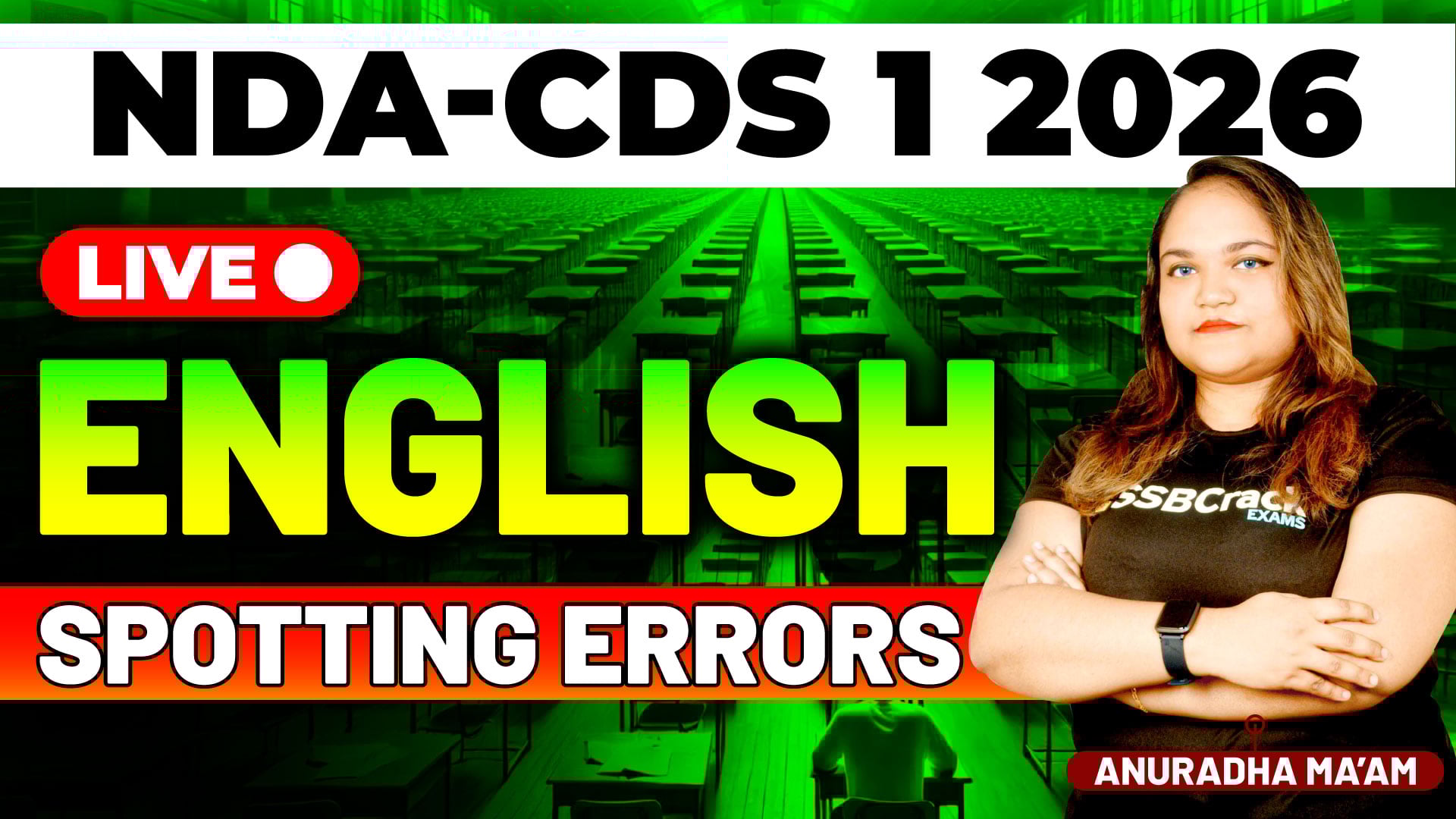
The Spotting Errors topic is one of the most important and scoring areas in the English section of NDA and CDS examinations. It tests a candidate’s command over grammar rules, sentence structure, and vocabulary usage. In this type of question, a sentence is divided into parts, and candidates must identify which part contains a grammatical or usage error.
The English Live Class for NDA & CDS 1 2026 – Live Batch 2 was conducted to strengthen aspirants’ ability to detect errors quickly and accurately through exam-level multiple choice questions (MCQs).
Objective of the Live Class
The primary aims of this session were to:
- Develop clarity in fundamental grammar rules
- Improve accuracy in identifying sentence-level errors
- Train students in solving MCQs under time pressure
- Reduce common mistakes in subject-verb agreement, tense, and word usage
- Enhance confidence in tackling tricky options
The session combined concept revision with intensive MCQ practice, mirroring the pattern seen in defence exams.
Understanding Spotting Errors Questions in NDA & CDS
In the exam, candidates are usually given:
- A sentence divided into four parts (A, B, C, D)
- One of the parts may contain an error
- Sometimes, an option stating “No Error”
The candidate must:
- Carefully read the full sentence
- Identify the incorrect part based on grammar or vocabulary rules
- Avoid assumptions based on spoken English
These questions test precision and attention to detail.
Major Grammar Areas Covered in the Live Class
A. Subject-Verb Agreement
Students practised identifying mismatches between singular and plural subjects and verbs, especially in:
- Compound subjects
- Collective nouns
- Indefinite pronouns
B. Tense Consistency
Questions tested correct usage of:
- Present, past, and future tenses
- Sequence of tenses in complex sentences
- Correct verb forms
C. Articles and Determiners
Common mistakes involving:
- A, An, The
- Omission or unnecessary use of articles
- Quantifiers and determiners
D. Prepositions
Errors related to:
- Incorrect preposition usage
- Confusion between similar prepositions
- Fixed expressions
E. Pronoun Usage
Focus was given to:
- Pronoun-antecedent agreement
- Case of pronouns
- Ambiguous references
F. Vocabulary-Based Errors
Some MCQs tested:
- Incorrect word choice
- Confusing words
- Wrong collocations
These questions required both grammar knowledge and vocabulary awareness.
MCQ Practice Approach in the Class
During the live session, students were trained to:
✔ Read the entire sentence before checking options
✔ Check subject-verb agreement first
✔ Verify tense consistency
✔ Examine pronouns and prepositions carefully
✔ Look for vocabulary misuse
This systematic approach helped reduce random guessing.
Common Mistakes Highlighted
The class identified frequent errors made by aspirants:
- Relying on spoken English instead of grammar rules
- Ignoring subtle tense shifts
- Overlooking article usage
- Confusing similar-looking words
- Rushing without reading the complete sentence
Students were encouraged to slow down and analyse logically.
Importance of Grammar & Vocabulary Knowledge
Spotting Errors questions require:
- Strong understanding of basic grammar concepts
- Awareness of commonly misused words
- Careful reading habits
- Logical reasoning ability
Without grammar clarity, even simple sentences can become confusing.
Exam Strategy for Spotting Errors
✔ Do not read sentence parts in isolation
✔ Identify the subject and verb first
✔ Check agreement and tense
✔ Look for small but critical mistakes
✔ If the sentence sounds correct, still verify grammar
✔ Be cautious with “No Error” options
Accuracy is more important than speed in this section.
Why Spotting Errors Is a Scoring Topic
This topic is highly scoring because:
- Rules are fixed and predictable
- Practice improves accuracy significantly
- Questions are direct if grammar concepts are clear
- Regular revision builds confidence
With proper preparation, candidates can attempt these questions with high certainty.
Conclusion
The Spotting Errors Live Class for NDA & CDS 1 2026 – Live Batch 2 equipped aspirants with the necessary grammar and vocabulary tools to confidently handle error-detection MCQs. Through structured concept revision and exam-oriented practice, students learned to approach each sentence logically and systematically.
Mastering this topic can significantly boost scores in the English section of NDA & CDS examinations and strengthen overall language accuracy.