




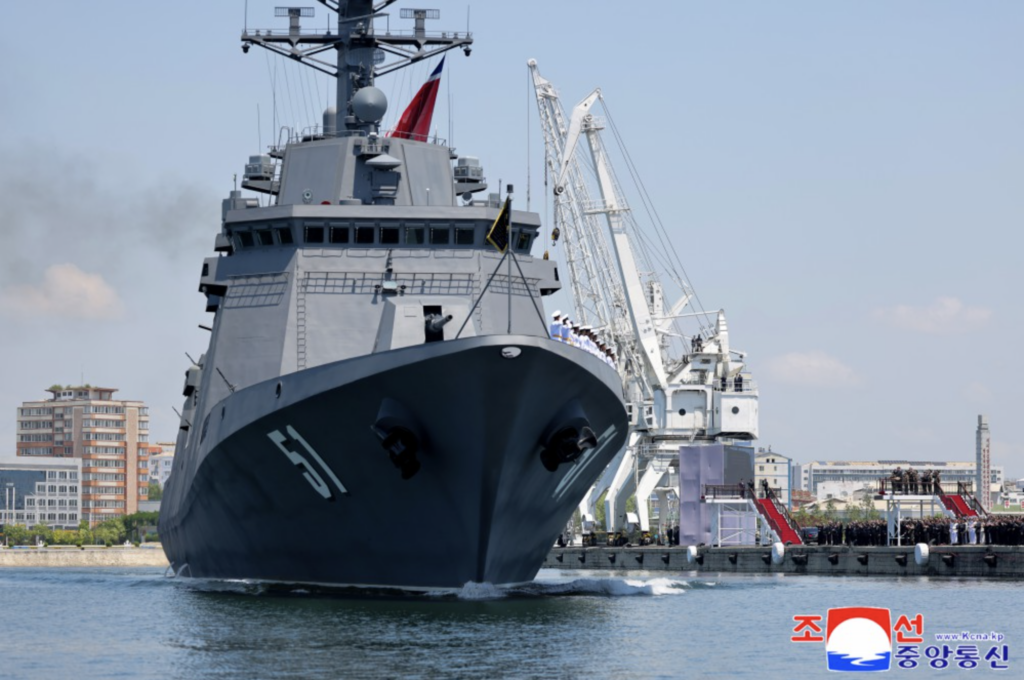
North Korea’s leader, Kim Jong Un, has announced a significant expansion of the nation’s naval capabilities, revealing plans to equip the navy with nuclear weapons and construct larger warships. This announcement was made during a ceremony for the commissioning of the Choe Hyon, one of two 5,000-ton class warships launched in the previous year, held in the port city of Nampho.
According to the Korean Central News Agency, Kim emphasized that the initiative to integrate nuclear capabilities into the naval fleet is progressing as planned. He referred to this strategic direction as vital for ensuring that the country’s nuclear assets are prepared for diverse and effective operations.
The Choe Hyon has previously been touted by North Korea as being equipped with "the most powerful weapons." Notably, Kim oversaw a cruise missile test conducted from this vessel earlier in April. During the ceremony, he further revealed that the North would soon introduce the destroyer Kang Kon and plans to continuously develop larger vessels, indicating a goal to produce two new, more advanced surface ships annually, including a 10,000-ton cruiser.
Warships of this size, like the U.S. Navy’s Arleigh Burke-class destroyers and South Korea’s Sejong the Great-class ships, measure between 150-170 meters in length—equivalent to the length of 1.5 football fields—and possess a weight comparable to multiple thousand vehicles.
Currently, South Korea operates over ten ships exceeding 5,000 tonnes, while North Korea maintains only two. Military analysts suggest that achieving the 10,000-tonne milestone would symbolize North Korea’s intent to enhance its maritime military stature and keep pace with South Korean naval power.
Since declaring itself an "irreversible" nuclear state following the collapse of denuclearization talks with the United States in 2019, North Korea has consistently reinforced its military posture. Tensions remain high on the Korean Peninsula, which is technically still in a state of war, as the 1950-53 conflict concluded with an armistice.
Experts interpret the recent naval developments as a strategic message directed at the United States, which plays a critical role in South Korean defense. Analysts point out that if North Korea successfully deploys cruise missiles with tactical nuclear capabilities on naval vessels, the implications for U.S. and South Korean defense strategies would be profound, increasing operational complexities and costs.
This announcement follows Kim’s earlier pledges for accelerated military modernization, during which he criticized the actions of both South Korea and the United States, claiming they have pushed the region to the brink of a nuclear conflict. The U.S. currently maintains around 28,500 troops in South Korea to enhance the nation’s defense against potential threats from the North.


