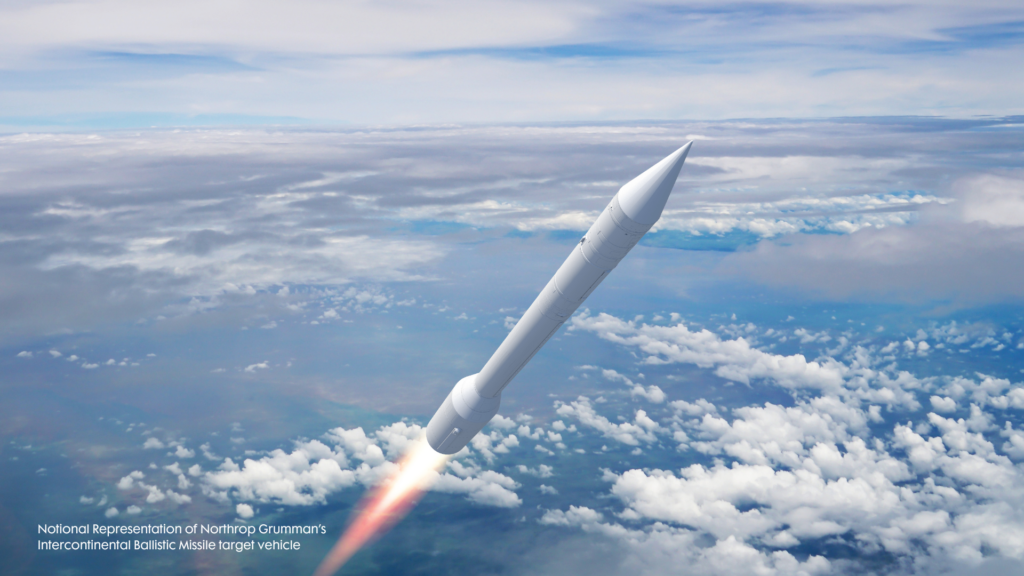
Northrop Grumman has successfully executed the inaugural launch of its digitally redesigned Intercontinental Ballistic Missile (ICBM) target vehicle, a milestone aimed at enhancing the efficacy of U.S. missile defense testing against sophisticated threats. This launch signifies the introduction of Northrop’s latest technology, which is specifically engineered to closely mimic the long-range ballistic missile profiles utilized during flight tests conducted by the Missile Defense Agency.
The test met all designated performance goals and featured the use of a decommissioned Peacekeeper ICBM second-stage motor, provided by the Space Force’s Rocket Systems Launch Program. ICBM target vehicles play a vital role in the Missile Defense Agency’s efforts, validating systems such as Aegis Ballistic Missile Defense and Ground-based Midcourse Defense. Since 2011, Northrop has delivered a total of 27 such targets and has supported 12 successful launches.
What distinguishes this redesigned target vehicle is its construction through a digital-first approach. Northrop Grumman noted that employing digital tools has cut down field execution time by 25 percent during Pathfinder operations while simultaneously enhancing operational safety and integration before launch. Engineers utilized a digital twin concept to ensure that manufacturing, testing, and integration remained synchronized with the physical vehicle throughout its development.
The integration process saw the adoption of virtual reality pathfinders, which allowed teams to rehearse factory integration and assembly procedures prior to the actual construction. This proactive approach facilitated the early identification and resolution of potential issues. Additionally, augmented reality was employed during the integration of interstages, significantly reducing mechanical assembly time and minimizing the likelihood of errors.
Robin Heard, Northrop Grumman’s director of targets and interceptors, emphasized that the incorporation of digital technologies throughout the redesign process has streamlined operations and enhanced cost efficiency for upcoming missile defense testing missions.
In a broader context, U.S. missile programs are increasingly recognizing the necessity for digital redesign and modernization to effectively respond to evolving threats. Lockheed Martin’s Next Generation Interceptor, an integral part of the Missile Defense Agency’s Ground-Based Midcourse Defense system, successfully completed a digital All Up Round Preliminary Design Review in 2023. This milestone was achieved through the use of advanced digital engineering and model-based tools that validated its design and accelerated the progression toward detailed design.
Northrop Grumman’s ICBM target redesign is part of a multi-year transition toward more capable and adaptable test vehicles. The program has replaced aging propulsion hardware with an updated SR119 first stage and has integrated virtual and augmented reality tools for comprehensive factory planning, positioning itself at the forefront of adaptive missile defense technologies.