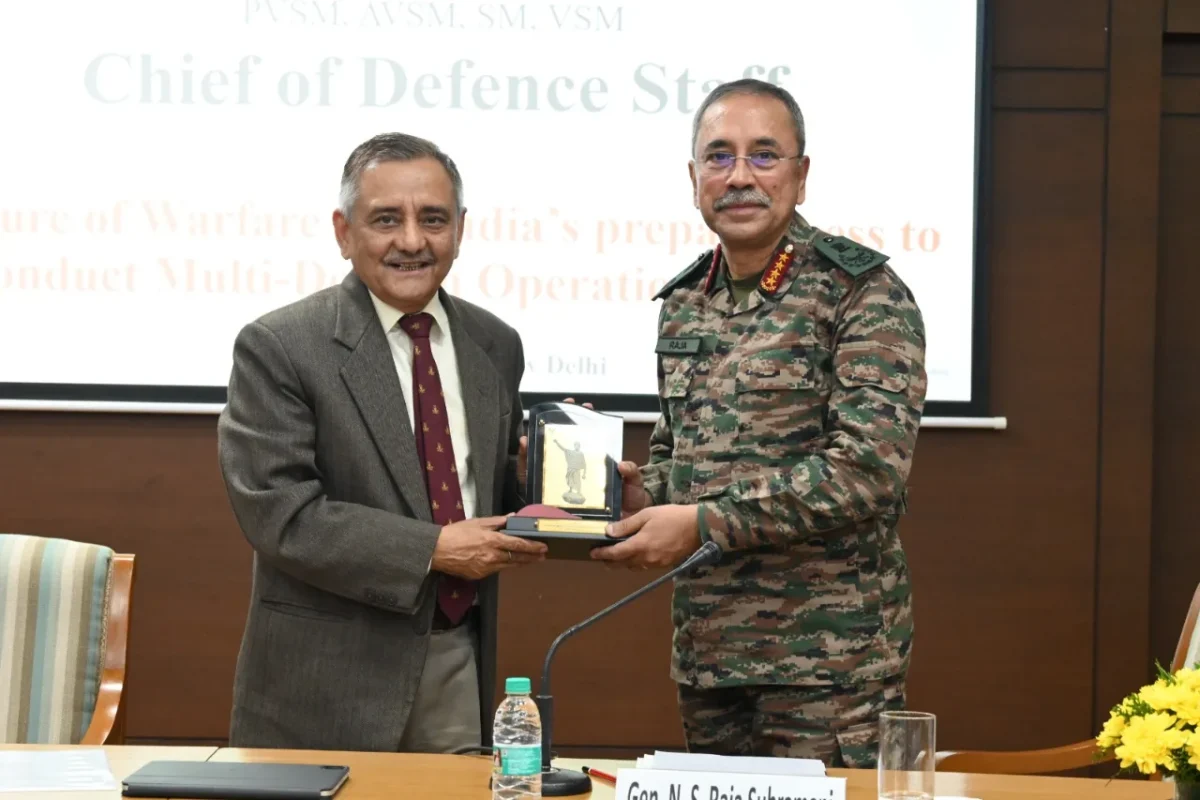
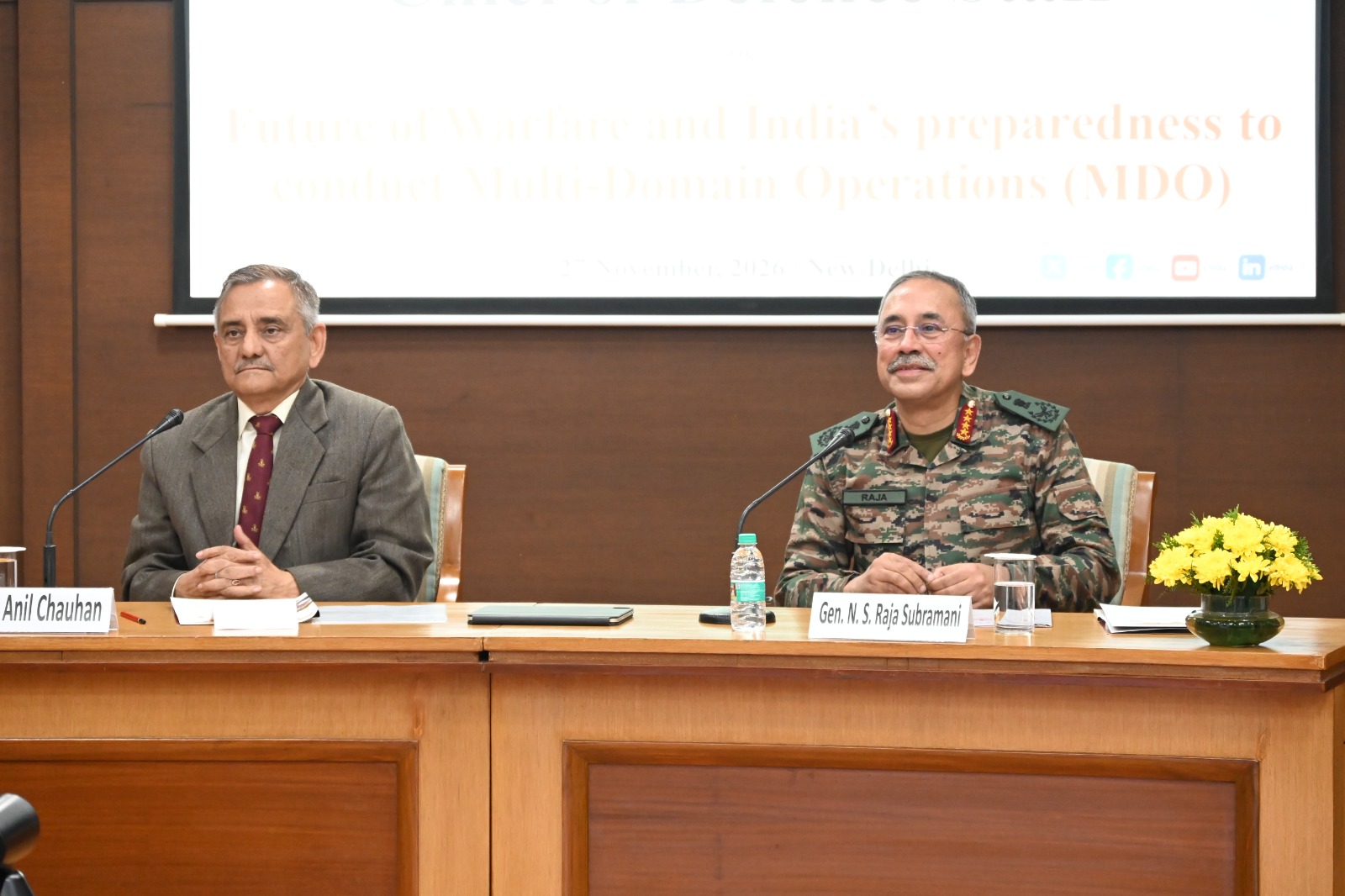
The changing character of warfare, the lessons of recent conflicts and India’s readiness to coordinate military capabilities across domains were the focus of a Vimarsh lecture held in New Delhi on November 27, 2026. Organised by the Vivekananda International Foundation (VIF), the event featured General N. S. Raja Subramani, PVSM, AVSM, SM, VSM, as its principal speaker.
VIF Director General Anil Chauhan (Retd) opened the session, welcoming General Subramani and recognising his four decades of distinguished military service. He said that forecasting future warfare was difficult amid fast-moving technological change, shifting geopolitical conditions and evolving operational environments.
General Chauhan described Multi-Domain Operations (MDO) as synchronised military activity across land, maritime, air, cyber, electromagnetic and space domains, directed towards political and military objectives.
In his address, General Subramani distinguished between the enduring nature of war and its changing character. He said warfare remains shaped by political aims, human will, violence and uncertainty, while advances in technology continue to alter how armed forces plan, coordinate and conduct operations.
He pointed to technology’s influence on contemporary military architecture, particularly in intelligence gathering, precision targeting, operational integration and the pace of military decision-making.
What recent conflicts have shown
General Subramani discussed the growing battlefield role of drones, loitering munitions and advanced surveillance systems. Citing the Armenia-Azerbaijan conflict, he noted how unmanned aerial platforms and precision-guided weapons have influenced modern combat operations.
He also referred to the Israel-Hamas conflict, saying that surprise and deception remain significant military tools, including against technologically advanced forces. On the US-Israel-Iran conflict, he highlighted the increasing importance of long-range precision strikes and artificial intelligence-enabled decision-making.
He linked military strength with domestic production, stating, “A nation’s military power is as good as its industrial power.” His remarks underscored the value of an indigenous defence industrial base to support sustained operations, technological innovation and the development of advanced weapons systems.
Operation Sindoor and India’s preparedness
A substantial part of the lecture addressed lessons from Operation Sindoor. General Subramani emphasised political-military coordination, intelligence sharing, joint planning and integration among the Indian Army, Indian Navy and Indian Air Force.
According to the account of his address, he said the operation demonstrated the effectiveness of precise, intelligence-led strikes and that the operations were conducted without collateral damage. He also highlighted long-range strike capabilities, including indigenous systems such as the BrahMos supersonic cruise missile.
Operation Sindoor was discussed as an example of jointness and Multi-Domain Operations, with coordinated capabilities across different operational domains contributing to strategic objectives. General Subramani said India would need to continue strengthening its technology, defence manufacturing ecosystem, intelligence architecture and operational integration.
He also drew attention to the demands of an increasingly complex battlefield, where cyber capabilities, space-based assets, electronic warfare, artificial intelligence and conventional military power must operate in close coordination.
The lecture concluded with an interactive question-and-answer session on emerging strategic challenges, operational requirements and the future direction of warfare. The discussion highlighted the importance of an integrated, technologically advanced and self-reliant military capable of responding to evolving security challenges and coordinating operations across multiple domains.