Many SSB aspirants fear GTO tasks because of one common belief:
“Physics strong hai toh GTO easy hoga.”
This is completely false.
The GTO does not expect you to solve equations or remember formulas.
He wants to see whether you understand real-life application of basic physics while solving practical problems.
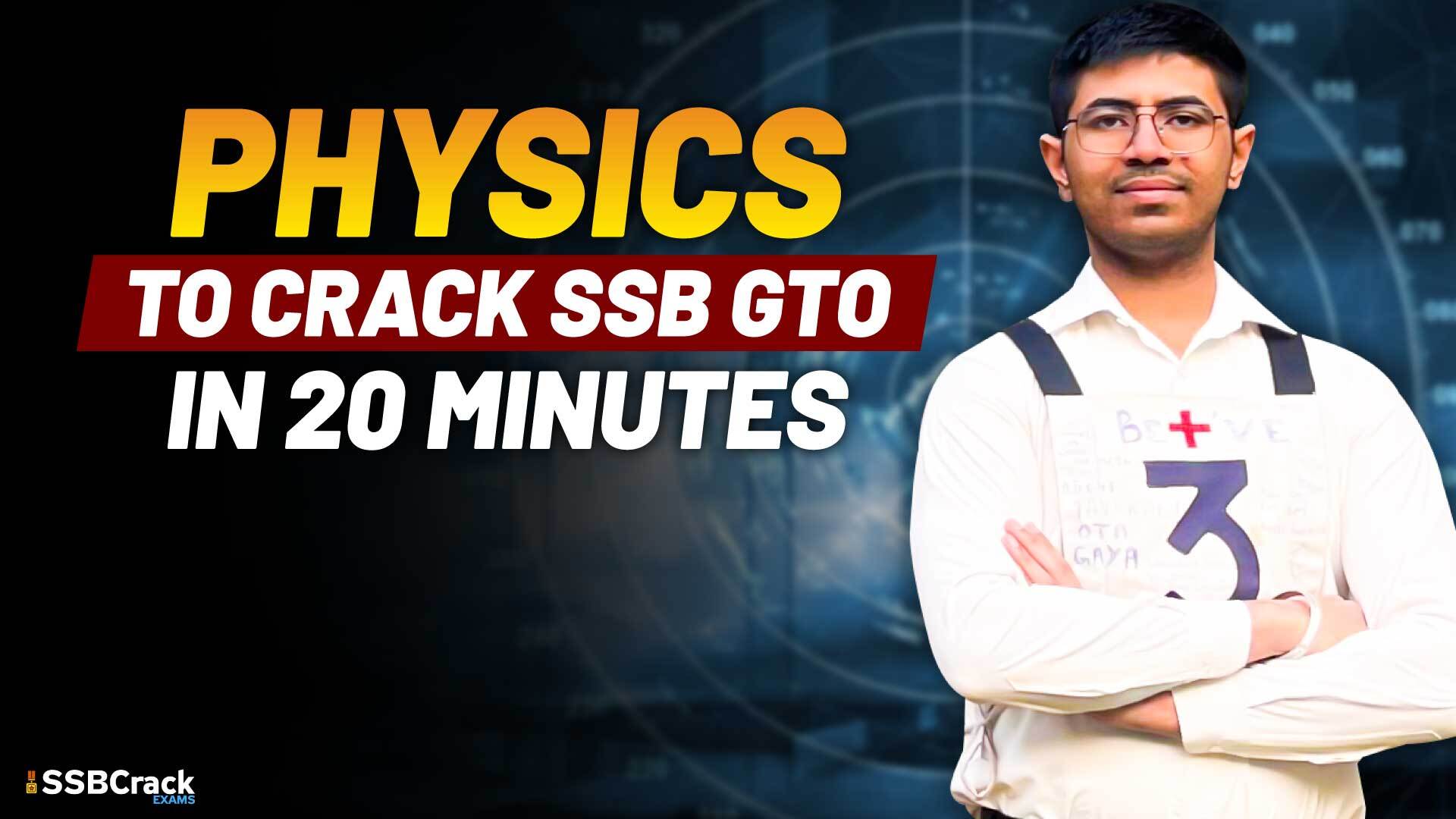
This video/article will teach you all the physics required for GTO in just 20 minutes — especially useful for Arts, Commerce, and Non-Science candidates.
Why Physics Matters in GTO Tasks
In tasks like:
- PGT (Progressive Group Task)
- HGT (Half Group Task)
- FGT (Final Group Task)
- Command Task
- Snake Race
You are constantly dealing with:
- Balance
- Support
- Load
- Movement
- Stability
Every successful obstacle crossing depends on applied physics, even if you don’t realise it.
Rule 1: Center of Gravity (Balance Rule)
Simple Meaning:
The heavier part must remain supported.
If body weight moves outside support → structure falls.
GTO Application:
- Don’t stand at extreme edge of plank.
- Avoid crowding one side.
- Keep movement controlled.
✅ Smart candidate:
Steps near support points first.
❌ Common mistake:
Jumping to middle of unsupported plank.
Remember:
Balance decides survival of structure.
Rule 2: Lever Principle (Effort vs Support)
Every plank works like a see-saw.
If support is near one end:
- Longer side bends.
- Structure tilts.
Practical Thinking:
Keep support closer to middle whenever possible.
In Command Task:
- Shift fulcrum intelligently.
- Reduce bending length.
Golden Line:
Smaller free length = stronger bridge.
Rule 3: Load Distribution
One person = manageable load
Three people together = structural failure
Apply This:
- Move one by one.
- Spread team weight.
- Avoid group rushing.
GTO observes candidates who control traffic intelligently.
Leadership = Load management.
Rule 4: Friction (Anti-Slip Science)
Friction prevents slipping.
Higher friction → better grip.
Practical Examples:
- Flat plank grips better than tilted plank.
- Tight rope increases stability.
- Proper placement reduces sliding.
Before stepping:
Always test with foot pressure.
That small testing action reflects awareness.
Rule 5: Stability Triangle
Three-point contact creates maximum stability.
Examples:
- Two supports + ground contact
- Rope + plank + drum
Unstable structures usually have only one contact point.
Engineering shortcut:
More contact points = safer structure.
Rule 6: Tension vs Compression
You don’t need technical terms — just understand behaviour.
Compression:
Material being pressed (plank under weight)
Tension:
Material being pulled (rope tightening)
In GTO:
- Plank handles compression.
- Rope provides tension support.
Best structures combine both.
Example:
Plank bridge stabilized with rope tie.
Rule 7: Shortest Safe Path Principle
Many candidates create complex long routes.
Physics says:
Longer structure = more bending + instability.
Smart candidates:
- Reduce distance first.
- Change angle.
- Use intermediate support.
Efficiency impresses GTO.
Rule 8: Momentum Control
Running or jumping increases force.
Even light candidates can destabilize structure.
Correct behaviour:
- Walk smoothly.
- Maintain rhythm.
- Avoid sudden movements.
Controlled motion = mature thinking.
Rule 9: Testing Before Commitment
Engineers always test before loading.
In GTO:
- Press plank slightly.
- Check wobble.
- Confirm locking.
Never blindly step.
GTO notices this instantly.
Rule 10: Resource Optimization
Physics is also about efficiency.
Ask:
- Can one plank do two jobs?
- Can support be reused?
- Can angle reduce gap?
Smart use of resources shows Effective Intelligence.
Biggest Myth Broken
GTO tasks are NOT won by:
- Engineering students
- Physicists
- Technically qualified candidates
They are won by candidates who apply:
✅ Observation
✅ Logic
✅ Stability judgment
✅ Calm experimentation
20-Minute Mental Checklist Before Every Task
Ask yourself:
- Where is support?
- Where will weight act?
- Will this slip?
- Is distance reducible?
- Can load move gradually?
If yes — physics applied successfully.
What GTO Actually Thinks
When he sees you:
- Testing structure
- Adjusting support
- Controlling movement
- Improving stability
He concludes:
“This candidate thinks practically under pressure.”
And that is an Officer Like Quality.
Final Message for Aspirants
You don’t need formulas like:
- Force = Mass × Acceleration
- Torque equations
- Numerical calculations
You only need applied common sense physics.
Remember:
Physics in GTO = Safe Thinking + Logical Execution
Master these basics, and you can confidently handle:
- PGT
- HGT
- FGT
- Command Task
—even within your first attempt.