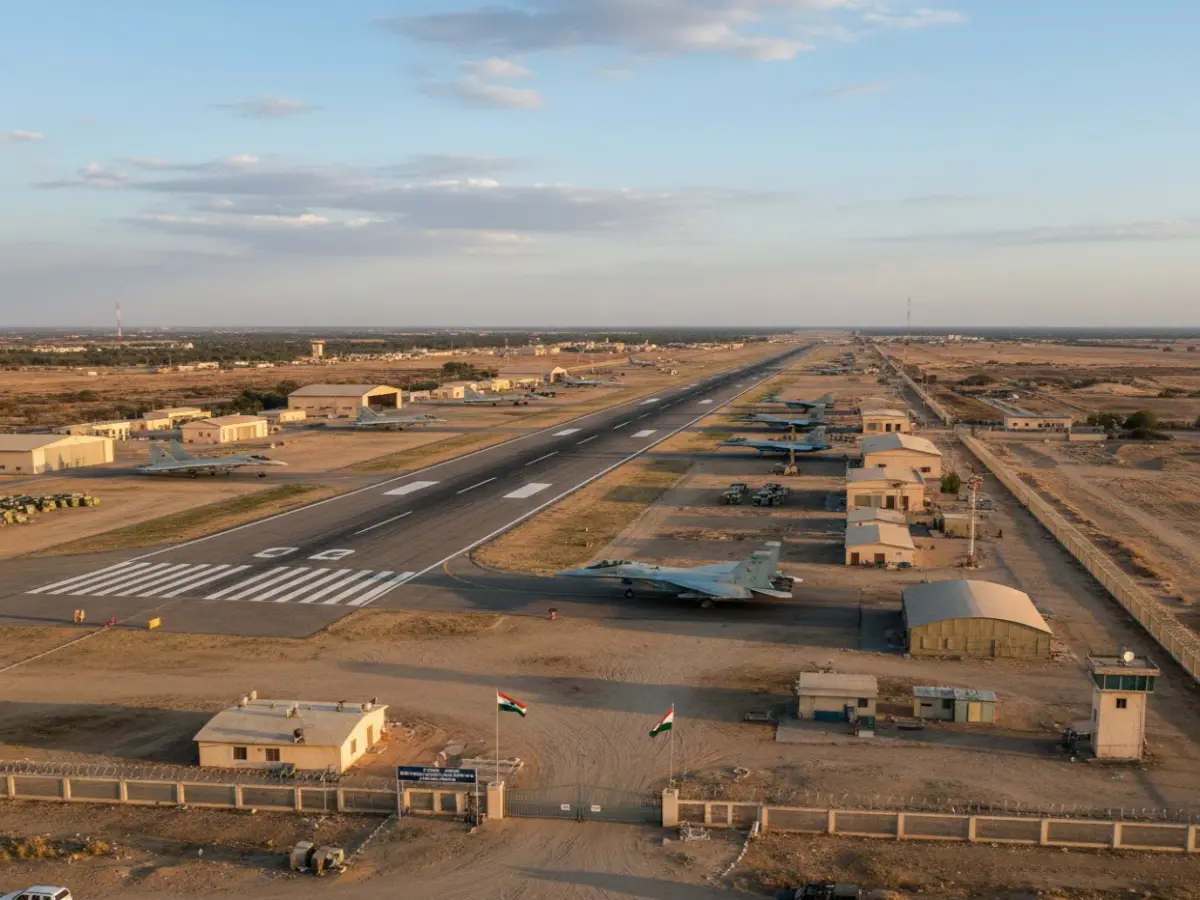
In a landmark ruling, the Rajasthan High Court has paved the way for the construction of a new Indian Air Force (IAF) airbase near the India-Pakistan border, dismissing all legal challenges regarding the land acquisition for this strategic project. The proposed airbase, known as a Forward Composite Aviation Base (FCAB), is strategically located near Sadulshahar tehsil in Sri Ganganagar district, approximately 40 kilometers from the Pakistan border.
This new facility is anticipated to bolster India’s military preparedness by enabling swift deployment of fighter aircraft to critical Pakistani airbases like Jacobabad, Bholari, and Rahim Yar Khan in potential conflict scenarios.
The court’s judgment came from a bench led by Justice Dr. Nupur Bhati, which rejected petitions submitted by 58 farmers and landowners who opposed the land acquisition. The court characterized the petitions as attempts to obstruct a project of national significance on technical grounds. Emphasizing the primacy of national security, the court affirmed that individual interests cannot supersede the collective security needs of the nation.
Upon reviewing official documentation, the High Court concluded that all necessary procedures for land acquisition had been duly observed. This included conducting a Social Impact Assessment (SIA) public hearing, appropriately publishing newspaper notices, completing joint survey reports, and addressing concerns raised by the Tehsildar regarding objections. The court firmly stated that allegations of procedural irregularities were baseless.
The establishment of the Sadulshahar airbase marks the IAF’s second station in Sri Ganganagar, joining the existing Suratgarh Air Force Station. The new base promises to significantly enhance the capability for rapid response, relocation of assets, and overall aerial dominance along India’s western front.
Developed under the strategic framework of Operation Sindoor, the project involves acquiring roughly 130.349 hectares of private land along with 2.476 hectares of government land in Chak 21 SDS, a move overseen by the Ministry of Defence.
Recent hostilities have underscored the urgency of enhancing military infrastructure in the region. Following Operation Sindoor, reports indicated that Pakistani forces attempted drone and air assaults on India’s border areas, including efforts directed at Indian airbases, which were successfully countered. The role of Indian military bases in Rajasthan was crucial during this operation, facilitating strikes against terrorist targets across the border.
In light of these developments, the Ministry of Defence has intensified initiatives to upgrade military infrastructure along the Rajasthan border. The forthcoming Sadulshahar airbase is considered a vital component of this strategy, aimed at ensuring efficient air operations, bolstered deterrence, and sustained air superiority along India’s western frontier.
With the dismissal of the final legal barriers, the Indian Air Force is set to move forward with a project that significantly enhances India’s defensive and offensive air capabilities in proximity to the Pakistan border.