




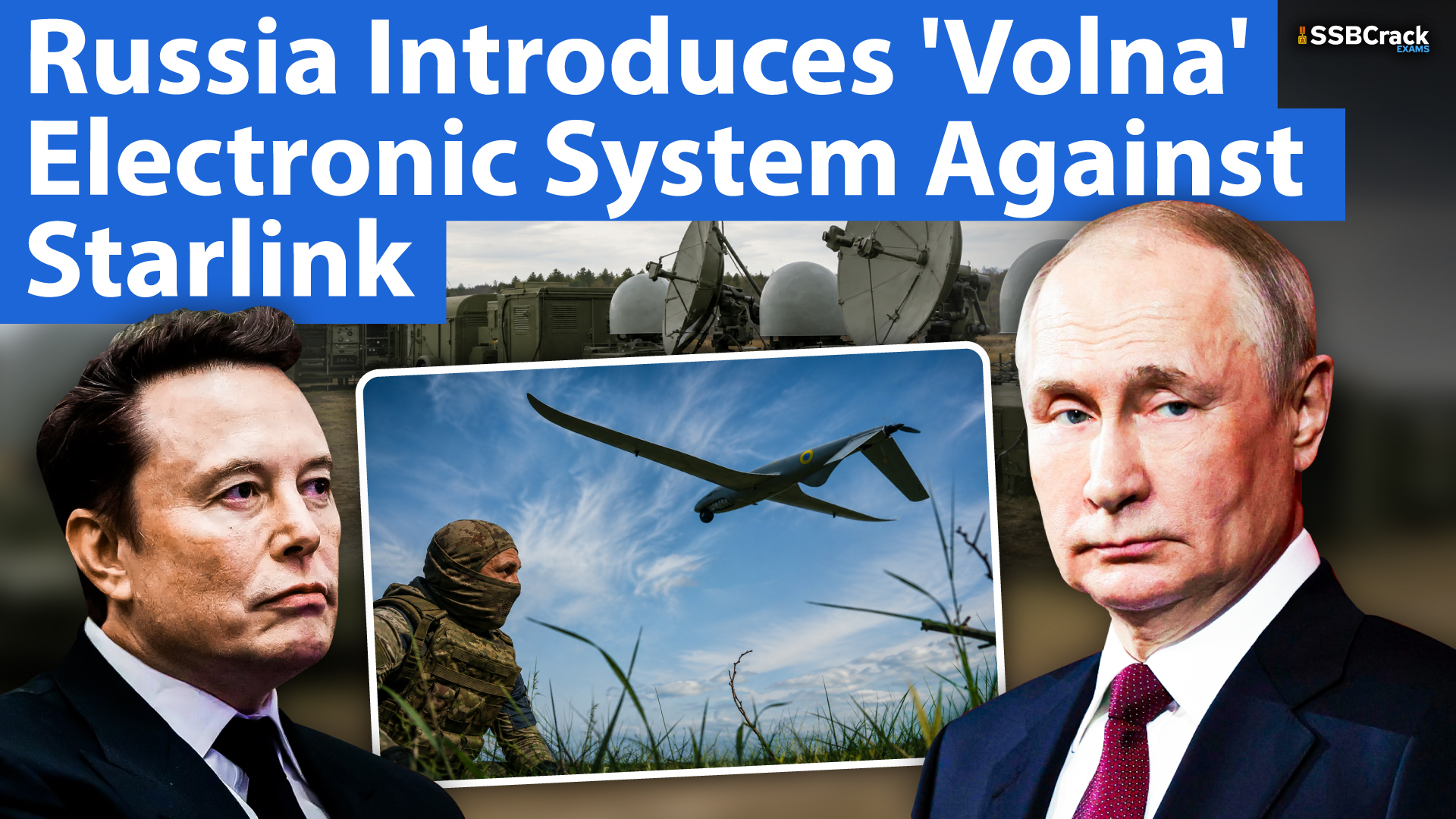
Russia has unveiled a new electronic warfare system named Volna Kupol Garant, designed to interfere with Starlink satellite communications by targeting satellites instead of ground terminals. The system represents a new approach to space-based electronic warfare.
Russia Introduces ‘Volna’ Electronic Warfare System Against Starlink
Russia has unveiled a new electronic warfare system named Volna Kupol Garant, designed to interfere with Starlink satellite communications by targeting satellites instead of ground terminals. The system represents a new approach to space-based electronic warfare.
Key Highlights
- Uses high-frequency narrow-beam radio transmissions.
- Targets Starlink satellites directly rather than user terminals.
- Temporarily blocks satellites from receiving signals from ground stations.
- Does not physically damage satellites.
- Intended to counter military dependence on satellite-based communication networks.
Significance
The development highlights the increasing role of space-based communications in modern warfare and demonstrates the evolution of electronic warfare technologies targeting satellite constellations.

Starlink: SpaceX’s Satellite Internet Constellation
Starlink is a satellite-based broadband internet service developed and operated by SpaceX, the aerospace company founded by Elon Musk. It provides high-speed, low-latency internet by using a large constellation of satellites in Low Earth Orbit (LEO) instead of relying on traditional ground-based communication infrastructure.
Background
The Starlink project was launched to provide reliable internet access to remote and underserved regions where conventional broadband services are unavailable or unreliable. Unlike traditional communication satellites placed in geostationary orbit, Starlink satellites orbit much closer to Earth, significantly reducing communication delay.

Key Features
- Developed and operated by SpaceX.
- Uses thousands of Low Earth Orbit (LEO) satellites.
- Provides high-speed broadband internet with low latency.
- Offers internet connectivity to homes, businesses, ships, aircraft, and remote locations.
- Can be deployed rapidly in disaster-hit or conflict-affected regions.
How Starlink Works
- Thousands of small satellites orbit the Earth at an altitude of approximately 550 km.
- Users install a Starlink terminal (dish antenna) that communicates directly with the satellites.
- The satellites relay data to ground stations connected to the global internet network.
- Some newer satellites also use laser inter-satellite links, enabling communication between satellites without relying solely on ground stations.
Advantages
- High-speed internet in rural and remote areas.
- Lower latency than traditional geostationary satellites.
- Quick deployment during emergencies and natural disasters.
- Supports communication in regions lacking fibre-optic infrastructure.
Challenges
- Large satellite constellations increase the risk of space debris.
- Bright satellites can interfere with astronomical observations.
- Requires regulatory approval from individual countries before commercial operation.
- Satellite internet services may be more expensive than conventional broadband in some areas.
Defence and Strategic Importance
Starlink has become strategically significant because it provides resilient communications during conflicts and disasters. Military forces can use satellite internet for:
- Secure battlefield communications
- Intelligence sharing
- Drone and unmanned system operations
- Navigation support
- Command and control in remote areas
Its widespread use has also made it a focus of electronic warfare (EW) efforts, where countries are developing technologies to disrupt or interfere with satellite-based communications.


