




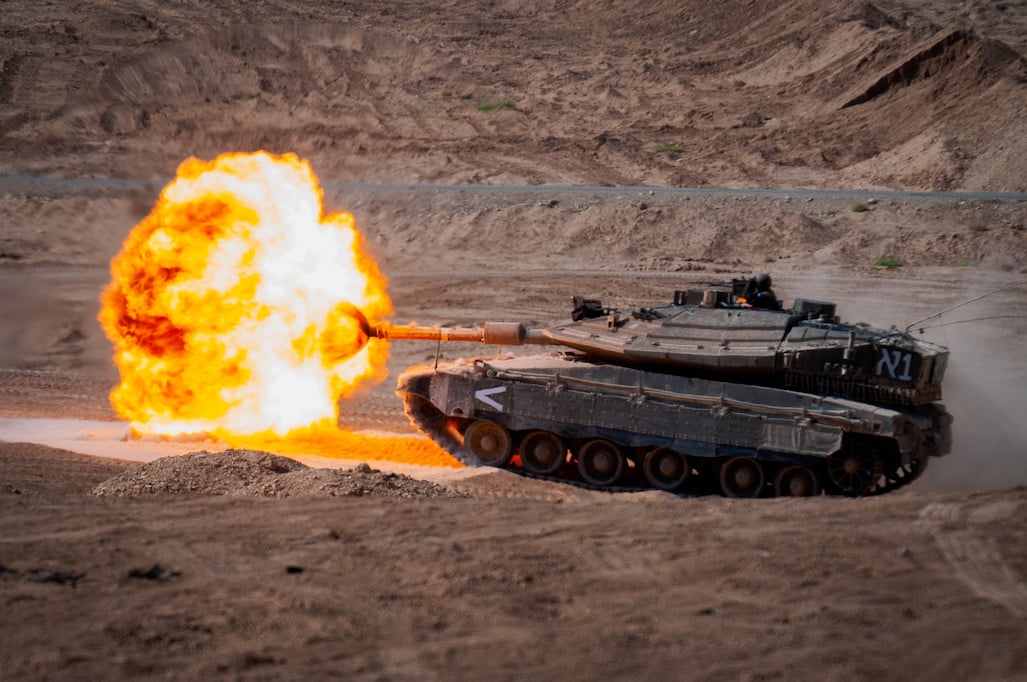
Built around the realities of ambushes, confined terrain, and close-range combat, the Israeli Merkava tank prioritizes crew survivability as a fundamental design feature rather than a secondary consideration. This unique architecture reflects operational imperatives where protecting personnel is as essential as achieving battlefield effectiveness.
As Israel’s primary main battle tank (MBT) and the backbone of the Israel Defense Forces’ armored corps, the Merkava was developed to handle frontline operations across diverse combat environments. It has been an integral part of Israeli ground warfare doctrine since its inception, designed for the kind of combat characterized by dense urban terrain, sudden ambushes, and close engagements.
A significant advancement in the Merkava’s design is the inclusion of the Trophy Active Protection System in its latest variants. This system has the capability to detect and intercept incoming anti-tank missiles and rockets, enhancing the tank’s defensive capabilities.
Overview
The Merkava is notable for its distinctive features, including:
- Type: Main battle tank
- Role: Armored warfare, urban combat, defensive operations
- Country of Origin: Israel
- Crew: 4 (commander, gunner, loader, driver)
- Armament: Main – 120mm smoothbore gun; Secondary – Coaxial and roof-mounted machine guns
- Weight: Approximately 65 to 70 tonnes
- Speed: Up to 65 km/h on roads; 50 km/h off-road
- Engine: V12 diesel engine with varying power outputs across variants
- Protection Systems: Modular composite armor, along with active protection systems for later versions
Origins
The Merkava program began in the 1970s as Israel reevaluated its armored warfare strategy in response to regional conflicts and a desire to decrease dependence on foreign military suppliers. Major General Israel Tal, a key figure and veteran tank commander, greatly influenced the program’s foundation. His philosophy emphasized that the survival of the crew was as vital as the destruction of enemy forces.
The trajectory of the Merkava includes several key milestones:
- 1979: The Merkava Mk 1 officially enters service.
- 1980s-1990s: Subsequent models, Mk 2 and Mk 3, see improvements in protection, mobility, and fire control.
- 2004: The introduction of the Merkava Mk 4, representing the most advanced variant equipped with modular armor and the Trophy system.
- 2010s: Further integration of active protection systems to adapt to modern threats.
Variants and Progressions
The Merkava’s design has evolved through various iterations:
- Merkava Mk 1 and 2: Laid the groundwork for the Merkava’s design ethos.
- Merkava Mk 3: Featured an upgraded 120 mm main gun and enhanced mobility.
- Merkava Mk 4: Introduced significant advancements including a redesigned chassis and the integration of sophisticated active protection systems.
- Merkava Mk 4 Barak: This latest modernization emphasizes digital battlefield capabilities and enhanced situational awareness through artificial intelligence.
Key Features and Performance
Protection-Centered Design: The tank’s engine placement at the front acts as an additional protective shield for the crew, enhancing survivability against frontal attacks.
Firepower and Targeting Systems: Equipped with a potent 120mm smoothbore gun capable of firing various advanced munitions, the Merkava features cutting-edge fire control systems for day and night operations.
Mobility: Despite its weight, the Merkava is engineered for maneuverability, enabling operations in rough and urban settings where quick repositioning is essential.
Infantry Support: The tank’s rear hull access allows infantry to enter and exit the vehicle easily, enabling it to assist in casualty evacuation, thus enhancing safety during troop movements.
Challenges and Limitations
The Merkava’s design and capabilities bring certain limitations, including its heavier build, which can make air transport more difficult. The logistics and maintenance requirements can also be substantial. Moreover, it is less prevalent in export markets compared to other battle tanks.
Combat History
While primarily utilized by the Israeli Defense Forces, the Merkava has had limited export, making it a unique feature of the Israeli military. Key operational engagements include:
- 1982 Lebanon War: Marks one of its significant early combat utilizations.
- Second Intifada: Frequently deployed in urban counterinsurgency operations.
- Gaza Conflicts: Utilized for direct fire support and breaching fortified enemy positions.
The recent escalation post-October 7, 2023, saw Merkava Mk 4 tanks rapidly deployed to lead ground operations, providing sustained fire support but also facing significant risks during engagements.
Future Developments
Looking to the future, the Merkava appears poised to advance towards more networked and digitally integrated warfare systems, particularly in its Mk 4 Barak variant. Future developments are likely to emphasize enhancements like unmanned systems support and improved active protection without merely focusing on increasing armor or firepower.


