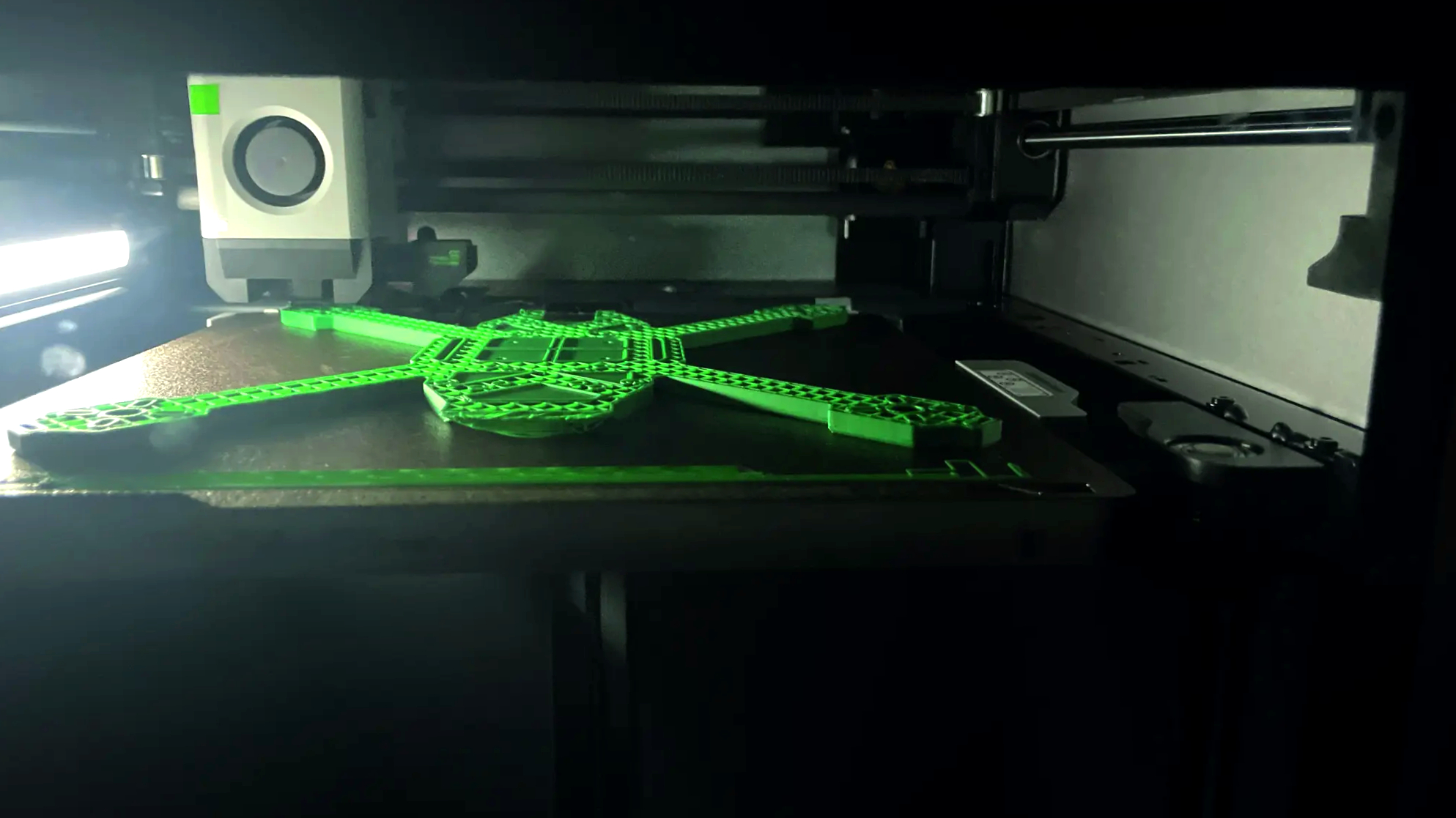
During a recent training exercise in Kenya, the British Army deployed Chinese-made 3D printers to manufacture tactical unmanned aerial systems, raising significant concerns regarding the security implications associated with technology sourced from Beijing. Soldiers from the 3rd Battalion “The Rifles” utilized portable printers developed by Shenzen-based Bambu Labs, setting up a makeshift workshop under a camouflaged canopy powered by a small generator. This innovative setup enabled them to produce first-person‑view (FPV) kamikaze drones on-site for simulated strike missions near Nanyuki.
The troops successfully printed five attack drones during this trial, along with spare parts, with each drone’s airframe taking approximately three and a half hours to complete. This agile production process allowed the team to create drone bodies right beside operational vehicles, where technicians subsequently equipped the drones with cameras, batteries, and circuit boards, ready for deployment.
Major Steve Watts, commanding officer of The Rifles and lead for the experiment, confirmed that the army obtained special approval to build and operate these drone platforms. He remarked, “I believe it’s the first time anyone in the army has done this,” adding that broader adoption of such technology could potentially enhance the military’s frontline capabilities significantly.
The exercise highlighted various advantages of 3D printing in a military context. Each kamikaze drone produced during the trial cost around £400 ($525), starkly lower than the roughly £2,000 ($2,630) required for commercially available models. This suggests that the 3D-printed drones could be customized for specific missions and produced rapidly; as Maj. Watts pointed out, the use of 3D-printed drones in Ukraine illustrates the speed with which bespoke devices can be created, stating, “We could print bespoke FPVs now and fly them the same day.”
Nevertheless, the trial was not without its difficulties. The printers experienced malfunctions under extreme temperatures, and managing power in field conditions proved to be challenging.
Amidst the enthusiasm for potential cost reductions and operational flexibility, serious security concerns have surfaced regarding the use of technology manufactured by Chinese firms. Defense analysts have criticized this decision, expressing fears that the UK could be placing itself at risk of foreign surveillance due to China’s National Intelligence Law, which permits local authorities to request data from domestic companies.
Defence expert Robert Clark described the situation as “outrageous,” suggesting that it exposes vulnerabilities in the UK’s national security framework. He emphasized the gravity of the situation by asserting, “We may as well be handing them the keys to the back door of our security systems.” He warned that this reliance on Chinese technology could lead to severe repercussions for both the Army and the Government.
In response to these apprehensions, the UK Ministry of Defence has assured that the 3D printers are not connected to military networks and maintains that there is no evidence indicating they store sensitive information that could be accessed by Chinese authorities.