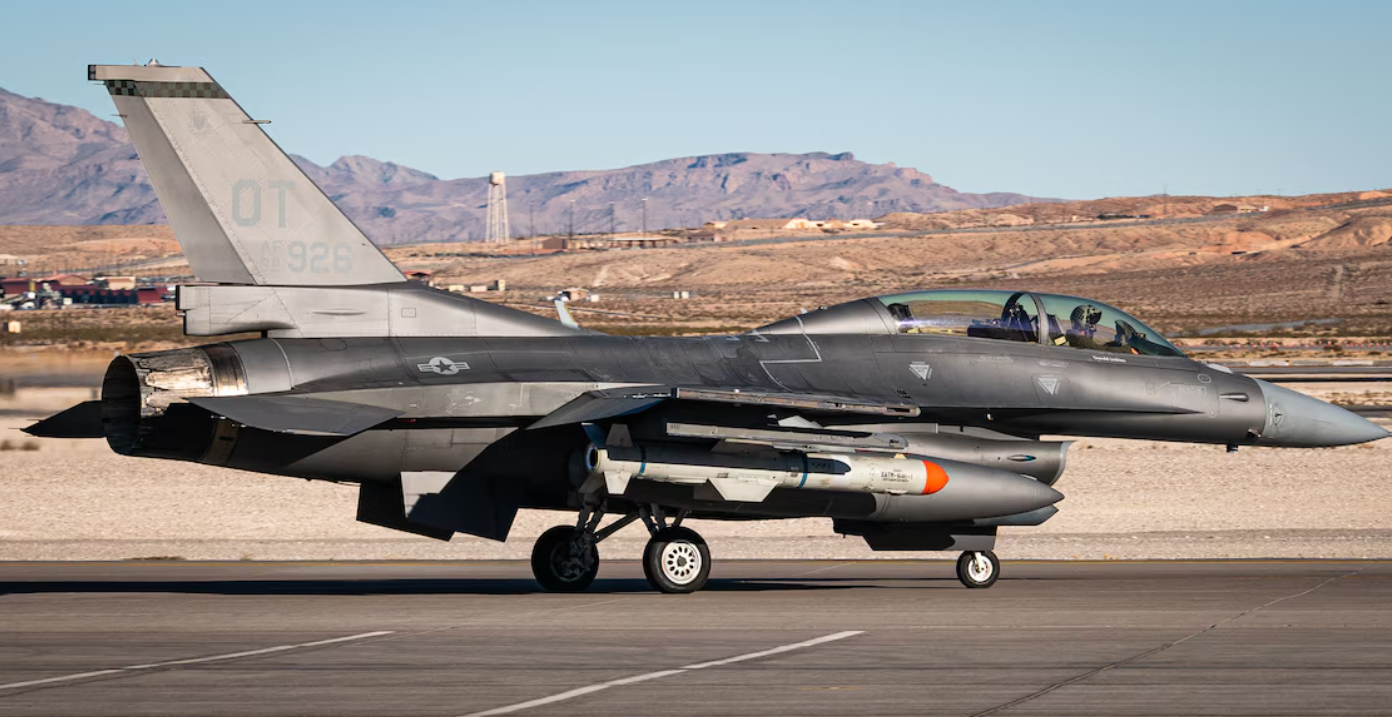
The US Air Force has made significant advancements in weapon integration capabilities with the successful testing of a US Navy Harpoon missile system on an F-16 Fighting Falcon at Nellis Air Force Base in Nevada. This milestone demonstrates innovative military engineering, as the test team implemented a gateway system that facilitated seamless communication between the Harpoon missile and the F-16 without needing to modify either platform.
The gateway system functions as a “translator,” enabling the combat jet to recognize the incoming missile and transmit necessary commands effectively. This approach, adopted by the US Air Force’s 53rd Test and Evaluation Group, has markedly streamlined the integration process, allowing the Air Force to equip aircraft with new weapon capabilities in significantly reduced timeframes. The Air Force stated, “The execution of this test event showcases a viable pathway for rapidly integrating advanced weaponry onto existing platforms, potentially transforming traditional timelines that previously spanned several years.”
The Harpoon missile itself is an all-weather, long-range anti-ship weapon developed by Boeing, capable of being launched from various platforms including ships, submarines, shore batteries, and aircraft. It boasts a diameter of 13.5 inches (34.3 centimeters) and has a weight of approximately 1,160 pounds (526 kilograms). Depending on its configuration, the missile varies in length, measuring 182.2 inches (4.63 meters) for ship-launched versions and 151.5 inches (3.85 meters) for those launched from aircraft.
The missile employs mid-course guidance alongside an active radar seeker to effectively track and engage surface targets. The Harpoon is also compatible with Air Force B-52H bombers, which can carry up to 12 of the missiles. Since advancing with the Harpoon Block II upgrade in 1998, which introduced GPS-assisted inertial navigation, the missile has enhanced its capabilities for both land attacks and anti-ship operations.
This recent achievement in integrating the Harpoon missile onto the F-16 represents a promising development in military readiness and versatility, opening avenues for future adaptations of existing airframes to accommodate modern weaponry efficiently.