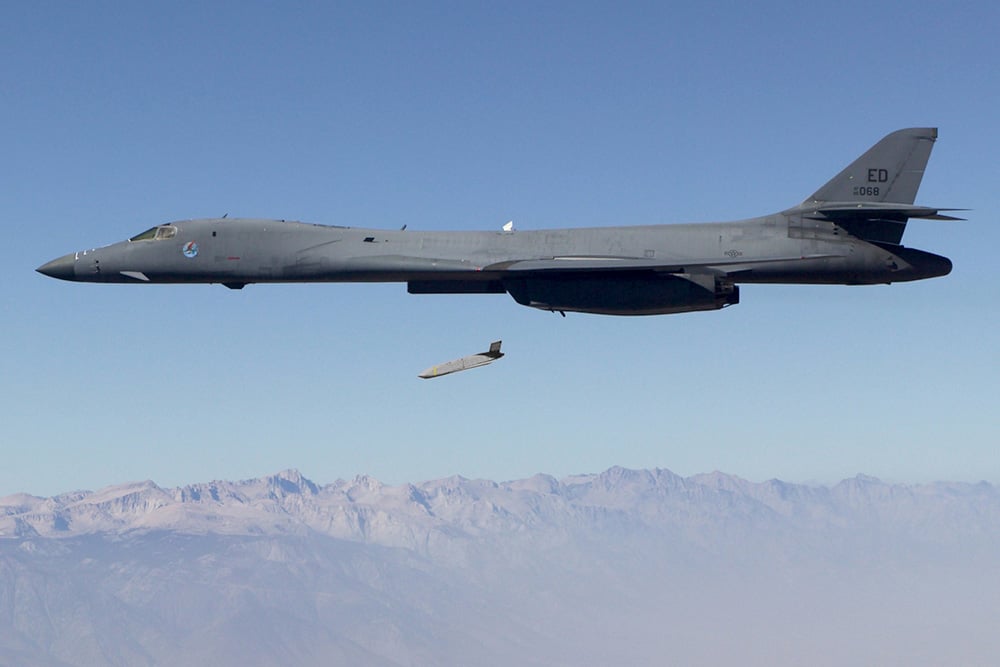
In a rapidly evolving military landscape marked by contested airspace, the ability to engage well-defended targets from a safe distance is essential for modern conflict. This need is being met by the AGM-158 Joint Air-to-Surface Standoff Missile (JASSM), a family of stealth cruise missiles that provide U.S. and allied forces with long-range precision capabilities against heavily fortified targets.
The JASSM system features advanced stealth technology, autonomous guidance, and penetrating warhead capabilities, positioning it as a vital asset in contemporary military operations. The missile’s design helps mitigate risks to aircraft by allowing them to strike targets without entering hostile airspace, making it a critical consideration for adversaries planning defensive strategies.
The concept of the JASSM emerged following post-Cold War military engagements, which highlighted a significant need for standoff munitions that could deliver precision strikes while keeping pilots out of harm’s way. Recognizing this gap, the Pentagon commissioned Lockheed Martin in the late 1990s to create a missile that integrated low observable technology, autonomous operation, and precise guidance mechanisms.
The resulting missile is capable of being launched from a variety of platforms, including fighters and bombers, allowing aircraft to remain safely outside enemy defenses while engaging high-value targets. As adversary missile systems evolved, Lockheed Martin introduced extended-range variants of the JASSM to enhance its operational reach.
The design of the JASSM incorporates a low-observable airframe, minimizing its radar signature to increase survivability in contested environments. The missile can travel approximately 370 kilometers (230 miles) for the original model, with newer versions achieving much greater distances. It carries a 450-kilogram (992-pound) blast-fragmentation warhead optimized for penetrating hardened targets.
Several key variants of the JASSM exist, each with distinct features and roles:
-
AGM-158A (JASSM): The baseline version, featuring GPS/INS guidance coupled with an imaging infrared seeker. While effective, it has limitations in range compared to its extended-range counterparts. Notably, it was utilized in the 2018 strikes on Syria.
-
AGM-158B (JASSM-ER): This extended-range variant can reach approximately 900 kilometers (559 miles) thanks to improvements in engine efficiency and avionics. It has been widely procured by the U.S. and its allies for long-range deterrence.
-
AGM-158C (LRASM): Designed specifically for maritime and anti-ship missions, this version incorporates autonomous target recognition capabilities, making it effective in complex environments at sea.
- AGM-158D (JASSM-XR): Currently in development, this extreme-range variant is projected to achieve a range of 1,800 kilometers (1,118 miles). It aims to provide unprecedented standoff capabilities, particularly in the Pacific and against peer competitors.
The integration of the JASSM into U.S. defense strategies has positioned it as a coalition asset, with numerous allied nations procuring its extended-range variants, thereby enhancing their deterrent and strike capabilities in critical regions such as Europe and the Indo-Pacific.
Economically, the JASSM’s affordability compared to manned air missions makes it an attractive option for military planners. The baseline JASSM is estimated to cost around $1 million, while the advanced LRASM can exceed $3.5 million per unit. Lockheed Martin has secured substantial Pentagon contracts to ensure robust production levels, solidifying JASSM’s status as a significant player within modern missile development.
Since its operational debut in coalition strikes in April 2018, the JASSM has proven its efficacy, including in high-profile missions such as the elimination of ISIS leader Abu Bakr al-Baghdadi in 2019. Demand from allied nations like Japan and Finland has further cemented JASSM’s status as a strategic munition, extending its reach beyond U.S. forces to international partners.
Looking ahead, the future trajectory of the JASSM program is closely tied to advancements in technology and the evolving strategic landscape. With projects like the JASSM-XR aiming to achieve ranges nearing 2,000 kilometers, the missile is anticipated to be integrated with next-generation platforms, such as the B-21 Raider stealth bomber, ensuring the U.S. can maintain a global precision strike capability well into the future. As adversaries enhance their air defense systems, the JASSM remains a cornerstone of U.S. and allied military power, offering the ability to strike decisively from distances that keep pilots safe.