




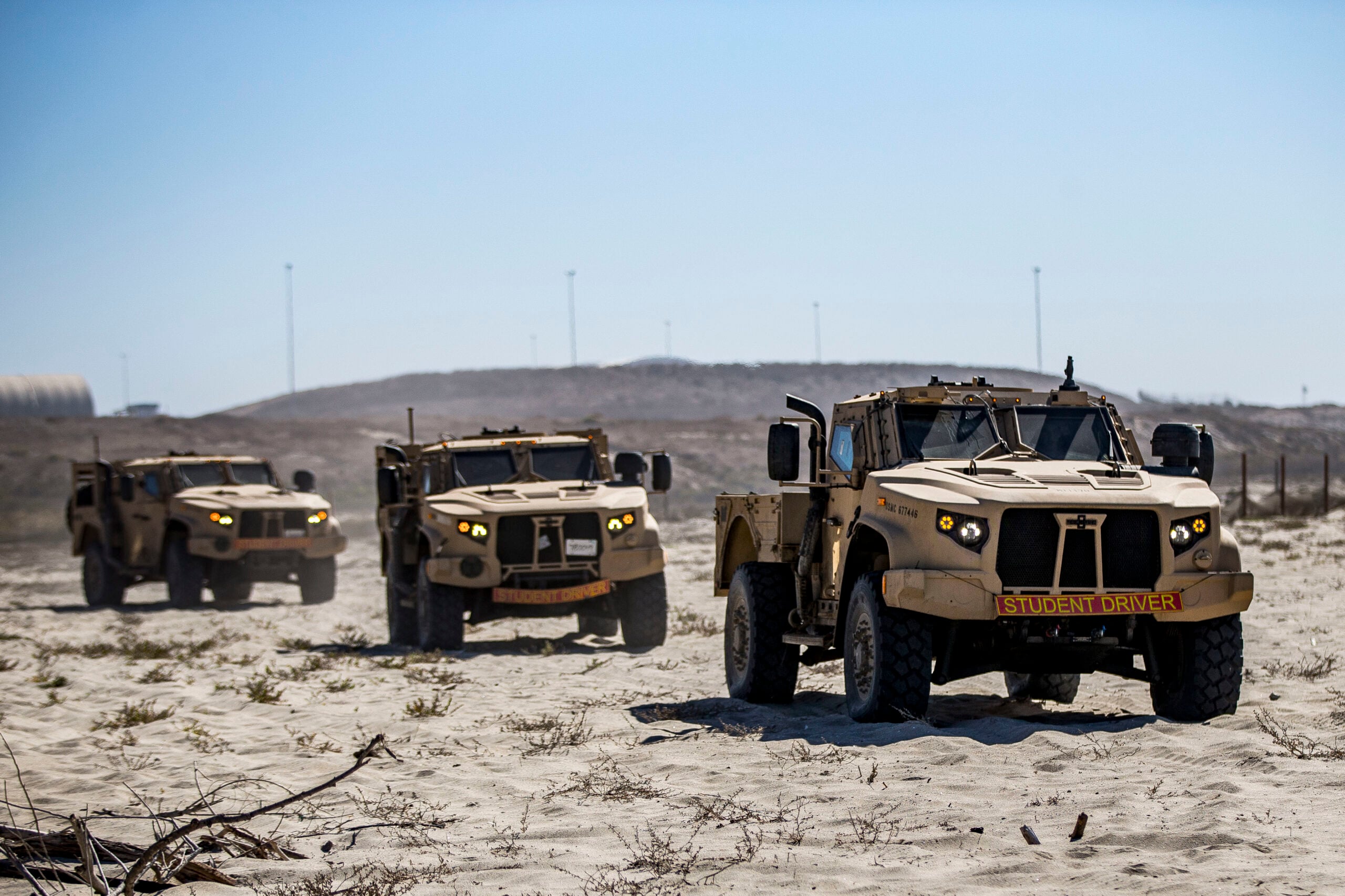
The US Marine Corps has initiated a request for information (RFI) aimed at identifying potential additional suppliers for its Joint Light Tactical Vehicle (JLTV) program. This initiative underscores a need for commercially available or non-developmental platforms that can be integrated into service rapidly, without necessitating extensive new vehicle development.
This strategic move is anticipated to position Oshkosh Defense as a potential returning collaborator following its recent loss of the follow-on JLTV contract to AM General in 2023. The RFI signifies a renewed commitment from the military towards JLTV expansion, particularly after the US Army paused the vehicle’s acquisition less than a year ago to focus on lighter and more mobile vehicle alternatives.
Jennifer Moore, the program executive officer for land systems at the US Marine Corps, reiterated the unwavering requirement to replace the entire Humvee fleet with JLTVs. “Our requirement remains steadfast. We are replacing our entire Humvee fleet with the Joint Light Tactical Vehicle, period. We’ll have a unitary fleet going forward, and there is no change,” she stated.
The RFI outlines an ambitious potential requirement for up to 7,500 vehicles and 4,000 trailers over an initial five-year contract, with the option to extend for an additional five years. The Marine Corps expects to receive three production-representative vehicles within 90 days following the contract award, with an anticipated deliverance of 50 vehicles and trailers within a 10-month timeframe.
Oshkosh, the original manufacturer of the JLTV, has successfully delivered over 24,000 vehicles worldwide since 2015, including more than 6,000 units for the US Marine Corps alone. In its response to the RFI, the company emphasized its unique capability to swiftly produce combat-proven JLTVs at scale.
Specifications detailed in the RFI highlight that the desired JLTV or equivalent platforms should possess an approximate payload capacity of 3,500 pounds for four-door variants and 5,100 pounds for two-door models. Furthermore, they must feature a towing capacity of up to 7,500 pounds, scalable armor protection, and the ability to ford water up to 60 inches deep.
The military’s operational requirements extend to vehicles that can function in environments where 70 percent of missions are off-road and can generate 10 kilowatts of on-board power, in addition to integrating seamlessly with existing logistics and training systems. Essential further capabilities include anti-lock braking and electronic stability control systems, front- and rear-facing cameras, compatibility with trailers, parts commonality across vehicles and trailers, and adherence to the Pentagon’s cybersecurity and risk management standards.


