





The US Senate has approved a Bill by an 86–11 vote that seeks to increase economic pressure on Russia by targeting countries that continue to purchase Russian oil and natural gas. The proposed legislation could allow the United States to impose tariffs of up to 100% on imports from the five largest buyers of Russian energy.
US Targets Russian Oil: Why India and Global Markets Are Concerned
What Is the Proposed US Legislation?
The legislation is known as the Lindsey O. Graham Sanctioning Russia and Iran Act of 2026. The current version is considerably less severe than the original proposal.
The earlier version had proposed a potential 500% tariff on countries purchasing Russian energy. The revised Bill reduces the maximum proposed tariff to 100% and focuses on the five largest buyers of Russian oil and natural gas.
After clearing the Senate, the Bill is expected to move to the US House of Representatives, which is scheduled to reconvene on August 31.
However, Senate approval does not mean that the legislation will automatically become law. Its future will depend on further consideration in the House and the position taken by the US administration.
Why Is India Particularly Concerned?
India is heavily dependent on imported crude oil. More than 88% of India’s crude-oil requirements are met through imports, while Russia currently accounts for more than half of India’s crude imports.
This makes any major disruption to Russian oil supplies a significant concern for India’s energy security.
Russian crude became particularly attractive to Indian refiners after Western countries reduced their purchases following Russia’s invasion of Ukraine in February 2022. Russia responded by offering discounted crude to willing buyers, including Indian refiners.
As a result, Russia moved from being a relatively small supplier to becoming India’s leading source of crude oil.
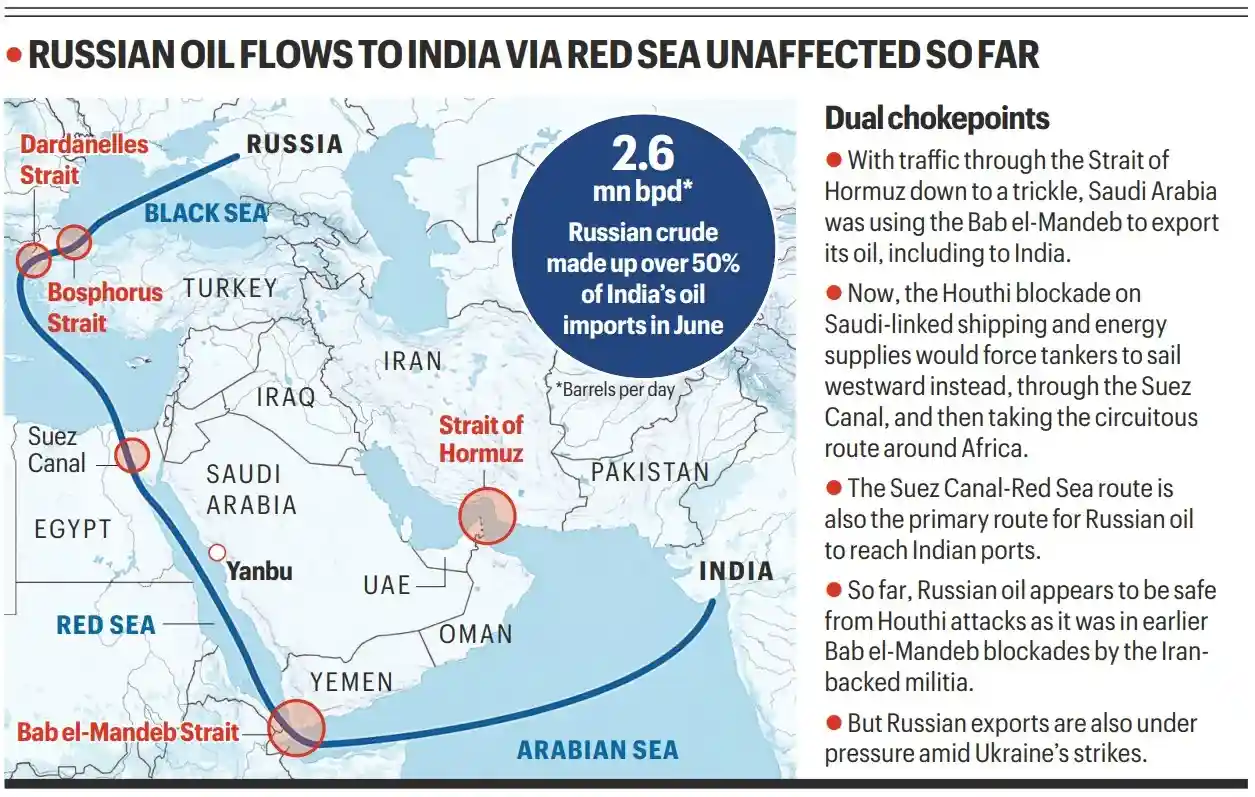
India’s Russian Oil Imports
According to the data cited in the material, India’s Russian crude purchases increased to around 2.7 million barrels per day during June–July, representing more than half of the country’s total oil imports.
The importance of Russian supplies has become even more visible amid disruptions and uncertainty in the West Asian energy market.
For Indian refiners, Russian crude remains an economically competitive and practically important source of supply. Replacing such a large volume quickly could be difficult.
Why Could the Bill Affect the Global Oil Market?
The proposed legislation comes at a sensitive time for international energy markets.
West Asia remains a major source of global oil supplies, and the crisis surrounding the Strait of Hormuz has already created concerns about energy transportation and availability.
If Russian oil were suddenly removed from international markets, the reduction in supply could create another major shock.
Lower global availability could push crude prices higher, increasing costs for:
- Transport
- Manufacturing
- Electricity generation
- Petrochemical industries
- Consumers
Higher crude prices could therefore affect not only India but also economies across the world.
The Bill Has Some Important Exceptions
Although the proposed tariffs appear severe, the revised legislation contains provisions that could provide governments with some flexibility.
One important feature is the power given to the US President to waive the application of the proposed measures under specified circumstances.
This provision could become particularly important for India if the legislation eventually becomes law.
India could seek an exemption or waiver from Washington to protect its energy security while continuing discussions on broader economic and trade issues.
Impact on India-US Relations
The proposed sanctions also come at a sensitive point in India-US trade negotiations.
India and the United States have been working towards greater trade cooperation. A measure that significantly increases the cost of India’s Russian oil-related trade could create additional friction between the two countries.
Therefore, Washington would have to balance its strategic objective of putting pressure on Russia with its broader economic relationship with India.
For New Delhi, the priority would be to communicate the importance of maintaining reliable and affordable energy supplies.
Why Is Russian Oil Difficult for India to Replace?
Following the Russia-Ukraine conflict, several Western countries reduced their purchases of Russian crude. Russia subsequently offered discounts to countries that continued buying its oil.
Indian refiners increased their purchases because the discounted Russian crude offered an economically attractive alternative.
The shift also helped India diversify its sources of supply and reduce its exposure to disruptions from traditional suppliers.
Consequently, immediately replacing Russian crude with alternative supplies could prove difficult and potentially expensive.
What Could India Do If the Bill Becomes Law?
If the legislation is enacted, India could explore several diplomatic and economic options.
1. Seek a US Waiver
The presidential waiver provision could provide an important avenue for India to request an exemption.
2. Continue Diplomatic Engagement
India could communicate its energy-security requirements directly to Washington while continuing negotiations on trade and economic issues.
3. Diversify Oil Sources
India could continue increasing supplies from different international markets to reduce excessive dependence on any single source.
4. Prepare for Price Volatility
Indian policymakers and refiners may need to prepare for possible increases in international crude prices if Russian supplies are disrupted.
What Are Analysts Saying?
The key uncertainty is whether the Bill will ultimately become law and, if enacted, how aggressively its provisions will be implemented.
The legislation has already undergone substantial changes from its original version. The proposed tariff has been reduced from 500% to a maximum of 100%, while provisions for exemptions and presidential waivers provide additional flexibility.
These changes suggest that policymakers are attempting to balance geopolitical pressure on Russia with the possible economic consequences of disrupting global energy supplies.
Why the Strait of Hormuz Matters
The situation becomes more complicated because of developments surrounding the Strait of Hormuz, one of the world’s most important energy routes.
Any major disruption to oil transportation through the Strait can reduce the availability of crude in international markets.
If Russian supplies were simultaneously restricted, global oil markets could face pressure from two directions—reduced Gulf-region flows and reduced Russian exports.
Such a combination could trigger a substantial increase in crude prices.
Will the Bill Become Law?
At present, the Bill’s final outcome remains uncertain.
The Senate’s 86–11 vote represents a significant political endorsement, but the legislation still has to move through the House of Representatives.
Even if the House approves it, implementation could depend heavily on decisions by the US administration, particularly because the revised Bill contains waiver and exemption provisions.
The Bill has already been substantially modified from its original form, indicating that economic considerations could influence its final shape.
India’s Key Challenge
India faces a difficult balancing act.
On one side, India needs affordable and reliable crude oil supplies to support its rapidly growing economy. On the other, continuing to purchase large quantities of Russian crude could expose Indian businesses to potential US trade penalties if the legislation becomes law.
India therefore has an interest in maintaining its energy relationship with Russia while simultaneously protecting its economic and trade relationship with the United States.


