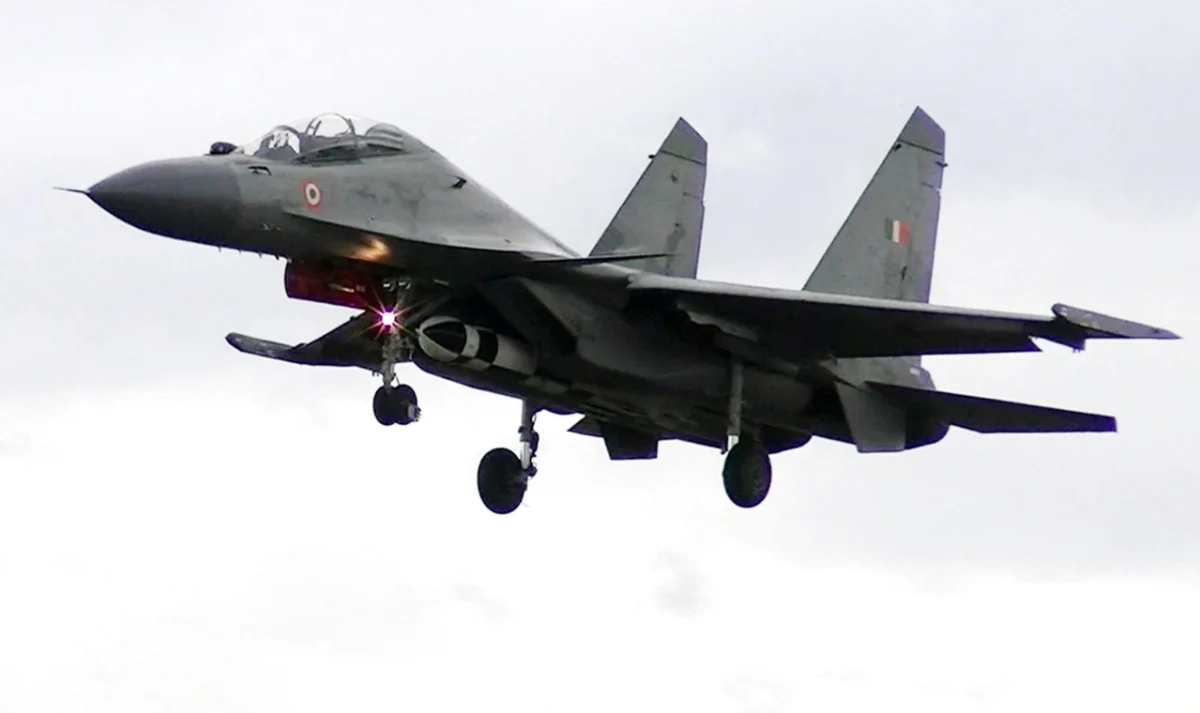
If you are preparing for AFCAT, the NDA or CDS examinations, or the Air Force Selection Board, you should know the main weapons of the Indian Air Force (IAF). Questions on missiles such as BrahMos, Astra and Akash appear often in general knowledge papers. At the interview, a candidate who wants to fly for the IAF may also be asked what weapons its fighters carry.
A fighter aircraft is only as effective as the missiles it carries. The IAF uses missiles for three broad jobs: shooting down enemy aircraft in the air (air-to-air missiles), striking targets on land or at sea from long distances (air-to-surface and cruise missiles), and protecting Indian airspace and air bases from the ground (surface-to-air missiles).
This article covers 10 important missiles in IAF service. They include Indian designs such as Astra and Akash, joint ventures such as BrahMos and MRSAM, and imported weapons such as Meteor and the S-400. The numbering is for easy reading, not a ranking. Ranges are approximate, because a missile’s real reach depends on launch height, speed and the target.
1. BrahMos-A Supersonic Cruise Missile
Type: Air-launched supersonic cruise missile (air-to-surface)
Origin/Maker: BrahMos Aerospace, an India–Russia joint venture of DRDO and Russia’s NPO Mashinostroyeniya
Carrier aircraft: Su-30MKI
Speed/Range: About Mach 2.8; extended-range versions of about 450 km
First air launch: 22 November 2017
BrahMos-A is the air-launched version of the BrahMos cruise missile, whose name joins the Brahmaputra and Moskva rivers. The air version weighs about 2.5 tonnes, lighter than the ground-launched missile, so that the Su-30MKI can carry one under its fuselage. Fitting it needed major mechanical, electrical and software changes to the aircraft. HAL did the mechanical and electrical work, and IAF engineers wrote the aircraft software.
On 22 November 2017 an IAF Su-30MKI fired BrahMos-A at a ship target in the Bay of Bengal. The IAF said it was the first air force in the world to fire an air-launched Mach 2.8 surface-attack missile of this class. About 40 Su-30MKIs have since been modified to carry it. Because it flies at nearly three times the speed of sound, the enemy has very little time to react. This makes it one of the IAF’s most important weapons for striking well-defended targets on land and at sea.
2. SCALP-EG (Storm Shadow) Cruise Missile
Type: Long-range, air-launched stealthy cruise missile
Origin/Maker: MBDA (France/United Kingdom)
Carrier aircraft: Rafale
Range: More than 250 km
Inducted: With the Rafale fleet, from 2020
SCALP-EG, known in British service as Storm Shadow, is a deep-strike weapon. It was designed to destroy hardened, high-value targets such as command bunkers, ammunition dumps and air-base facilities from far outside the range of enemy air defences.
The missile flies low and follows the terrain, and its shape makes it hard to detect on radar. Near the target it climbs, then dives onto it and fires a penetrating warhead that can break through concrete. India bought the SCALP as part of the weapons package for its 36 Rafale fighters. Indian media have widely reported that it was used in the strikes of Operation Sindoor in May 2025.
3. Meteor Beyond Visual Range Air-to-Air Missile
Type: Beyond visual range air-to-air missile (BVRAAM)
Origin/Maker: MBDA, a European consortium
Carrier aircraft: Rafale
Range: More than 100 km
Inducted: With the Rafale fleet, from 2020
Meteor is one of the most advanced air-to-air missiles in the world. Most air-to-air missiles use a rocket motor that burns out in a few seconds, after which the missile coasts and slows down. Meteor is powered by a ramjet, a ‘throttleable ducted rocket’, so it keeps its speed and can manoeuvre right up to the end of its flight.
This gives Meteor a very large ‘no-escape zone’: the area in which an enemy aircraft cannot escape by turning away. When the first Rafales arrived at Ambala in July 2020, Meteor gave the IAF a long-range air combat capability that no other aircraft in the region had at the time.
4. Astra Mk1 Air-to-Air Missile
Type: Beyond visual range air-to-air missile
Origin/Maker: India; designed by DRDO, produced by Bharat Dynamics Limited (BDL), Hyderabad
Carrier aircraft: Su-30MKI; integrated on the Tejas
Range: More than 100 km
Production order: ₹2,971 crore contract with BDL, 2022
Astra is India’s first indigenous beyond visual range air-to-air missile. In 2022 the Ministry of Defence signed a ₹2,971 crore contract with BDL for Astra Mk1 missiles for the IAF and the Navy. On 23 August 2023, a Tejas fired an Astra off the coast of Goa, an important step towards arming India’s own fighter with an Indian missile.
In July 2025 DRDO and the IAF flight-tested Astra with an indigenous radio-frequency seeker from a Su-30MKI off the Odisha coast, and the missile destroyed both high-speed unmanned targets. Work on an extended-range Astra Mk1 and on Astra Mk2, with a dual-pulse rocket motor for longer range, is continuing. The aim is to reduce India’s dependence on imported air-to-air missiles.
5. R-77 (RVV-AE) Air-to-Air Missile
Type: Beyond visual range air-to-air missile with active radar homing
Origin/Maker: Vympel, Russia
Carrier aircraft: Su-30MKI, MiG-29UPG
Range: About 80 km for the export version
The R-77, called RVV-AE in its export version, has long been the main beyond visual range missile of the IAF’s Russian-origin fighters. It is used by the Su-30MKI, the backbone of the fighter fleet, and by the upgraded MiG-29.
The R-77 has its own active radar seeker. In the final part of its flight it can find and follow the target by itself, so the launch aircraft can turn away after firing. It is often called a ‘fire-and-forget’ missile for this reason. The missile’s unusual lattice (grid) fins help it turn sharply. Over time, the indigenous Astra is expected to take over much of the role the R-77 plays today.
6. R-73 Close-Combat Missile
Type: Short-range, infrared-guided air-to-air missile
Origin/Maker: Vympel, Russia
Carrier aircraft: Su-30MKI, MiG-29UPG and Tejas Mk1
Range: About 30 km
Not every air battle is fought at long range. When fighters close in for a dogfight, the R-73 is the IAF’s main close-combat weapon on its Russian-origin jets and the Tejas Mk1. It homes in on the heat from an enemy aircraft’s engines.
The R-73 can be aimed with a helmet-mounted sight. The pilot only has to look at the target, and the missile can engage it even when it is well off the nose of the aircraft. This ‘high off-boresight’ ability is a big advantage in a turning fight. For the Jaguar and the newer Tejas Mk1A, the IAF has chosen the British ASRAAM for the same short-range role.
7. MICA Air-to-Air Missile
Type: Short- to medium-range air-to-air missile
Origin/Maker: MBDA, France
Carrier aircraft: Mirage 2000 (upgraded), Rafale
Versions: MICA IR (infrared seeker) and MICA EM (active radar seeker)
MICA arrived in the IAF with the upgrade of the Mirage 2000 fleet, the jets that fought in the Kargil War and carried out the Balakot air strike in 2019. India ordered the missile from France in 2012 as part of the upgrade, which turned the Mirage 2000 into the Mirage 2000I/TI standard. The Rafale also carries MICA.
MICA comes in two versions that share the same body. MICA IR uses an infrared seeker that gives off no signal of its own, so the target gets little warning. MICA EM uses an active radar seeker. Because MICA can be used both in a close dogfight and beyond visual range, it gives the pilot flexibility in combat.
8. S-400 Triumf ‘Sudarshan Chakra’
Type: Long-range surface-to-air missile system
Origin/Maker: Almaz-Antey, Russia
Range: Up to about 400 km, depending on the missile used
Contract: Five squadrons for about US$5.43 billion, signed in 2018
The S-400 is the longest-range air defence system in Indian service. In IAF service it is named ‘Sudarshan Chakra’, after the divine weapon of Lord Krishna. One S-400 unit combines long-range radars, a command post and launchers that can fire several types of missile, so it can engage fighters, surveillance aircraft, drones and missiles at different ranges and heights.
India signed for five squadrons in 2018. Four had been delivered by mid-2026, and the fifth is expected in early 2027. During Operation Sindoor in May 2025 the system played a major role. Air Chief Marshal A.P. Singh later said that the S-400 shot down Pakistani aircraft, including one large aircraft at a range of about 300 km. In March 2026 the Defence Acquisition Council approved the purchase of five more squadrons; that contract had not been signed as of November 2026.
9. MRSAM (Medium Range Surface-to-Air Missile)
Type: Medium-range surface-to-air missile system
Origin/Maker: Jointly developed by DRDO and Israel Aerospace Industries (IAI); missiles produced in India by BDL
Range: Up to 70 km
Inducted: First firing unit handed over to the IAF at Air Force Station Jaisalmer on 9 September 2021
MRSAM fills the gap between short-range systems such as Akash and long-range systems such as the S-400. It protects air bases and other important assets against fighter aircraft, helicopters, drones, guided and unguided munitions, and subsonic and supersonic cruise missiles.
According to the Ministry of Defence, MRSAM can engage several targets at the same time at ranges of up to 70 km, even in ‘saturation’ attacks where many threats arrive together. Its rocket motor and control system were developed in India and make the missile very manoeuvrable in the final phase of an interception. The system belongs to the same family as the Barak-8 missiles used on Indian Navy warships.
10. Akash Surface-to-Air Missile
Type: Short-range surface-to-air missile system
Origin/Maker: India; developed by DRDO, with Bharat Electronics Limited (BEL) as the prime production agency and missiles built by BDL
Range: About 25–30 km
Inducted into IAF: Formally on 10 July 2015 at Gwalior
Akash is India’s most successful home-grown air defence missile. The IAF formally inducted it in July 2015, although squadrons had begun deploying from 2013. One Akash battery can engage several targets at the same time, including fighters, helicopters, drones and cruise missiles. Its ramjet-powered missile keeps a supersonic speed throughout its flight.
Akash was part of the integrated air defence network that the government credited with defeating Pakistani drone and missile attacks during Operation Sindoor in May 2025. It has also been exported, to Armenia. A new-generation version, Akash-NG, with a longer range and an active seeker, has been under trial and is expected to strengthen the IAF’s air defence further.
Conclusion
Together, these missiles show how the IAF fights: long-range strike weapons such as BrahMos-A and SCALP, air-to-air missiles from the long-range Meteor down to the R-73, and a layered ground-based air defence shield of S-400, MRSAM and Akash.
The trend is clear. Indian-designed weapons such as Astra and Akash are taking a bigger share of the arsenal, and the next generation, including Astra Mk2, Akash-NG and the Rudram anti-radiation missiles, is in development or trials. For AFCAT, NDA and CDS aspirants, the aim is not to memorise every number. Understand what each missile does, which aircraft or unit uses it, and whether it is Indian or imported. That knowledge will help you in the written exam and at the Selection Board.
Frequently Asked Questions
1. Which is the longest-range missile in the Indian Air Force?
Among surface-to-air systems, the S-400 ‘Sudarshan Chakra’ has the longest reach, up to about 400 km. Among air-launched weapons, the BrahMos-A carried by the Su-30MKI has a range of about 450 km in its extended-range version.
2. What is India’s indigenous air-to-air missile?
Astra Mk1, designed by DRDO and produced by Bharat Dynamics Limited, is India’s first indigenous beyond visual range air-to-air missile. It has a range of more than 100 km and is used on the Su-30MKI, with integration on the Tejas.
3. Which IAF aircraft carries the BrahMos missile?
The Su-30MKI. About 40 of these fighters have been modified to carry the air-launched BrahMos-A.
4. What is the S-400 called in India?
The S-400 Triumf is called ‘Sudarshan Chakra’ in Indian service. India ordered five squadrons in 2018; four had been delivered by mid-2026.
5. Which missiles does the Rafale carry?
The IAF’s Rafales carry the Meteor beyond visual range air-to-air missile, the MICA air-to-air missile and the SCALP-EG long-range cruise missile, among other weapons.