


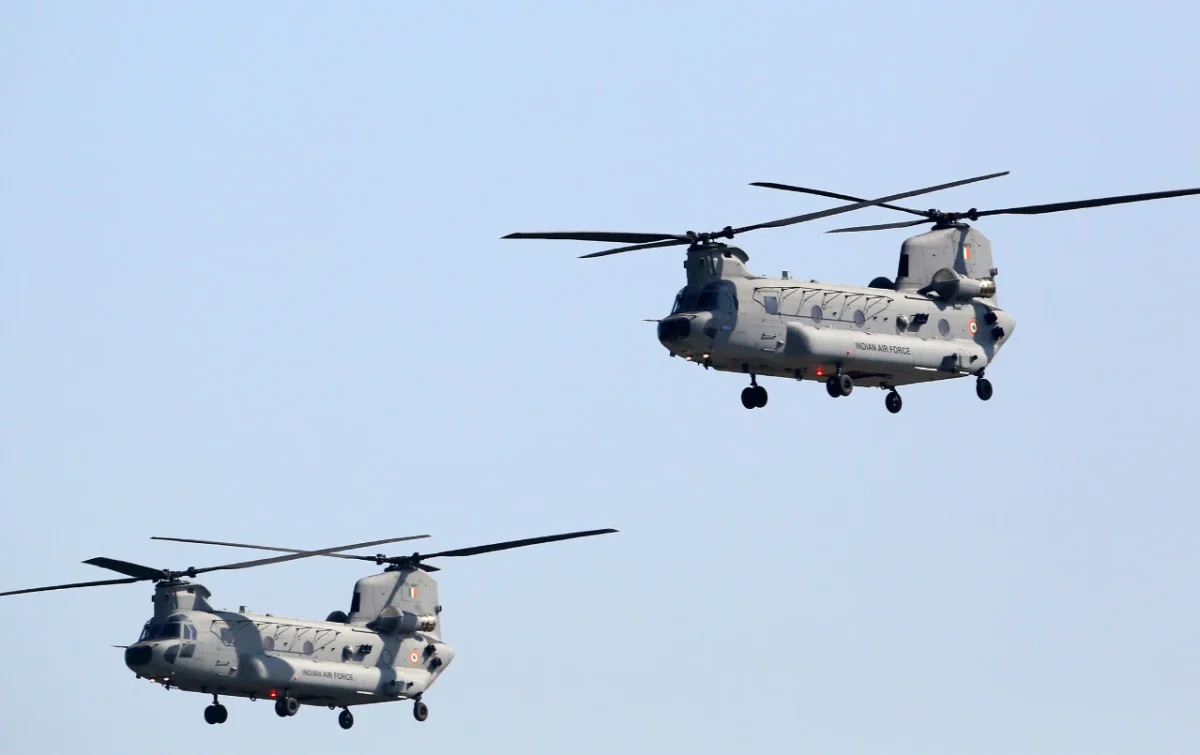
Fighter jets may own the skies, but helicopters are what get the Indian Air Force (IAF) closest to the ground. They land troops on 15,000-foot helipads in Ladakh, pull stranded families from flood waters, hunt tanks in the desert and lift artillery guns to posts that no road can reach.
For AFCAT, NDA and CDS aspirants, IAF helicopters are a steady source of static GK questions: which helicopter is indigenous, which one is the heavy-lifter, which unit flies the Apache and which display team flies the Dhruv. They also come up often in SSB interviews and group discussions on disaster relief, the China border and self-reliance in defence.
Here are 10 helicopters operated by the Indian Air Force, with the key facts you should know about each. One point to remember: the Indian Army has its own Army Aviation Corps, which flies several of the same types. This list looks only at the IAF, and the numbering is for easy reading, not a ranking.
1. Mi-17V5
Role: Medium-lift utility and transport
Manufacturer: Kazan Helicopters, Russia
Inducted: February 2012
Fleet: 151 delivered under two contracts (2008 and later), the last in 2016
The Mi-17V5 is the workhorse of the IAF’s helicopter fleet. India first ordered 80 of these helicopters in 2008 and followed up with more, taking the total to 151. They were formally inducted in February 2012 and now equip a large number of helicopter units across the country.
Compared to the older Mi-17s, the V5 has a glass cockpit, night-vision compatibility, a weather radar and more powerful engines. It can carry a section of fully armed troops or several tonnes of cargo inside the cabin or slung underneath, and it can also be fitted with rockets and machine guns for armed missions.
The Mi-17V5 has carried out some of the IAF’s largest rescue missions, including Operation Rahat during the 2013 Uttarakhand floods, and it regularly supports flood and cyclone relief. Sadly, it was also the helicopter involved in the December 2021 crash near Coonoor in Tamil Nadu that killed India’s first Chief of Defence Staff, General Bipin Rawat, and 13 others.
2. Mi-17 and Mi-17 1V
Role: Medium-lift utility, troop transport and armed support
Manufacturer: Soviet Union / Russia (Mil design)
Inducted: Mi-17 in the mid-1980s; Mi-17 1V in the early 2000s
Status: Older variants, being gradually replaced
Before the V5 arrived, the original Mi-17 and the improved Mi-17 1V were the backbone of the IAF’s medium-lift fleet. The Mi-17 is part of the famous Mi-8 family and joined the IAF in the mid-1980s. The Mi-17 1V, with more powerful engines for hot and high conditions, followed in the early 2000s.
These helicopters have served in almost every major IAF operation of the past four decades, from the Siachen Glacier to Sri Lanka and the North-East. During the Kargil War in 1999, IAF Mi-17s flew armed missions against intruders on the heights. On 28 May 1999, one Mi-17 was shot down by a shoulder-fired missile near Tololing, and all four crew members lost their lives.
Many of these older airframes are now nearing the end of their service lives and are expected to be replaced over the coming years.
3. CH-47F(I) Chinook
Role: Heavy-lift transport
Manufacturer: Boeing, USA
Inducted: 25 March 2019 at Air Force Station Chandigarh
Key unit: No. 126 Helicopter Unit ‘Featherweights’
Fleet: 15 helicopters
The Chinook is the IAF’s heavy-lifter. India signed a contract for 15 CH-47F(I) Chinooks in September 2015, alongside the deal for 22 Apaches. The first four were formally inducted at Chandigarh on 25 March 2019, and a second unit was set up at Mohanbari in Assam in 2020.
Its most recognisable feature is the tandem-rotor design, with two large rotors and no tail rotor. This gives it excellent lifting power and stability. It can carry around 10 tonnes of load, including the M777 ultra-light howitzer slung beneath it, as well as vehicles, engineering equipment and dozens of troops.
The Chinook proved its value during the 2020 standoff with China in eastern Ladakh, when it helped move guns, troops and supplies to high-altitude positions in a short time.
4. AH-64E Apache
Role: Attack helicopter
Manufacturer: Boeing, USA
Inducted: 3 September 2019 at Air Force Station Pathankot
Key unit: No. 125 Helicopter Squadron ‘Gladiators’
Fleet: 22 helicopters
The AH-64E Apache is one of the most advanced attack helicopters in the world. The IAF ordered 22 in 2015 and formally inducted them at Pathankot on 3 September 2019, close to the western border. Deliveries were completed by 2020.
The Apache has a tandem cockpit, with the co-pilot/gunner in front and the pilot behind. Its weapons include Hellfire anti-tank missiles, 70 mm rockets, Stinger air-to-air missiles and a 30 mm chain gun under the nose. Its sensors allow it to find and engage targets by day, at night and in poor weather, and it can share target data with other platforms.
The Apache replaced the Mi-35 in the IAF’s No. 125 Helicopter Squadron. Do not confuse the two Apache fleets: the Indian Army’s Army Aviation Corps ordered six Apaches of its own separately, which began arriving in 2025.
5. HAL Light Combat Helicopter (LCH) ‘Prachand’
Role: Light attack helicopter, especially for high altitude
Manufacturer: Hindustan Aeronautics Limited (HAL), India
Inducted: 3 October 2022 at Jodhpur
Key unit: No. 143 Helicopter Unit ‘Dhanush’
Key fact: Can land and take off at 5,000 metres with fuel and weapons
The Prachand is India’s first indigenous dedicated attack helicopter. Its need was felt during the Kargil War, when the IAF lacked an attack helicopter for very high altitudes. HAL developed the LCH from the Dhruv, and the first prototype flew in 2010.
Defence Minister Rajnath Singh formally inducted the first LCHs into the IAF at Jodhpur on 3 October 2022, where they joined No. 143 Helicopter Unit ‘Dhanush’, and the helicopter was named ‘Prachand’ (fierce). It is powered by two HAL-Safran Shakti engines and is armed with a 20 mm turret gun, 70 mm rockets and air-to-air missiles. According to the Ministry of Defence, it is the only attack helicopter in the world that can land and take off at an altitude of 5,000 metres while carrying a considerable load of fuel and weapons.
In March 2025, the Ministry of Defence signed contracts worth about ₹62,700 crore with HAL for 156 more Prachands: 66 for the IAF and 90 for the Army. On 27 February 2026, President Droupadi Murmu flew a sortie in a Prachand at Air Force Station Jaisalmer, a strong signal of confidence in Indian-made combat aircraft.
6. Mi-35 ‘Hind’
Role: Attack helicopter and armed assault
Manufacturer: Soviet Union / Russia (Mil design)
Inducted: Mi-25 in the mid-1980s; Mi-35 in 1990
Key unit: No. 104 Helicopter Squadron ‘Firebirds’
The Mi-35, known by its NATO name ‘Hind’, was the IAF’s main attack helicopter for more than three decades. The IAF first inducted the Mi-25 in the mid-1980s, followed by the more capable Mi-35 in 1990. Today, the type remains in service with a single squadron.
The Hind is often called a ‘flying tank’. It is heavily armoured, carries anti-tank missiles, rockets and a nose gun, and unlike most attack helicopters it also has a small cabin that can carry a few troops.
The IAF’s Mi-35s were sent to Russia for overhaul in 2022–23 to extend their service life by several years. The fleet is expected to be retired in the coming years, with the Prachand and Apache taking over its role.
7. HAL Advanced Light Helicopter (ALH) Dhruv
Role: Utility, transport, search and rescue, and aerobatic display
Manufacturer: Hindustan Aeronautics Limited (HAL), India
Inducted: 2002 (first deliveries to the services)
Famous unit: Sarang Helicopter Display Team
The Dhruv is India’s first indigenous multi-role helicopter and one of HAL’s biggest successes. It first flew in 1992, and the first production helicopters were delivered to the armed forces in 2002. Hundreds have since been built for all three services, the Coast Guard and other users.
The Dhruv is a twin-engine helicopter in the 5.5-tonne class. Later versions use the HAL-Safran Shakti engine and a glass cockpit, which improve performance at high altitudes. In the IAF, it is used for troop transport, casualty evacuation, search and rescue, and communication duties, especially in the mountains and the North-East.
The IAF’s Sarang Helicopter Display Team, formed in 2003, flies the Dhruv and is one of the very few helicopter aerobatic teams in the world. In January 2025, the entire Dhruv fleet was grounded after a Coast Guard ALH crashed in Gujarat. On 1 May 2025, HAL announced that the Army and Air Force versions had been cleared for operations, and they returned to service under a phased plan.
8. HAL Rudra (ALH Mk IV)
Role: Armed helicopter for close support and reconnaissance
Manufacturer: Hindustan Aeronautics Limited (HAL), India
IAF clearance: Initial Operational Clearance for the IAF version in 2015
Main user: Indian Army (Army Aviation Corps); IAF has a smaller fleet
The Rudra is the armed version of the Dhruv. Rather than designing a new helicopter, HAL added weapons and sensors to the proven Dhruv airframe to give the armed forces an indigenous armed helicopter quickly. The Army’s Rudra received Initial Operational Clearance in 2013, and the IAF version followed in 2015.
The Rudra carries a 20 mm turret gun, 70 mm rockets and air-to-air missiles, along with thermal imaging and electro-optical sensors for day and night operations.
The Army is by far the largest Rudra operator. The IAF operates a smaller fleet, reported in 2022 to be around 14 to 16 helicopters, and has used it in high-altitude areas, including eastern Ladakh during the standoff with China.
9. HAL Chetak
Role: Light utility, training, casualty evacuation and rescue
Manufacturer: HAL, under licence from France (Alouette III design)
Inducted: 1960s; its Diamond Jubilee (60 years) was marked in April 2022
Key unit: Helicopter Training School, Air Force Station Hakimpet
The Chetak is the licence-built Indian version of the French Alouette III and one of the longest-serving aircraft in Indian military service. It entered Indian service in the early 1960s and has served the Army, Navy, Air Force and Coast Guard. On 2 April 2022, a Diamond Jubilee conclave marking 60 years of the Chetak was held at Air Force Station Hakimpet.
Hakimpet, near Hyderabad, is home to the IAF’s Helicopter Training School, where trainee pilots learn rotary-wing flying. The Chetak has trained generations of IAF helicopter pilots there. It is also used for casualty evacuation, search and rescue, communication and relief work, such as flood relief in Assam.
The Chetak is light, simple and easy to maintain, but it is now very old. The IAF and the Army plan to replace their Chetak and Cheetah fleets with modern light helicopters, including HAL’s indigenous Light Utility Helicopter (LUH).
10. HAL Cheetah
Role: Light utility and high-altitude support
Manufacturer: HAL, under licence from France (SA 315B Lama design)
Inducted: 1970s
Key unit: No. 114 Helicopter Unit ‘Siachen Pioneers’, Leh
The Cheetah is the Indian licence-built version of the French SA 315B Lama, a helicopter designed for very high altitudes. The original Lama set a world altitude record for helicopters in 1972, and that performance made it ideal for India’s mountain borders.
The Cheetah has been a lifeline for troops on the Siachen Glacier since Operation Meghdoot in 1984. It carries supplies, mail and medicines to posts at extreme heights and evacuates the sick and wounded. The IAF’s No. 114 Helicopter Unit at Leh, the ‘Siachen Pioneers’, is famous for these missions in some of the harshest flying conditions in the world.
Like the Chetak, the Cheetah is now ageing, and the Army Aviation Corps is the larger user of the type. Both services are moving towards modern light helicopters, such as HAL’s LUH, to replace it.
What About the Mi-26?
The IAF also owns three Mi-26 heavy-lift helicopters, the largest helicopters ever to serve in India. They were inducted in the 1980s, but all three were grounded between 2013 and 2017 after reaching the end of their technical life. An overhaul with Russian assistance is being carried out at No. 3 Base Repair Depot in Chandigarh. Until they return to regular flying, the Chinook is the IAF’s main heavy-lift helicopter, which is why the Mi-26 is not counted in this list.
Conclusion
From the giant Chinook and the hard-working Mi-17V5 to the deadly Apache and the home-grown Prachand, IAF helicopters do a remarkable range of jobs. The fleet is also changing: older Russian and French-origin types are slowly giving way to Indian-built helicopters such as the Dhruv, Rudra, Prachand and, in the future, the LUH.
For AFCAT, NDA and CDS aspirants, knowing these helicopters is useful for the written exam and for your SSB interview. If you can explain why the IAF needs high-altitude attack helicopters or why indigenous helicopters matter for India’s self-reliance, you show the awareness and clear thinking that assessors look for in a future officer.
Frequently Asked Questions
1. Which is the main heavy-lift helicopter of the Indian Air Force?
The Boeing CH-47F(I) Chinook. The IAF operates 15 of them, and the first were inducted at Air Force Station Chandigarh on 25 March 2019.
2. When was the LCH Prachand inducted into the IAF?
The Prachand was formally inducted on 3 October 2022 at Jodhpur, where it joined No. 143 Helicopter Unit ‘Dhanush’.
3. How many Apache helicopters does the IAF operate?
The IAF operates 22 AH-64E Apaches. They were inducted at Air Force Station Pathankot on 3 September 2019. The Army has a separate, smaller Apache fleet.
4. Which helicopter does the IAF’s Sarang team fly?
The Sarang Helicopter Display Team flies the HAL Dhruv Advanced Light Helicopter.
5. Which IAF helicopter is the most numerous?
The Mi-17 family, led by the Mi-17V5, of which 151 were delivered to the IAF.




