


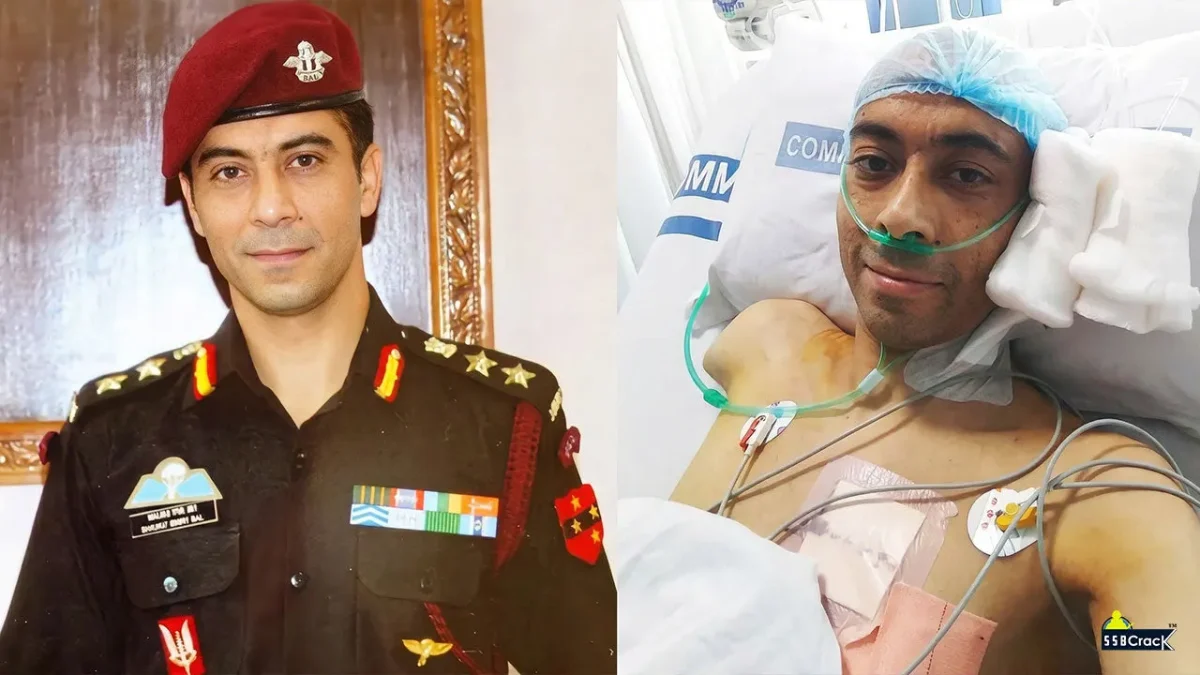
Courage in the Special Forces is usually measured in operations: the raid, the ambush, the close-quarter fight. Colonel Navjot Singh Bal, Shaurya Chakra, showed that kind of courage as a young Captain in the forests of Kashmir. A decade later, while commanding one of the Indian Army’s most respected Special Forces battalions, he showed a different kind. Diagnosed with a rare and aggressive bone cancer, he lost his right arm to amputation and still went back to lead his men.
Colonel Bal passed away in a military hospital in Bengaluru on 9 April 2020. He was 39. His story moved the armed forces community across the country, and it remains one of the most powerful examples of resilience that any defence aspirant can study. This article looks at his life, his career with 2 Para (Special Forces) and the lessons it holds for young men and women preparing to wear the uniform.
Colonel Navjot Singh Bal at a Glance
| Detail | Information |
|---|---|
| Rank and name | Colonel Navjot Singh Bal, SC |
| Unit | 2nd Battalion, The Parachute Regiment (Special Forces), or 2 Para SF |
| Schooling | Army Public School, Dhaula Kuan, New Delhi |
| Academy | National Defence Academy (joined in 1998) |
| Commissioned | 2002, into the Parachute Regiment (Special Forces) |
| Gallantry award | Shaurya Chakra, 2008, as a Captain, for counter-terrorist operations in the Lolab Valley, Kupwara, Jammu and Kashmir |
| Other service | United Nations mission in Congo; Operations branch, Headquarters Northern Command |
| Command | Commanding Officer of 2 Para SF, Bengaluru, from 20 March 2018 |
| Illness | Telangiectatic osteosarcoma, a rare form of bone cancer, detected in 2018; right arm amputated in January 2019 |
| Died | 9 April 2020, military hospital, Bengaluru, aged 39 |
A Son of the Army
Navjot Singh Bal grew up in a military family. His father, Lieutenant Colonel Karnail Singh Bal, is a retired officer of the Garhwal Rifles, and the family later settled in Punjab. Like many children of Army families, Navjot studied at Army Public School, Dhaula Kuan, in New Delhi, where the routines and values of military life were part of everyday school experience.
In 1998 he joined the National Defence Academy at Khadakwasla, the tri-service academy that trains cadets for the Army, Navy and Air Force. After completing his training, he was commissioned in 2002 into the Parachute Regiment (Special Forces) and served with 2 Para, the battalion with which his name would remain linked for the rest of his career.
About 2 Para (Special Forces)
2 Para is one of the Special Forces battalions of the Parachute Regiment. Para SF battalions are made up entirely of volunteers. Officers and soldiers must clear a gruelling probation before they earn the maroon beret and the Balidan badge, and their training covers airborne operations, close-quarter battle, mountain and jungle warfare, and small-team tactics.
For a young officer, serving in such a unit means constant operational deployment, demanding physical standards and a culture in which excellence is the minimum expectation. Colleagues and seniors remembered Navjot Bal as someone who thrived in that environment. In a tribute published in The Tribune, a retired Major General described him as an officer who topped his courses and excelled at football, cricket, alpine adventure and counter-insurgency.
Shaurya Chakra in the Lolab Valley
The Lolab Valley in Kupwara district of north Kashmir is thickly forested, close to the Line of Control and long used by infiltrating terrorists. In 2008, during counter-terrorist operations in the upper reaches of the valley, Captain Navjot Singh Bal and his buddy chased a group of terrorists. According to reports in ThePrint and The Indian Express, the two of them closed in and shot dead two terrorists at close range.
For this act he was awarded the Shaurya Chakra, India’s third-highest peacetime gallantry award. Those who knew him said he rarely spoke about it. He was known to brush the award aside, saying that Special Forces soldiers who wear the Balidan badge do such things routinely.
Congo, Northern Command and the Surgical Strikes
Like many Special Forces officers, Bal also served abroad. He was part of a United Nations peacekeeping mission in the Democratic Republic of the Congo, where Indian troops have served for many years in difficult conditions.
Before taking over command of his battalion, he served as a General Staff Officer Grade 1 in the Operations branch of Headquarters Northern Command, the headquarters responsible for operations in Jammu and Kashmir and Ladakh. Reports state that in this role he was involved in planning the cross-Line of Control surgical strikes carried out in September 2016.
Command of 2 Para SF
On 20 March 2018, Colonel Bal took over as Commanding Officer of 2 Para SF, then based in Bengaluru. Command of a battalion is the dream of most infantry and Special Forces officers, and he took it on at the peak of his physical and professional abilities. He was widely known as a fitness enthusiast. Fellow officers told reporters that his routine included 50 pull-ups with one hand and that he was an avid cyclist and runner.
The Diagnosis
Only two months into his command, in May 2018, he felt pain in his right elbow while doing chin-ups and noticed a lump. Tests revealed Telangiectatic osteosarcoma, an uncommon and highly aggressive variant of bone cancer. He was put on chemotherapy, but he continued to carry out his duties as Commanding Officer while undergoing treatment.
In January 2019, his right arm had to be amputated to contain the spread of the disease. For most people, the loss of the dominant arm would have meant the end of a career in the field. For Colonel Bal, it became a new challenge to overcome.
Leading With One Arm
Accounts from his fellow officers, reported by ThePrint, The Indian Express and The Hindu, describe an officer who refused to let the amputation slow him down.
- He taught himself to do everyday tasks with his left hand, from tying laces and dressing to eating and writing.
- He learnt to fire his weapon with his left hand with the same ease he had with his right.
- One of the first things he did after returning from surgery was to modify his bicycle so that both brakes were on the left side.
- He ran a 21-km half marathon even as the disease affected his breathing.
- Officers recalled seeing him lead his troops in a major exercise in the Rajasthan desert after the amputation.
His empty right sleeve became a rallying point for the men of his battalion. It showed them, every day, what determination looks like.
Sadly, the cancer eventually spread to his lungs and heart. When it became clear that the disease had returned, he handed over charge of the battalion and sought full treatment, but he continued to stay at the Para centre in Bengaluru, close to the community he belonged to.
His Final Days
A day before he passed away, Colonel Bal posted a smiling selfie from his hospital bed, which was widely shared on social media. He died on 9 April 2020 at a military hospital in Bengaluru. He was survived by his wife, Arti, and two young sons, then aged eight and four.
His passing came during the first nationwide COVID-19 lockdown. Because of confusion over approvals for a service aircraft, his parents had to travel by road from north India to Bengaluru for the last rites. The episode drew strong reactions from veterans, including former Army Chief General V.P. Malik, who expressed his condolences and criticised the lack of flexibility in the rules.
Tributes poured in from coursemates, seniors and soldiers who had served with him. Many described him as a living icon of the Special Forces. A commentary in The Tribune borrowed lines from the poem Invictus to describe him as a man who was the master of his fate and the captain of his soul.
Lessons for Defence Aspirants
Colonel Bal’s life offers lessons that go well beyond the battlefield, and many of them relate directly to the qualities assessed at the SSB.
- Resilience is an officer-like quality. Setbacks will come in training and in service. What matters is how quickly you adapt and keep moving forward.
- Fitness is a habit, not a test. His one-arm pull-ups and half marathon came from years of daily discipline. Start building yours long before the SSB or the academy.
- Courage takes many forms. Closing in on terrorists in a forest and returning to command after losing an arm both demand the same steady mind.
- Humility suits the brave. He played down his own Shaurya Chakra and gave credit to the ethos of his unit.
- Lead by example. His men followed him because he did everything he asked of them, even with one arm.
- Staff work matters. His role in operational planning at Northern Command shows that an officer’s contribution is not limited to the field.
Frequently Asked Questions
Who was Colonel Navjot Singh Bal?
He was an Indian Army Special Forces officer, a Shaurya Chakra recipient and a former Commanding Officer of 2 Para (Special Forces). He passed away from cancer on 9 April 2020 at the age of 39.
Why was he awarded the Shaurya Chakra?
He received the Shaurya Chakra in 2008, as a Captain, for counter-terrorist operations in the upper Lolab Valley of Kupwara in Jammu and Kashmir, where he and his buddy chased a group of terrorists and killed two of them at close range.
What illness did he have?
He was diagnosed in 2018 with Telangiectatic osteosarcoma, a rare and aggressive form of bone cancer. His right arm was amputated in January 2019, and the cancer later spread to his lungs and heart.
Did he continue to command after the amputation?
Yes. He continued as Commanding Officer of 2 Para SF after the amputation, learnt to shoot and write with his left hand, and led his troops in an exercise in Rajasthan before handing over charge when the disease spread.
Where did he study?
He studied at Army Public School, Dhaula Kuan, in New Delhi, joined the National Defence Academy in 1998 and was commissioned in 2002.
Conclusion
Colonel Navjot Singh Bal lived only 39 years, but he packed into them a lifetime of service: a gallantry award in the forests of Kashmir, a UN mission abroad, operational planning at a key headquarters and the command of an elite Special Forces battalion. His final battle, fought against an illness that no amount of training could defeat, showed the same spirit that defined his career. For every aspirant who dreams of the maroon beret, his story is a reminder that true courage is not the absence of fear or hardship, but the decision to keep leading through it.




