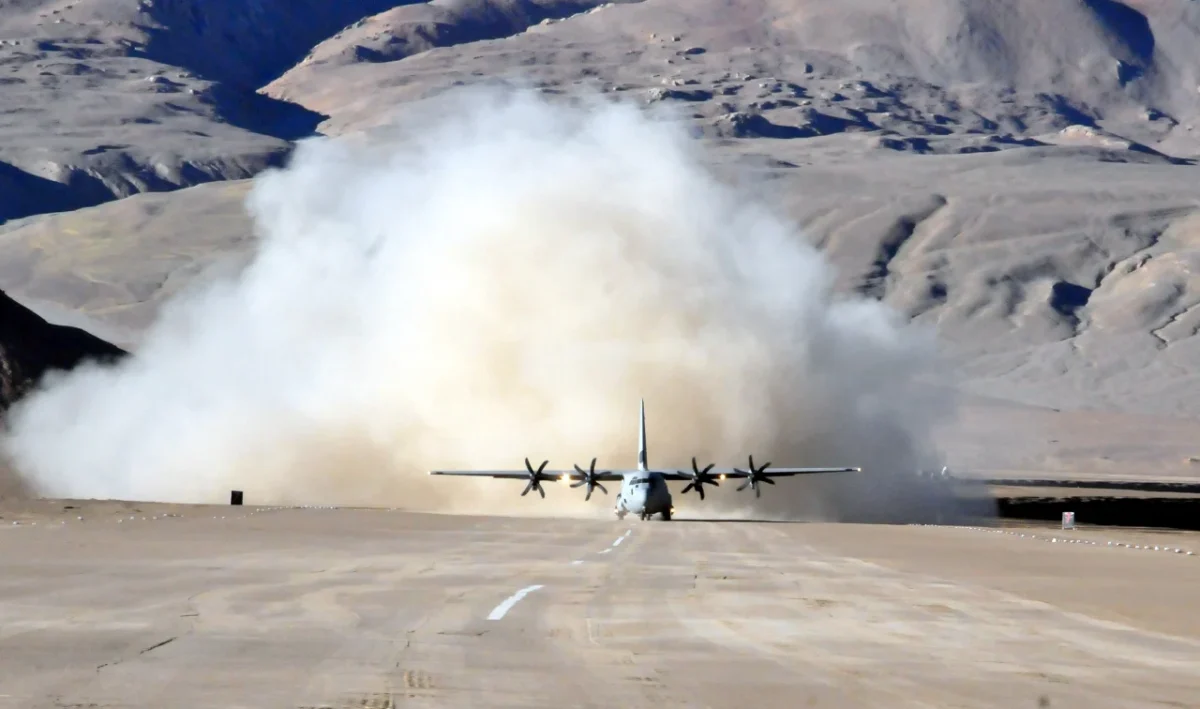
When people think of the Indian Air Force (IAF), they usually picture fighter jets. Yet some of the IAF’s most important missions are flown by large, slow and unglamorous aircraft. They carry troops and tanks to Ladakh, drop paratroopers, evacuate Indians from war zones, refuel fighters in mid-air and keep watch over the skies hundreds of kilometres beyond the border.
For AFCAT, NDA and CDS aspirants, these transport and special-mission aircraft are a regular source of static GK questions, and they come up often in SSB interviews and group discussions on humanitarian assistance, the China border and India’s growing role in the region.
Here are 10 aircraft that the IAF uses for transport and special missions, with the key facts you should know about each.
1. Boeing C-17 Globemaster III
Role: Strategic heavy airlift
Manufacturer: Boeing, USA
Inducted: 2013 (formally on 2 September 2013 at Hindan)
Key unit: No. 81 Squadron ‘Skylords’, Air Force Station Hindan
Fleet: 11 aircraft
The C-17 Globemaster III is the largest aircraft in the IAF’s fleet and the backbone of its strategic airlift. India ordered 10 aircraft in 2011 and later added an 11th, which arrived in 2019. All of them fly with No. 81 Squadron, the ‘Skylords’, at Hindan near Delhi.
The C-17 can carry heavy loads such as tanks, artillery, helicopters and large numbers of troops over long distances, and it can still land on comparatively short runways. This combination makes it ideal for moving forces quickly from the plains to forward bases in Ladakh and the North-East.
The Globemaster has also become the face of India’s humanitarian missions abroad. It has flown relief to earthquake-hit Nepal in 2015 and Turkey in 2023 (Operation Dost), and evacuated Indian citizens from crisis zones, including students from Ukraine during Operation Ganga in 2022.
2. Lockheed Martin C-130J-30 Super Hercules
Role: Tactical airlift and special operations
Manufacturer: Lockheed Martin, USA
Inducted: 5 February 2011
Key units: No. 77 Squadron ‘Veiled Vipers’ (Hindan) and No. 87 Squadron (Panagarh, West Bengal)
Fleet: 12 aircraft in two squadrons
The C-130J-30 Super Hercules is a four-engine turboprop designed for tactical missions. India bought six in 2008 for No. 77 Squadron at Hindan and later ordered six more, which equip No. 87 Squadron at Panagarh in the east. The IAF’s C-130Js are configured for special operations, with equipment for low-level flying, night operations and airdrops of troops and supplies.
On 20 August 2013, a C-130J of No. 77 Squadron landed at Daulat Beg Oldi (DBO) in Ladakh, an advanced landing ground at about 16,614 feet near the Karakoram Pass. It was a record landing for an aircraft of its class and showed that the IAF could sustain troops in the most remote parts of the northern border.
The aircraft has also proved its worth in rescue missions. During Operation Kaveri in April 2023, an IAF C-130J carried out a night landing at a small airstrip near Khartoum, Sudan, without landing lights to evacuate Indian nationals during the fighting there.
3. Ilyushin Il-76MD ‘Gajraj’
Role: Strategic heavy airlift and paratrooping
Manufacturer: Ilyushin, Soviet Union
Inducted: 16 June 1985
Key unit: No. 44 Squadron ‘Mighty Jets’, Air Force Station Chandigarh
The Il-76MD, known in the IAF as the ‘Gajraj’, was India’s first true strategic airlifter. No. 44 Squadron brought the type to India in March 1985 and it was formally inducted on 16 June 1985. Before the C-17 arrived, it was the IAF’s main heavy-lift aircraft.
The Gajraj has taken part in almost every major Indian military and relief operation of the last four decades. It carried troops to Sri Lanka during Operation Pawan and flew paratroopers to the Maldives in Operation Cactus in 1988, when India foiled a coup attempt within hours. It also supported the Kargil conflict in 1999 and many evacuation and relief missions.
The fleet is ageing, and maintaining Russian-origin spares has been a challenge. Even so, the Il-76 remains an important heavy-lift asset, especially for flights to Leh and other high-altitude bases. The same Il-76 airframe also forms the base for the IAF’s Il-78 tankers and Phalcon AWACS.
4. Antonov An-32
Role: Medium tactical transport
Manufacturer: Antonov, Soviet Union (now Ukraine)
Inducted: 1984
Key bases: Squadrons in Chandigarh, Jorhat, Agra and Sulur, among others
The twin-engine An-32 is the workhorse of the IAF’s medium transport fleet. It was inducted in 1984 and has since served with several squadrons across the country. Its powerful engines make it suited to ‘hot and high’ conditions, which is why it flies regularly to airfields in Ladakh and to small advanced landing grounds in the North-East.
The An-32 carries troops, paratroopers, cargo and supplies, and it is used for air maintenance of posts that cannot be reached easily by road. Over the years, a large part of the fleet was upgraded to the An-32RE standard, with new avionics and a longer service life, partly in Ukraine and partly at the IAF’s base repair depot in Kanpur.
The type has had two well-known losses: an An-32 disappeared over the Bay of Bengal in July 2016, and another crashed in Arunachal Pradesh in June 2019. These accidents added urgency to the IAF’s plans to replace older transport aircraft with modern types such as the C-295.
5. Airbus C-295MW
Role: Tactical transport (replacement for the HS-748 Avro)
Manufacturer: Airbus Defence and Space, with Tata Advanced Systems Limited
Inducted: 25 September 2023 at Hindan
Key units: No. 11 Squadron at Vadodara, with a second squadron at Agra
The C-295MW is the newest transport aircraft in the IAF. In September 2021, the Ministry of Defence signed a contract with Airbus for 56 aircraft. The first 16 were to come in fly-away condition from Spain, while the remaining 40 are being built in India by Tata Advanced Systems Limited (TASL).
The first aircraft was formally inducted at Hindan on 25 September 2023, and No. 11 Squadron at Vadodara became the first C-295 unit. The aircraft can carry troops, paratroopers, cargo and casualties, and it can operate from short and semi-prepared airstrips, making it well suited to India’s mountainous borders.
The programme is also a milestone for India’s aerospace industry. The final assembly line at the Tata Aircraft Complex in Vadodara was inaugurated in October 2024, and the first Made-in-India C-295 made its maiden flight in June 2026. It is the first military aircraft to be built in India by a private company, and the C-295 will gradually replace the IAF’s ageing HS-748 Avro fleet.
6. Dornier Do-228
Role: Light transport, communication and transport pilot training
Manufacturer: HAL, Kanpur (under licence from Dornier, Germany)
Inducted: 1988
Key units: No. 41 Squadron ‘Otters’ and No. 59 Squadron, plus Air Force Station Yelahanka for training
The Do-228 is a small twin-turboprop aircraft built under licence by Hindustan Aeronautics Limited (HAL) at Kanpur. The IAF inducted it formally in 1988 to replace older light aircraft. It is used for route transport and communication duties, and it can operate from short, semi-prepared runways in the North-East and on the island chains.
The Dornier is especially important for future transport pilots. After basic training at the Air Force Academy, trainees in the transport stream do their advanced flying on the Do-228 at Air Force Station Yelahanka in Bengaluru before moving on to larger aircraft such as the C-130J, C-17 or C-295.
The IAF continues to add newer Dorniers. In March 2023, the Ministry of Defence signed a contract with HAL for six more Do-228s with upgraded, fuel-efficient engines and five-bladed composite propellers.
7. Ilyushin Il-78MKI Mid-Air Refueller
Role: Air-to-air refuelling (force multiplier)
Origin: Russian Ilyushin design, fitted with an Israeli refuelling system
Inducted: 2003
Key unit: No. 78 Squadron, Air Force Station Agra
Fleet: Six aircraft
The Il-78MKI is the IAF’s flight refuelling aircraft. It is based on the Il-76 airframe and fitted with a probe-and-drogue refuelling system. No. 78 Squadron was raised with these aircraft at Agra in 2003, and the fleet of six tankers has been in service since then.
A tanker is called a ‘force multiplier’ because it allows fighters to fly much farther or stay in the air much longer than their internal fuel would allow. An Il-78 can refuel up to three aircraft at the same time, and it has worked with fighters such as the Su-30MKI, Mirage 2000 and Jaguar, as well as the Indian Navy’s MiG-29Ks. The IAF has long sought more tankers to support its growing fighter fleet.
8. Phalcon AWACS (A-50EI)
Role: Airborne warning and control
Platform: Il-76 airframe with the Israeli EL/W-2090 Phalcon radar
Inducted: 28 May 2009
Key unit: No. 50 Squadron, Air Force Station Agra
Fleet: Three aircraft
An Airborne Warning and Control System (AWACS) is often called an ‘eye in the sky’. India’s Phalcon AWACS combines a Russian Il-76 airframe with an Israeli radar mounted in a large, fixed dome above the fuselage. The first aircraft landed at Jamnagar on 25 May 2009 and was inducted into No. 50 Squadron at Agra three days later. All three aircraft were delivered by 2011.
The Phalcon radar provides 360-degree coverage and can detect aircraft and missiles at long range, well beyond the reach of ground-based radars. This lets commanders watch enemy air activity deep across the border and direct their own fighters to intercept threats.
With only three aircraft for two active borders, the IAF has long wanted more AWACS. Plans for future systems include indigenous designs developed by the DRDO.
9. Netra AEW&C (Embraer ERJ-145)
Role: Airborne early warning and control
Developer: DRDO’s Centre for Airborne Systems, on a Brazilian Embraer ERJ-145 jet
Inducted: 14 February 2017 (Aero India, Bengaluru)
Fleet: Three Netra Mk1 aircraft
Netra is India’s first indigenously developed airborne early warning and control (AEW&C) system. The radar, data links and mission systems were developed by the DRDO and mounted on a Brazilian Embraer ERJ-145 jet. The first Netra was handed over to the IAF on 14 February 2017, on the opening day of Aero India at Yelahanka.
Instead of a rotating dome, Netra uses a long, flat active electronically scanned array (AESA) radar mounted on top of the fuselage, which gives it coverage on both sides of the aircraft. It is smaller than the Phalcon and covers a shorter range, but it is cheaper to operate and built with Indian technology.
Netra played a role during the Balakot air strike in February 2019, when the IAF had only one aircraft in service. The remaining two aircraft were delivered in 2019 and 2023, and in June 2026 the DRDO handed over the Final Operational Clearance for the system. An improved Netra Mk1A is being developed to expand the fleet.
10. VVIP and Communication Fleet (Boeing 777 and Boeing 737 BBJ)
Role: Transport of the President, Vice President, Prime Minister and other dignitaries
Aircraft: Boeing 777-300ER, Boeing 737 Business Jet (BBJ) and Embraer Legacy jets
Key unit: Air Headquarters Communication Squadron, Air Force Station Palam, New Delhi
Call sign: ‘Air India One’ when carrying the top three VVIPs
The Air Headquarters Communication Squadron at Palam flies India’s top leaders within the country and abroad. In 2009, three Boeing 737-based Business Jets with self-protection suites replaced older Boeing 737s for VIP travel. These are supported by smaller Embraer Legacy jets for shorter trips.
In October 2020, two specially modified Boeing 777-300ER aircraft were inducted for long-range VVIP flights. Earlier, Air India’s Boeing 747s were used and flown by airline pilots; the new aircraft are flown by IAF pilots. They are fitted with secure communications, a VVIP suite and a missile-defence system. When the President, Vice President or Prime Minister is on board, the flight uses the call sign ‘Air India One’.
These are not combat aircraft, but they are a special mission of national importance. Flying a VVIP aircraft demands precision, discipline and strict security, and it is one of the most prestigious assignments for an IAF transport pilot.
Conclusion
From the giant C-17 and the rugged C-130J to the new Made-in-India C-295, and from tankers that stretch the reach of fighters to radar aircraft that see deep beyond the border, these 10 aircraft show that air power is much more than fighter jets. They give India the ability to move forces quickly to the LAC, to evacuate its citizens from distant war zones and to deliver help when disaster strikes.
For AFCAT, NDA and CDS aspirants, knowing these aircraft is not just useful for the written exam. If you can explain at your SSB why the IAF needs strategic airlift, tankers and AWACS, you show the broad awareness and clear thinking that assessors look for in a future officer.
Frequently Asked Questions
1. Which is the largest transport aircraft of the Indian Air Force?
The Boeing C-17 Globemaster III is the largest aircraft in IAF service. The fleet of 11 aircraft is operated by No. 81 Squadron ‘Skylords’ from Hindan near Delhi.
2. Which aircraft will replace the IAF’s HS-748 Avro?
The Airbus C-295MW. Under a 2021 contract for 56 aircraft, 16 came from Spain and 40 are being built by Tata Advanced Systems Limited in Vadodara.
3. What is the difference between AWACS and AEW&C?
Both are airborne radar aircraft that detect and track air threats. In the IAF, ‘AWACS’ refers to the larger Phalcon with 360-degree coverage and longer range, while the smaller indigenous Netra is called an AEW&C.
4. Which IAF aircraft landed at Daulat Beg Oldi in 2013?
A C-130J-30 Super Hercules of No. 77 Squadron landed at Daulat Beg Oldi, at about 16,614 feet in Ladakh, on 20 August 2013.
5. Which aircraft does the IAF use for mid-air refuelling?
The Il-78MKI tanker, operated by No. 78 Squadron from Agra. It can refuel up to three aircraft at the same time.