




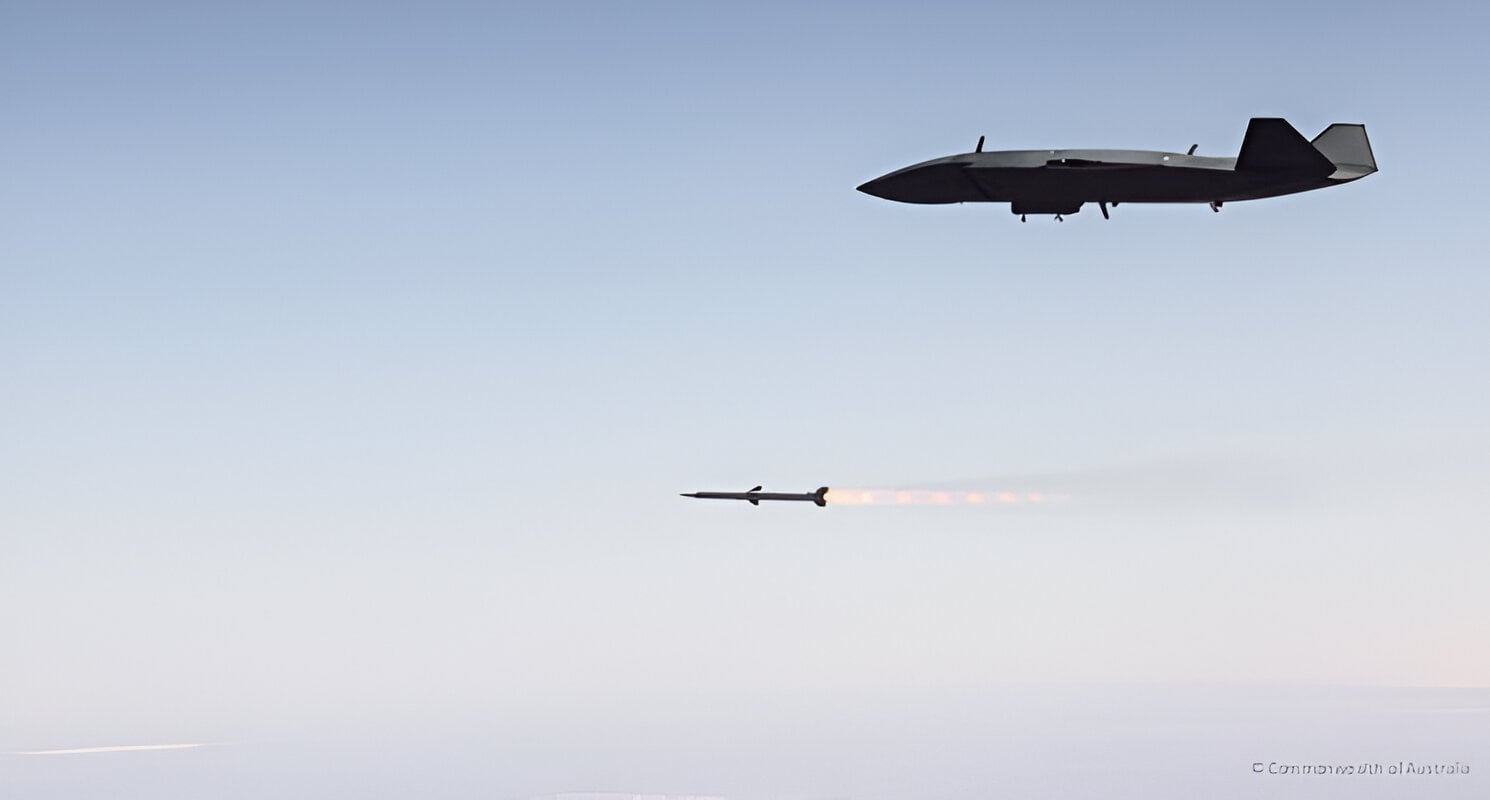
Boeing’s MQ-28 Ghost Bat has marked a significant milestone in the realm of autonomous aviation. The uncrewed aircraft recently completed a successful air-to-air engagement using an AIM-120 missile, further enhancing its operational capabilities and demonstrating the potential of unmanned systems in modern military operations.
In a collaborative test with the Royal Australian Air Force (RAAF), the MQ-28 operated effectively alongside two other aircraft – the E-7A Wedgetail and the F/A-18F Super Hornet. This exercise involved intercepting a fighter-class target drone, showcasing not only the Ghost Bat’s advanced targeting systems but also its ability to function within a coordinated strike framework.
The E-7A Wedgetail played a crucial role during the test, ensuring the Ghost Bat’s positioning was accurate and safe throughout the engagement. Its ability to monitor the engagement scenario allowed for effective command and control of the unmanned platform. Meanwhile, the F/A-18F Super Hornet provided essential sensor coverage, communicating real-time target data that was integral to the mission’s success.
This achievement underscores the evolving landscape of military aviation, where autonomous systems are increasingly integrated into complex combat scenarios. The successful engagement with the AIM-120 missile is a testament to both Boeing’s engineering advancements and the potential applications of uncrewed platforms in air superiority and multi-domain warfare.
The developments surrounding the MQ-28 Ghost Bat signify an important step in the integration of autonomous systems into frontline operations, promising enhanced capabilities for air forces around the world.


