




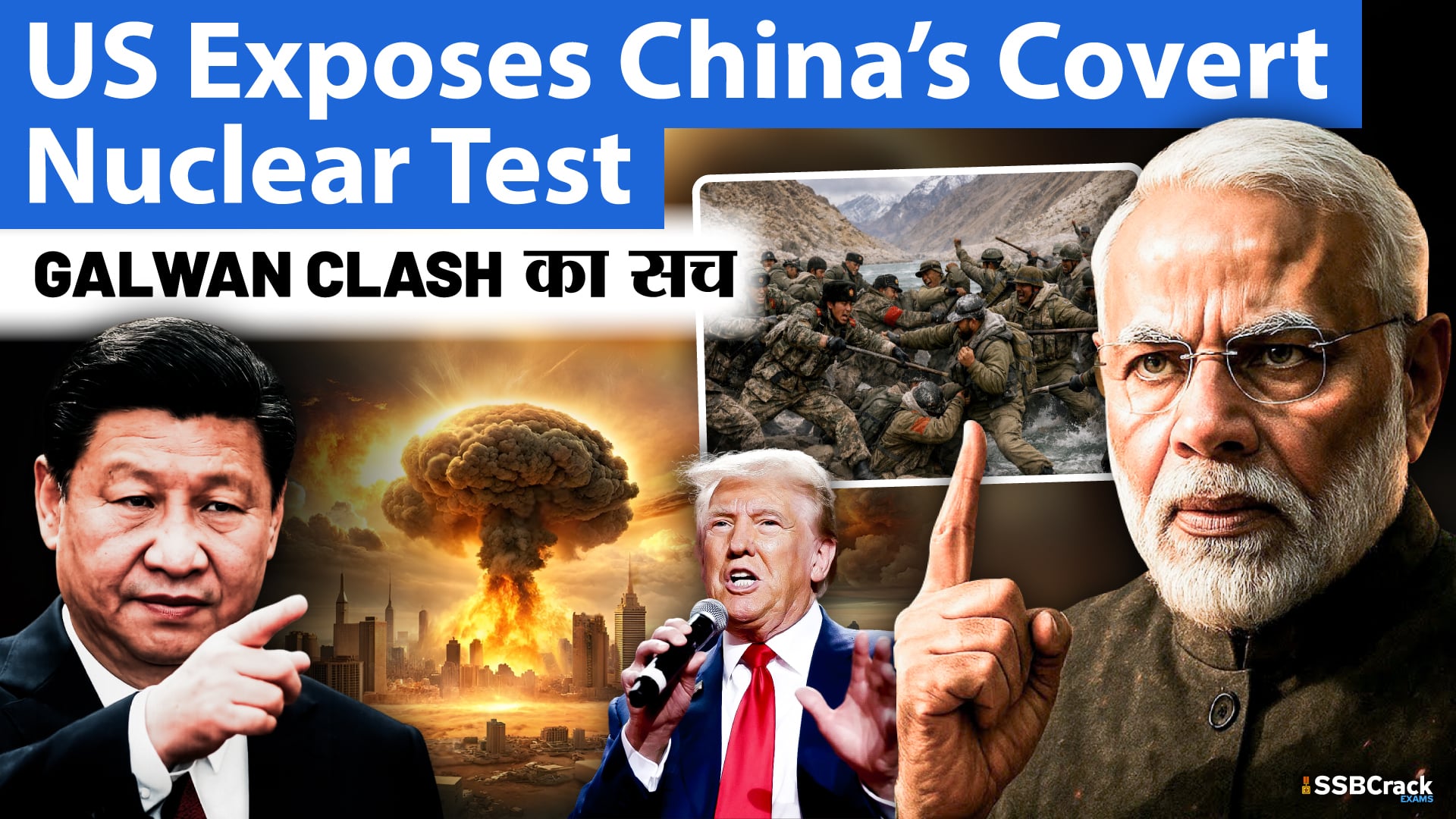
The United States has accused China of conducting a covert nuclear explosive test in June 2020, just days after the deadly Galwan Valley clash between Indian and Chinese troops in eastern Ladakh. The confrontation marked one of the most serious escalations in India–China relations in decades, resulting in the deaths of 20 Indian soldiers, while intelligence assessments suggested that Chinese casualties exceeded 30.
U.S. Accuses China of Secret Nuclear Test Amid Galwan Crisis
The alleged timing of the nuclear test has raised serious concerns in New Delhi, as it coincided with an exceptionally tense phase of the border standoff. The disclosure was made by Washington at an international disarmament forum, adding a new strategic dimension to the already fragile regional security environment.
U.S. Claims and Evidence
U.S. Under Secretary of State for Arms Control and International Security, Thomas DiNanno, stated that the American government possesses evidence indicating that China carried out nuclear explosive tests, including preparations for explosions with yields measured in hundreds of tons. According to DiNanno, a yield-producing test was conducted on 22 June 2020.
He further accused the Chinese military of using sophisticated “decoupling” techniques to conceal these explosions. Such methods are designed to dampen seismic signals, making detection by international monitoring systems difficult. If proven, these actions would represent a violation of global commitments related to nuclear test bans and non-proliferation norms.
China’s Response
China firmly rejected the allegations. Its ambassador on disarmament, Shen Jian, dismissed the claims without directly addressing the specific test mentioned by U.S. officials. He maintained that Beijing has consistently acted responsibly in nuclear matters and accused Washington of exaggerating the so-called “China nuclear threat” to justify its own military expansion. According to Shen, the United States is the primary driver of escalating global nuclear tensions.
Arms Control at a Crossroads
The revelation comes at a critical juncture for global arms control. The 2010 New START treaty between the United States and Russia has expired, leaving the world’s two largest nuclear powers without binding limits on strategic missiles and warheads for the first time in over half a century. This absence has heightened fears of a renewed nuclear arms race.
DiNanno argued that bilateral treaties are increasingly inadequate in 2026, given the emergence of multiple nuclear-armed states. The U.S. projects that China’s nuclear arsenal could surpass 1,000 warheads by 2030, a figure significantly higher than Beijing’s own estimate of around 600. Although still below the roughly 4,000 warheads held by the U.S. and Russia, China’s rapid nuclear modernisation has raised alarms. Beijing has so far refused to participate in trilateral arms control negotiations.
Strategic Implications
Security experts warn that the global system is drifting toward a strategic vacuum reminiscent of early Cold War uncertainties, where miscalculations between nuclear powers posed constant risks. In the absence of a successor arms control framework, nations may expand their arsenals based on worst-case assumptions. While Russia has indicated openness to renewed dialogue with Washington, countries like Britain and France have called for a broader multilateral framework that includes China.
India’s Perspective
For India, the Galwan Valley clash—the first incident involving combat deaths on the border in 45 years—triggered prolonged military standoffs and a sharp deterioration in bilateral ties with China. The alleged nuclear test adds another layer of concern, highlighting the opaque nature of China’s military advancements. It underscores the importance for India of enhanced surveillance, intelligence cooperation, and strategic preparedness in an increasingly unstable regional and global security environment.


