




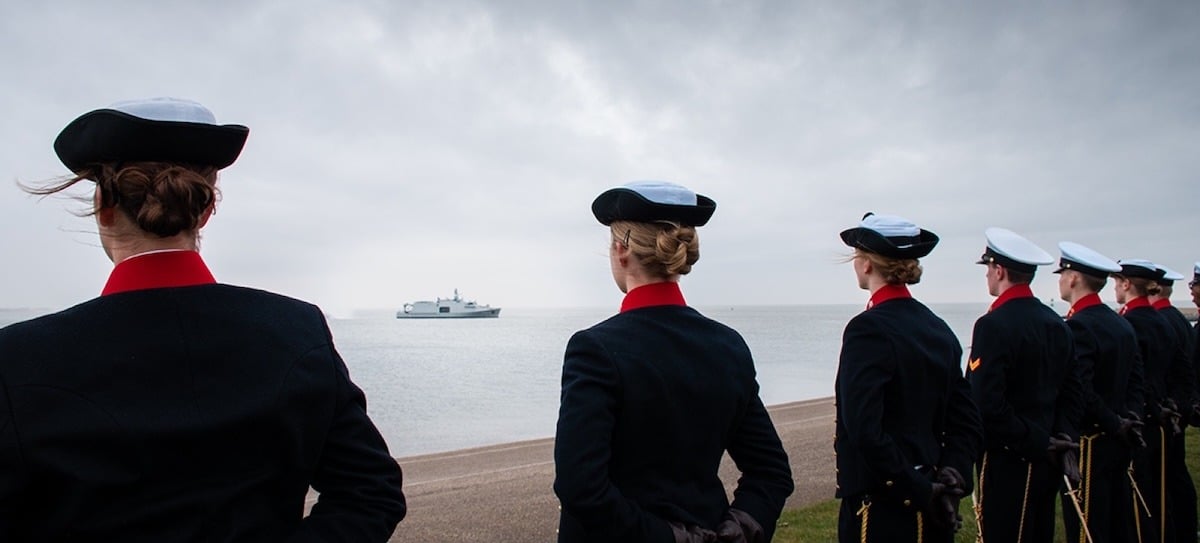
The Royal Netherlands Navy has recently received its first mine countermeasure vessel as part of the Belgian-Dutch Replacement Mine Countermeasures (rMCM) program, marking a significant advancement in collaborative naval capabilities. This program encompasses a total of 12 vessels, split evenly between the Netherlands and Belgium, with six Vlissingen-class vessels designated for the Netherlands and six City-class vessels for Belgium. All vessels are anticipated to be operational by 2030 and are set to replace the aging minehunting fleets currently in service.
The newly delivered vessel, named “Vlissingen,” stands as a milestone not only for the Dutch Navy but also for international defense collaboration, being the first vessel built under contract by the Belgian Ministry of Defence for the Royal Netherlands Navy. This development underscores the growing cooperative framework between Belgium and the Netherlands, known as BeNeSam. Captain Ludo Portier, Section Head of Procurement Naval Systems, emphasized the historic significance of this achievement.
The rMCM project was awarded to Belgium Naval & Robotics, a consortium comprised of the French companies Naval Group and Exail, back in 2019. The newly delivered vessels are designed to facilitate advanced maritime operations by deploying uncrewed systems from Exail, including two Inspector 125 uncrewed surface vehicles and three A-18 autonomous underwater vehicles. Additionally, the vessels can utilize two V200 Skeldar aerial drones developed by Saab, enhancing their operational versatility.
Key features of these vessels include a state-of-the-art robotic system capable of mine detection, classification, identification, and neutralization, thereby significantly increasing the safety and effectiveness of naval operations in potentially hazardous waters. Each platform measures 82.6 meters (270 feet) in length and 17 meters (55 feet) in width, providing accommodations for 63 personnel. With a displacement of 2,800 tons, the vessels can reach a top speed of 15.3 knots (28.3 kilometers or 17.6 miles per hour) and have a range of up to 3,500 nautical miles (4,028 miles or 6,482 kilometers).
The construction, assembly, and project management of the vessels are conducted by French shipbuilder Piriou, working under the auspices of Kership, a joint venture between Naval Group and Piriou. Meanwhile, Naval Group is responsible for the overall design of the vessels while Exail focuses on delivering the naval drones and integrating the mission systems.
In a further enhancement of defense collaboration, 2023 saw France, Belgium, and the Netherlands formalize their cooperation in the field of mine warfare through a tripartite agreement. Notably, while this deal does not provide France with rMCM vessels, it grants access to the vessel design and technology, which will be utilized for France’s independent series of mine warfare motherships under the broader French program known as SLAM-F. This tripartite agreement marks another step toward improved interoperability and shared capabilities in mine warfare across the three nations.


